Symphytum asperum
Lepech.
Prickly Comfrey

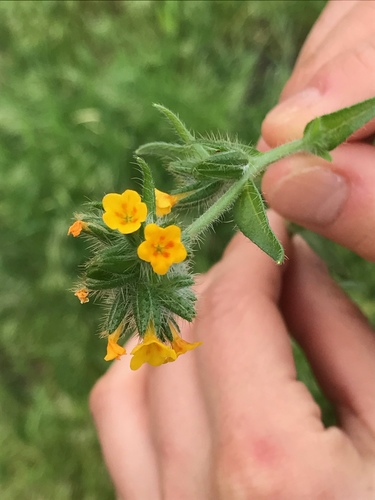
(c) Vyacheslav Luzanov, some rights reserved (CC BY-NC), uploaded by Vyacheslav Luzanov
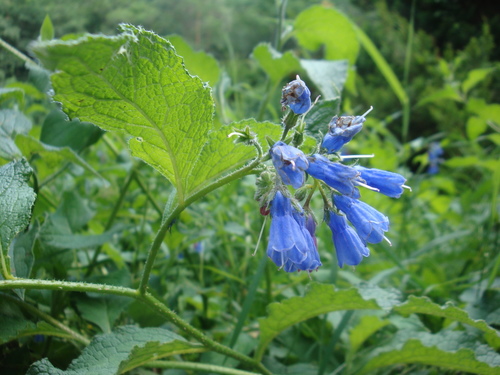
(c) Viktoria, some rights reserved (CC BY-NC), uploaded by Viktoria

(c) Eduard Garin, some rights reserved (CC BY-NC), uploaded by Eduard Garin
What to Eat
Edible parts: Leaves
Young leaves can be eaten raw or cooked, though most people find them unpleasant — they are hairy, mucilaginous, and mineral-rich. Chopping them finely and mixing into salads helps disguise the texture. Young blanched shoots make a reasonable asparagus substitute. Older leaves can be dried and brewed as a tea, and peeled roots can be sliced and added to soups. A tea is also made from a combination of dried leaves and roots. Roasted roots can be blended with dandelion and chicory roots as a coffee substitute.
Known Hazards
Dangerous Lookalikes
This plant can be confused with the following toxic species. Always verify identification carefully before consuming any wild plant.


Foxglove: Soft velvety hairy leaves, tall spike of tubular purple/pink spotted flowers, leaves feel like soft felt.
Prickly Comfrey: Rough/bristly hairy leaves, purple/blue drooping bell flowers, leaves feel like sandpaper.
Where to Find It
It is a temperate plant. It suits hardiness zones 5-10.
Asia, Australia, Britain, Caucasus, Europe, Fiji, India, Iran, Middle East, Pacific,
How to Identify
A bush. It grows 1.2-1.5 m high and spreads 1.5-2 m wide. The leaves are oval and have bristles. The leaves are 25 cm long. The flowers are tube shaped and 18 mm long. The start pink but turn blue.
How to Grow
Tolerates most soils and situations but prefers a moist soil and some shade. Grows well in heavy clay soils. Best grown in an open sunny site in a deep rich soil if it is being grown for compost material. Plants can be invasive, often spreading freely by means of self-sown seed. They are also very difficult to remove, the root system is very deep and even small fragments of root left in the soil can produce new plants.
Propagation: Sow seed in spring or autumn in a cold frame. Prick seedlings into individual pots once large enough to handle and grow on in the greenhouse through their first winter. Plant out in late spring or early summer after the last expected frosts. With sufficient seed, an outdoor sowing in situ in spring can be attempted. Division works at almost any time of year — chop off the top 7cm of root just below soil level with a spade. The original root will regrow, and each of the removed root tops can be potted up or planted directly into a permanent position.
Medicinal Uses
The leaves are anodyne, mildly astringent, demulcent, emollient, expectorant, haemostatic, refrigerant, and vulnerary. Applied as an external poultice, they help treat cuts, bruises, and sprains. Internally, a leaf tea is used for chest complaints. The plant contains allantoin, a cell-proliferating compound that accelerates healing. Leaves are harvested in summer and can be used fresh or dried.
Other Uses
The plant grows rapidly and produces large volumes of biomass. It tolerates multiple cuts per year, making it useful as an instant compost source for crops like potatoes — wilted leaves can be layered in planting trenches or applied as mulch in no-dig gardens. Soaking the leaves in a small amount of water for a week yields a liquid feed high in potassium, well suited to tomatoes. The leaves are also a valuable addition to the compost heap. A gum extracted from the roots was historically used to treat wool before spinning.
Wikipedia
Source ↗Symphytum asperum is a flowering plant of the genus Symphytum in the family Boraginaceae. Common names include rough comfrey and prickly comfrey. It is the tallest Symphytum species. It is native to Asia, and it is known in Europe and North America as an introduced species and sometimes a weed. Symphytum × uplandicum, the naturally occurring hybrid with the common comfrey (Symphytum officinale), is the economically most important kind of comfrey.
Notes
There are about 25-35 Symphytum species.
Names & Synonyms
Rough comfrey, Soft Comfrey
References (7)
- Bremness, L., 1994, Herbs. Collins Eyewitness Handbooks. Harper Collins. p 219
- Cundall, P., (ed.), 2004, Gardening Australia: flora: the gardener's bible. ABC Books. p 1385
- Nova Acta Acad. Sci. Imp. Petrop. Hist. Acad. 14:442. 1805
- Plants for a Future database, The Field, Penpol, Lostwithiel, Cornwall, PL22 0NG, UK. http://www.scs.leeds.ac.uk/pfaf/
- Smith, A.C., 1991, Flora Vitiensis Nova, Lawaii, Kuai, Hawaii, Volume 5 p 152
- World Checklist of Useful Plant Species 2020. Royal Botanic Gardens, Kew
- Zeven, A. C. & de West, J. M. J., 1982, Dictionary of cultivated plants and their regions of diversity. Wageningen. p 88