Syzygium boonjee
B. Hyland
Boonjee satinash

(c) Russell Cumming, some rights reserved (CC BY-NC), uploaded by Russell Cumming
(c) Callum Blacklaw, some rights reserved (CC BY-NC)
What to Eat
Edible parts: Fruit
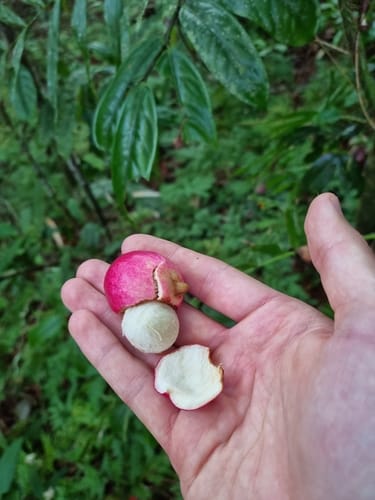
The round fruit are edible, featuring crisp white flesh inside a pink or red outer skin.
Where to Find It
A tropical plant. It occurs in north east Queensland in Australia. It grows from sea level to 770 m altitude. It needs shade during the early establishment stage. It needs abundant moisture.
Australia*,
How to Identify
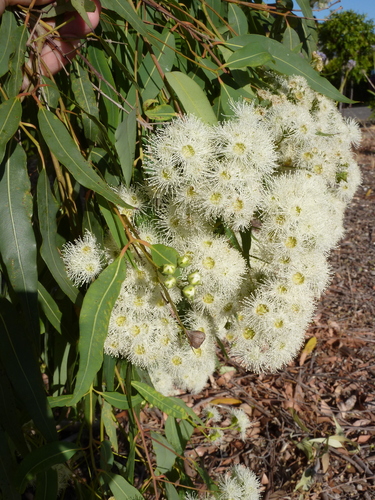
A small tree up to 6-7 m tall. The leaves are sword shaped and 5-12 cm long by 3.5 cm wide. The leaves are dark green on top and paler green underneath. The veins can be seen easily. The flowers are large and brownish. They are 6 cm across. They are carried in clusters near the ends of branches. The fruit are round and 4-5 cm across. They are pink or red on the outside with white crisp flesh inside. The fruit are edible. The fruit has a single seed. The seed is 3 cm across.
How to Grow
It is grown from fresh seed. It can be grown from layering branches near the soil until they produce roots.
Wikipedia
Source ↗Syzygium boonjee, known as the Boonjee satinash, is a rainforest plant of tropical Queensland, Australia. Found between Gordonvale and Tully. Usually a shrub, it may reach 8 metres tall.
Production
Flowering is February to July and fruit are ripe October to January.
References (4)
- Cooper W & Cooper W T, 1994, Fruits of the Rain Forest. RD Press p 268
- Cooper, W. and Cooper, W., 2004, Fruits of the Australian Tropical Rainforest. Nokomis Editions, Victoria, Australia. p 359
- Jones D, L, 1986, Ornamental Rainforest Plants in Australia, Reed Books, p 76
- Townsend, K., 1994, Across the Top. Gardening with Australian Plants in the tropics. Society for Growing Australian Plants, Townsville Branch Inc. p 343