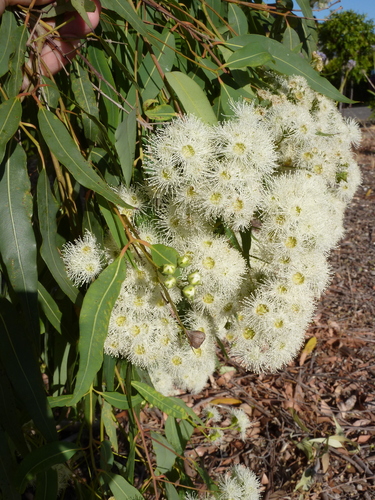
Syzygium eucalyptoides
(F. Muell.) B. Hyland

(c) Tony Rodd, some rights reserved (CC BY-NC)

(c) ryanthughes, some rights reserved (CC BY-NC)
What to Eat
Edible parts: Fruit
Fruit - raw. Used for making jam. The white fruit is a popular source of food for the Australian aborigines.
Where to Find It
A tropical plant. It grows across northern Australia. It is commonly near water courses and waterlogged depressions.
Australia*,
How to Identify
A tree with several stems. It grows from 2-18 m high. Often the tree has buttresses. But it can also occur as a clump of small suckers. The bark is grey-brown and mostly smooth although sometimes it is flaky. The leaves are long and thin. The leaves are 9-17 cm long by 1-2 cm wide. The leaf stalk is long (3 cm). The leaves are produced opposite each other and are thick and leathery. They are a dull green with distinct veins. The tip of the leaf is pointed. The flowers occur in a cluster at the ends of branches. Sometimes flowers occur on branches or in leaf axils. The flowers are white or cream coloured and are fluffy in appearance due to the stamens. The fruit is white or pale green but can be tinged with pink or red as it ripens. It can be 3 cm across. The surface of the fruit is ribbed. The fruit has a distinct crown at the end. There is one seed inside the succulent fruit. The fruit is edible.
How to Grow
Plants are grown from fresh seed.
Propagation: Seed - best sown as soon as it is ripe.
Wikipedia
Source ↗Syzygium eucalyptoides is a tree of the family Myrtaceae native to Western Australia and the Northern Territory.
Names & Synonyms
Tumaranka, Tumurangkini
References (7)
- Bailey, F. M., 1913, Comprehensive Catalogue of Queensland Plants. Queensland Government. p 209
- Cherikoff V. & Isaacs, J., The Bush Food Handbook. How to gather, grow, process and cook Australian Wild Foods. Ti Tree Press, Australia p 201
- Low, T., 1991, Wild Food Plants of Australia. Australian Nature FieldGuide, Angus & Robertson. p 148
- Paczkowska, G . & Chapman, A.R., 2000, The Western Australian Flora. A Descriptive Calatogue. Western Australian Herbarium. p 403
- Tiwi Plants and Animals. 2001, Aboriginal flora and fauna knowledge from Bathurst and Melville Islands, northern Australia. Northern Territory Botanical Bulletin; No. 24 p 82
- Townsend, K., 1994, Across the Top. Gardening with Australian Plants in the tropics. Society for Growing Australian Plants, Townsville Branch Inc. p 346
- Wheeler, J.R.(ed.), 1992, Flora of the Kimberley Region. CALM, Western Australian Herbarium, p 543