Talinum caffrum
(Thunb.) Eckl. et Zeyh.
Porcupine root

(c) Athol Ferguson, some rights reserved (CC BY-NC)

(c) Athol Ferguson, some rights reserved (CC BY-NC)

(c) Athol Ferguson, some rights reserved (CC BY-NC)
What to Eat
Edible parts: Leaves, Stems, Vegetable
Leaves - raw or cooked. Crisp and juicy, they are also eaten to rellieve thirst. The leaves are often pounded and mixed with other leaves and corms. The stems are considered to be unpalatable and are not eaten. Caudex - eaten with relish and salt.
Where to Find It
A tropical plant. It grows in dry rocky soil. It grows between sea level and 2,750 m above sea level. It can grow in arid places. It is drought resistant because of its tuber.
Africa, Angola, Botswana, Central Africa, East Africa, Eswatini, Ethiopia, Kenya, Lesotho, Malawi, Mozambique, Namibia, South Africa, Southern Africa, South America, Sudan, Swaziland, Tanzania, Uganda, Zambia, Zimbabwe,
How to Identify
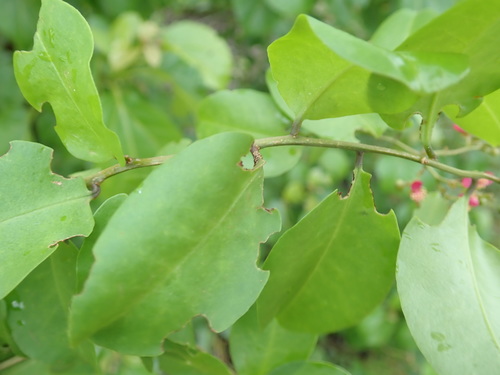
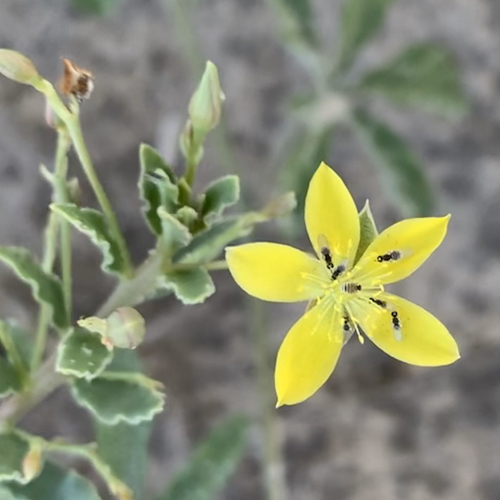
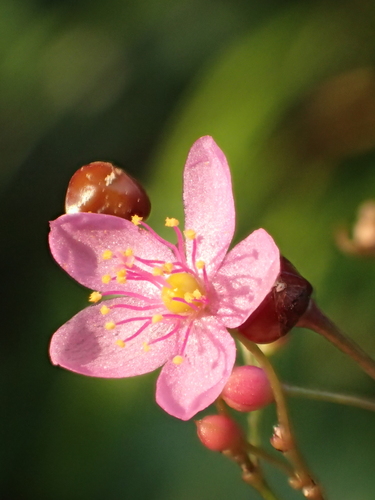
A herb. It keeps growing from year to year. It grows about 45 cm tall. It has a deeply buried tuber with annual stems. The leaves are 6 cm long and somewhat fleshy. The flowers are in groups of 1-3 in the axils of leaves. The petals are rich yellow. They are 2 cm long. The seeds are shiny and black. They are in a round capsule.
Nutrition Score: 7/100
| Part | Moisture | kJ | kcal | Protein | Vit A | Vit C | Iron | Zinc |
|---|---|---|---|---|---|---|---|---|
| Tubers | 79.8 | — | — | 1.2 | — | — | — | — |
How to Grow
Prefers a sunny position. Requires a well-drained soil, but likes plenty of moisture during the growing season.
Production
The leaves are preserved by drying. A tuber can be 0.5 kg.
Other Information
It is a minor vegetable in drier areas.
Notes
There are about 50 Talinum species. They grow in warm places. Also put in the family Portulacaceae.
Names & Synonyms
Acwe gweno, Fasi, Impunyu, Keller-athla, Kgalahete, Khasi, Khalahete, Khutsana, Mlelamvula, Nakatukwa, Ondindina, Osbossie, Ystervarkwortel
References (22)
- Brickell, C. (Ed.), 1999, The Royal Horticultural Society A-Z Encyclopedia of Garden Plants. Convent Garden Books. p 998
- CROSS-UPCOTT,
- Fox, F. W. & Young, M. E. N., 1982, Food from the Veld. Delta Books. p 310
- Goode, P., 1989, Edible Plants of Uganda. FAO p 41
- Grubben, G. J. H. and Denton, O. A. (eds), 2004, Plant Resources of Tropical Africa 2. Vegetables. PROTA, Wageningen, Netherlands. p 517
- Jardin, C., 1970, List of Foods Used In Africa, FAO Nutrition Information Document Series No 2.p 105
- Lyimo, M., et al, 2003, Identification and nutrient composition of indigenous vegetables of Tanzania. Plant Foods for Human Nutrition. 58: 85-92
- Martin, F.W. & Ruberte, R.M., 1979, Edible Leaves of the Tropics. Antillian College Press, Mayaguez, Puerto Rico. p 215
- Matlhare, T., et al, Vegetables in Botswana. p 21 Bioversity website.
- Msuya, T. S., et al, 2010, Availability, Preference and Consumption of Indigenous Foods in the Eastern Arc Mountains, Tanzania, Ecology of Food and Nutrition, 49:3, 208-227
- Mutie, F. M., et al, 2023, Important Medicinal and Food Taxa (Orders and Families) in Kenya, Based on Three Quantitative Approaches. Plants 2023, 12, 1145
- Peters, C. R., O'Brien, E. M., and Drummond, R.B., 1992, Edible Wild plants of Sub-saharan Africa. Kew. p 163
- Royal Botanic Gardens, Kew (1999). Survey of Economic Plants for Arid and Semi-Arid Lands (SEPASAL) database. Published on the Internet; http://www.rbgkew.org.uk/ceb/sepasal/internet [Accessed 6th June 2011]
- Ruiters-Welcome, A. K., 2019, Food plants of southern Africa. Ph.D. thesis. Univ. of Johannesburg p 91
- Silberbauer, 1972,
- Terra, G.J.A., 1973, Tropical Vegetables. Communication 54e Royal Tropical Institute, Amsterdam, p 77
- van Wyk, Be., & Gericke, N., 2007, People's plants. A Guide to Useful Plants of Southern Africa. Briza. p 76
- van Wyk, B-E., 2011, The potential of South African plants in the development of new food and beverage products. South African Journal of Botany 77 (2011) 857–868
- Welcome, A. K. & Van Wyk, B.-E., 2019, An inventory and analysis of the food plants of southern Africa. South African Journal of Botany 122 (2019) 136–179
- Williamson, J., 2005, Useful Plants of Malawi. 3rd. Edition. Mdadzi Book Trust. p 241
- World Checklist of Useful Plant Species 2020. Royal Botanic Gardens, Kew
- Youngblood, D., 2004, Identification and Quantification of Edible Plant Foods in the Upper (Nama) Karoo, South Africa. Economic Botany 58 (Supplement) :S43-S65