Talinum paniculatum
(Jacq.) Gaertn.
Jewels of Opar, Flameflower
no rights reserved, uploaded by 葉子
(c) 汪嘓嘓, some rights reserved (CC BY-NC), uploaded by 汪嘓嘓
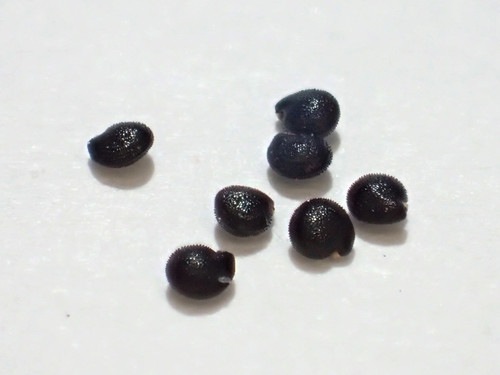
no rights reserved, uploaded by 葉子
What to Eat
Edible parts: Leaves, Vegetable
The leaves and stems are blanched and used in salads, or cooked in soups. It is cultivated as a minor commercial vegetable.
Where to Find It
It is a tropical plant. It can grow from sea level up to 2,200 m above sea level. It is best in well-drained moist soil rich in organic matter. It suits hardiness zones 9-10.
Africa, Amazon, Argentina, Asia, Australia, Bangladesh, Bolivia, Brazil, Cape Verde, Central Africa, Central America, China, Colombia, Congo DR, Cook Is., Costa Rica, Cuba, Dominican Republic, Ecuador*, El Salvador, Eswatini, Fiji, Ghana, French Guiana, Guatemala, Guyana, Haiti, Hawaii, Honduras, Indochina, Jamaica, Kenya, Lesser Antilles*, Malaysia, Mauritius, Mexico, Myanmar, New Caledonia, Nicaragua, Nigeria, North America, Pacific, Panama, Paraguay, Peru, Puerto Rico, SE Asia, Slovenia, South Africa, Southern Africa, South America*, Sri Lanka, St Helena, Swaziland, Thailand, Trinidad-Tobago, Tropical America*, Uganda, Uruguay, USA, Uzbekistan, Venezuela, Vietnam, West Africa, West Indies*,
How to Identify
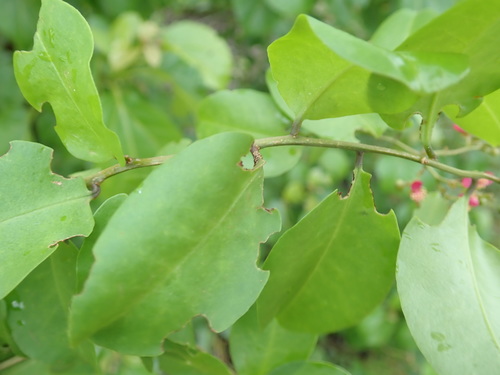
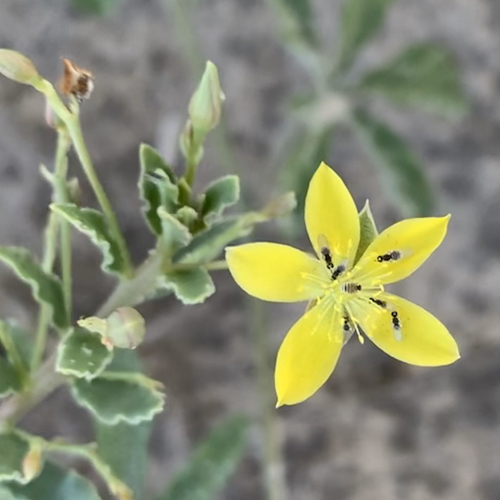
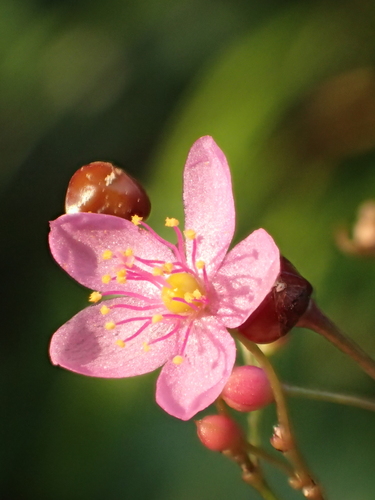
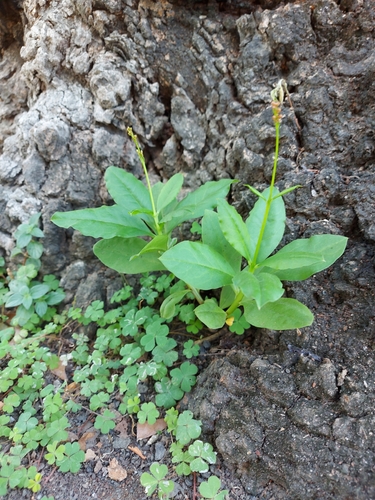
A herb. It can grow each year from seed or keep growing from year to year. It is 30-100 cm tall. The root is thick. The stems are erect and fleshy. The base is nearly woody. The leaves are alternate or almost opposite. The leaf blade is oval to sword shaped and 5-10 cm long by 2.5-5 cm wide. The base is almost wedge shaped and it tapers to a short tip with a sharp point. The flower panicle is large and at the tip or near the end. It has a long stalk. The flowers are purple-red. The flowering stalk is round in cross section.
Nutrition Score: 22/100
| Part | Moisture | kJ | kcal | Protein | Vit A | Vit C | Iron | Zinc |
|---|---|---|---|---|---|---|---|---|
| Leaves | 94 | 64 | 15 | 1.2 | — | 0 | 4.7 | 0.3 |
| Leaves | 90.9 | — | — | 2.8 | — | — | 1.5 | — |
How to Grow
Plants can be grown by stem cuttings. They can also be grown by seeds. Seeds are sown in light shade and seedlings appear in one week. They can be put in a nursery and transplanted. Removing flowers extends the time of leaf production.
Propagation: Seed - sow in situ or in a lightly shaded position in a nursery seedbed. Germination takes place within 7 days and young plants should be planted out within another 5 weeks. Cuttings are taken from slightly woody stems, from which tops and leaves are removed. They require ample watering.
Medicinal Uses
Talinum paniculatum is often grown as an ornamental plant. Cultivars include 'Kingwood Gold', 'Limón', and 'Variegatum'. The leaves are edible and have been used in traditional medicine in Asia. Used in home medicine as a diuretic, healing, emollient, vulval and anti-infective, it is also consumed in salads.
Wikipedia
Source ↗Talinum paniculatum is a succulent subshrub in the family Talinaceae that is native to much of North and South America, and the Caribbean countries. It is commonly known as fameflower, Jewels-of-Opar (a name borrowed from the title of the novel Tarzan and the Jewels of Opar by Edgar Rice Burroughs), or pink baby's-breath.
Production
Young shoots are picked when the plants are 30 cm tall.
Other Information
It is a commercially cultivated vegetable. It is a minor vegetable.
Notes
There are about 50 Talinum species. They grow in warm places. It is used in medicine. Also put in the family Portulacaceae. Presumably in a hot house in Slovenia.
Names & Synonyms
Allanu pu'fintsumi, Ameflower, Armo porteno, Caa ruru kyra, Carne gorda, Caruru, Fameflower, Major-gomes, Mata callos, Negrito aguachoso, Palo de rosa, Pasto del monte, Tu ren shen, Varataisi, Verdolaga camba, Verdolaga francesa
References (44)
- Adebooye, O. C. et al, 2005, Seed constraint to cultivation and productivity of African indigeous leaf vegetables. African Journal of Biotechnology 4(13) pp 1480-1484
- Barfod, A. S. & Kvist, L. P., 1996, Comparative Ethnobotanical Studies of the Amerindian Groups in Coastal Ecuador. The Danish Academy of Sciences and Letters. p 82
- Bodkin, F., 1991, Encyclopedia Botanica. Cornstalk publishing, p 966
- Brickell, C. (Ed.), 1999, The Royal Horticultural Society A-Z Encyclopedia of Garden Plants. Convent Garden Books. p 998
- Burkill, H. M., 1985, The useful plants of west tropical Africa, Vol. 4. Kew.
- "Chinese Nutrition Journal", 2002, Vol 23(11) p 121
- Cundall, P., (ed.), 2004, Gardening Australia: flora: the gardener's bible. ABC Books. p 1398
- Daly, D. C., An Index of Common Names of Plants in Acre, Brazil. New York Botanical Garden Universidade Federal do Acre.
- Duarte, M. C., et al, 2022, Diversity of Useful Plants in Cabo Verde Islands: A Biogeographic and Conservation Perspective. Plants 2022, 11, 1313 p 16
- Epenhuijsen C.W. van., 1974, Growing Native vegetables in Nigeria. FAO Rome, p 92
- Facciola, S., 1998, Cornucopia 2: a Source Book of Edible Plants. Kampong Publications, p 187
- Fruct. sem. pl. 2:219. 1791
- Geesink, 1971, Portulacaceae, Flora Malesiana, Ser. 1 Vol. 7 (1) p 124
- Grubben, G. J. H. and Denton, O. A. (eds), 2004, Plant Resources of Tropical Africa 2. Vegetables. PROTA, Wageningen, Netherlands. p 517
- Hibbert, M., 2002, The Aussie Plant Finder 2002, Florilegium. p 297
- http://www.botanic-gardens-ljubljana.com/en/plants
- Hunter, D., et al, 2019, The potential of neglected and underutilized species for improving diets and nutrition. Planta (2019) 250:709-729
- Hussey, B.M.J., Keighery, G.J., Cousens, R.D., Dodd, J., Lloyd, S.G., 1997, Western Weeds. A guide to the weeds of Western Australia. Plant Protection Society of Western Australia. p 202
- INFOODSUpdatedFGU-list.xls
- Japanese International Research Centre for Agricultural Science www.jircas.affrc.go.jp/project/value_addition/Vegetables
- Jardin, C., 1970, List of Foods Used In Africa, FAO Nutrition Information Document Series No 2.p 105
- Katz, E., et al, 2012, No greens in the forest? Note on the limited consumption of greens in the Amazon. Acta Soc Bot Pol 81(4):283–293
- Kays, S. J., and Dias, J. C. S., 1995, Common Names of Commercially Cultivated Vegetables of the World in 15 languages. Economic Botany, Vol. 49, No. 2, pp. 115-152
- Kermath, B. M., et al, 2014, Food Plants in the Americas: A survey of the domesticated, cultivated and wild plants used for Human food in North, Central and South America and the Caribbean. On line draft. p 852
- Kew Plants of the World Online
- Kinupp, V. F., 2007, Plantas alimenticias nao-convencionais da regiao metropolitana de Porto Alegre, RS, Brazil p 94
- Kinupp, V. F. & Bergman, I., 2008, Protein and minerals of native species, potential vegetables and fruits. Cienc.Tecnol. Aliment. Vol. 28 No. 4 Campinas Oct/Dec.
- Lazarides, M. & Hince, B., 1993, Handbook of Economic Plants of Australia, CSIRO. p 233
- Long, C., 2005, Swaziland's Flora - siSwati names and Uses http://www.sntc.org.sz/flora/
- Malezas Comestibles del Cono Sur, INTA, 2009, Buernos Aires
- Miguel, E., et al, 1989, A checklist of the cultivated plants of Cuba. Kulturpflanze 37. 1989, 211-357
- Mot So Rau Dai an Duoc O Vietnam. Wild edible Vegetables. Ha Noi 1994, p 122
- NYBG herbarium "edible"
- Okigbo, B.N., Vegetables in Tropical Africa, in Opena, R.T. & Kyomo, M.L., 1990, Vegetable Research and development in SADCC countries. Asian Vegetable Research and development Centre. Taiwan. p 45
- Pascual-Mendoza, S. et al, 2021, Traditional knowledge of edible plants in an indigenous community in the Sierra Norte of Oaxaca, Mexico. Plant Biosystems - An International Journal Dealing with all Aspects of Plant Biology
- Plants of Haiti Smithsonian Institute http://botany.si.edu/antilles/West Indies
- Quintana, C. M., 2010, Wild Plants in the Dry Valleys Around Quito Ecuador. An Illustrated Guide. Publicationes del Harbario, QCA p 181
- Reis, S. V. and Lipp, F. L., 1982, New Plant Sources for Drugs and Foods from the New York Botanical Garden herbarium. Harvard. p 59
- Smith, A.C., 1981, Flora Vitiensis Nova, Lawaii, Kuai, Hawaii, Volume 2 p 279
- Staples, G.W. and Herbst, D.R., 2005, A tropical Garden Flora. Bishop Museum Press, Honolulu, Hawaii. p 467
- Swaziland's Flora Database http://www.sntc.org.sz/flora
- Tanaka, Y & Van Ke, N., 2007, Edible Wild Plants of Vietnam. Orchid Press. p 125
- Torre, de la, L., et al, 2008, Enciclopedia de las Plantas Útiles del Ecuador. Herbario QCA. Pontificia Universidad Católica del Ecuador. p 528
- World Checklist of Useful Plant Species 2020. Royal Botanic Gardens, Kew