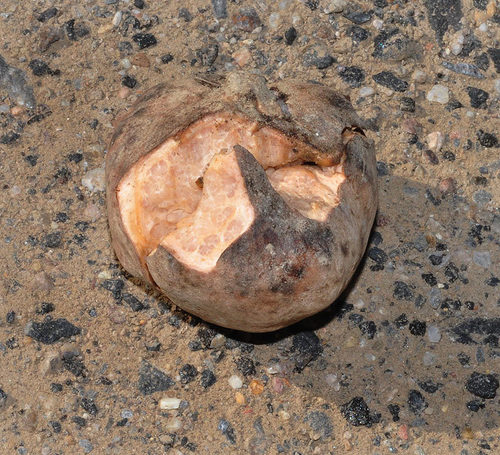
Terfezia boudieri
Chatin
Terfaz Moroccan truffle
TerfeziaceaeMushrooms

wikimedia · cc0
Wikimedia Commons - Louis Trabut
Wikimedia Commons - Louis Trabut
What to Eat
Edible parts: Fungus, Mushroom
The fruiting bodies are cooked and eaten, commonly added to lamb stew or cooked rice. They are also sold in canned form.
Where to Find It
It is a subtropical plant. It can grow in the desert.
Africa, Asia, Botswana, China, Libya, Mediterranean, Middle East, Morocco, Namibia, North Africa, Saudi Arabia, Southern Africa, Syria, Turkey, Türkiye,
Countries: United Arab Emirates, Afghanistan, Albania, Armenia, Angola, Azerbaijan, Bosnia & Herzegovina, Bangladesh, Burkina Faso, Bahrain, Burundi, Benin, Brunei, Bhutan, Botswana, Congo (DRC), Central African Republic, Congo (Republic), Cote d'Ivoire, Cameroon, China, Cape Verde, Cyprus, Djibouti, Algeria, Egypt, Eritrea, Spain, Ethiopia, France, Gabon, Georgia, Ghana, Gambia, Guinea, Equatorial Guinea, Greece, Guinea-Bissau, Croatia, Indonesia, Israel, India, Iraq, Iran, Italy, Jordan, Japan, Kenya, Kyrgyzstan, Cambodia, Comoros, North Korea, South Korea, Kuwait, Kazakhstan, Laos, Lebanon, Sri Lanka, Liberia, Lesotho, Libya, Morocco, Monaco, Montenegro, Madagascar, Mali, Myanmar, Mongolia, Mauritania, Malta, Mauritius, Maldives, Malawi, Malaysia, Mozambique, Namibia, Niger, Nigeria, Nepal, Oman, Philippines, Pakistan, Qatar, Rwanda, Saudi Arabia, Seychelles, Sudan, Singapore, Slovenia, Sierra Leone, Senegal, Somalia, South Sudan, Sao Tome & Principe, Syria, Eswatini, Chad, Togo, Thailand, Tajikistan, Timor-Leste, Turkmenistan, Tunisia, Turkey, Taiwan, Tanzania, Uganda, Uzbekistan, Vietnam, Yemen, South Africa, Zambia, Zimbabwe
How to Identify
A subtropical truffle or underground-fruiting mushroom in the family Terfeziaceae, capable of growing in desert conditions.
Production
In South Africa it is available in April to July.
Other Information
They are sold canned.
Names & Synonyms
Keme, Kimi
References (10)
- Ahmed, A.A., Mohamed, M. A. and Hami, M.A., 1981, Libyan truffles: Chemical composition and toxicity. Mushroom science 11:833-42
- Awameh, M. S., et al, Ascospore germination of Black Kame (Terfezia boudieri) Mycologia 7291) pp 50-54
- Boa, E. R., 2004, Wild edible fungi and their importance to people. FAO Non Wood Forest Products Booklet 17
- Facciola, S., 1998, Cornucopia 2: a Source Book of Edible Plants. Kampong Publications, p 254 (As Terfezia boudieri)
- Fox, F. W. & Young, M. E. N., 1982, Food from the Veld. Delta Books. p 232
- Kaya, O. M., et al, 2020, An ethnobotanical research in Sanhurfa central district and attached Villages (Turkey). Indian Journal of Traditional Knowledge. Vol. 19(1) pp 7-23
- Kiple, K.F. & Ornelas, K.C., (eds), 2000, The Cambridge World History of Food. CUP p 317
- Mandaville, J. P., 2004, Bedouin ethnobotany: Plant concepts and plant use in a desert pastoral world. PhD thesis University of Arizona. p 170
- Uphof,
- Yildiz, A et al, 2005, Organic elements and protein in some macrofungi of south east Anatolia in Turkey. Food Chemistry 89: 605-609