Terfezia claveryi
Chatin
Kalahari truffle, Bushman potato, Desert truffle
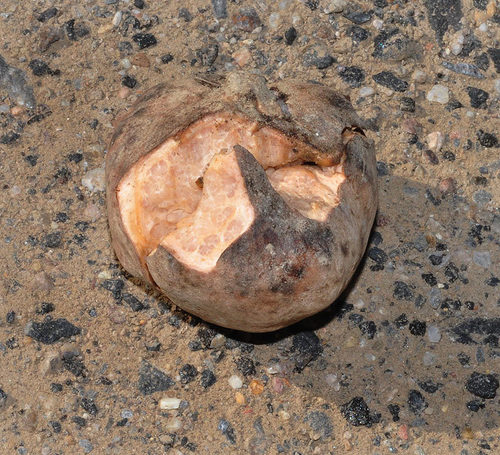
iNaturalist · cc-by-nc
(c) faluke, some rights reserved (CC BY-NC), uploaded by faluke
(c) faluke, some rights reserved (CC BY-NC), uploaded by faluke
What to Eat
Edible parts: Truffle, Fungus
The truffle fruiting body is eaten.
Where to Find It
It grows in Mediterranean climate regions. It grows in the desert.
Africa, Algeria, Asia, China, Europe, Himalayas, India, Iraq, Jordan, Mediterranean, Middle East, Namibia, North Africa, Northeastern India, Saudi Arabia, Sikkim, South Africa, Southern Africa, Spain,
Countries: Andorra, United Arab Emirates, Afghanistan, Albania, Armenia, Angola, Austria, Azerbaijan, Bosnia & Herzegovina, Bangladesh, Belgium, Burkina Faso, Bulgaria, Bahrain, Burundi, Benin, Brunei, Bhutan, Botswana, Belarus, Congo (DRC), Central African Republic, Congo (Republic), Switzerland, Cote d'Ivoire, Cameroon, China, Cape Verde, Cyprus, Czechia, Germany, Djibouti, Denmark, Algeria, Estonia, Egypt, Eritrea, Spain, Ethiopia, Finland, France, Gabon, United Kingdom, Georgia, Ghana, Gambia, Guinea, Equatorial Guinea, Greece, Guinea-Bissau, Croatia, Hungary, Indonesia, Ireland, Israel, India, Iraq, Iran, Iceland, Italy, Jordan, Japan, Kenya, Kyrgyzstan, Cambodia, Comoros, North Korea, South Korea, Kuwait, Kazakhstan, Laos, Lebanon, Liechtenstein, Sri Lanka, Liberia, Lesotho, Lithuania, Luxembourg, Latvia, Libya, Morocco, Monaco, Moldova, Montenegro, Madagascar, North Macedonia, Mali, Myanmar, Mongolia, Mauritania, Malta, Mauritius, Maldives, Malawi, Malaysia, Mozambique, Namibia, Niger, Nigeria, Netherlands, Norway, Nepal, Oman, Philippines, Pakistan, Poland, Portugal, Qatar, Romania, Serbia, Russia, Rwanda, Saudi Arabia, Seychelles, Sudan, Sweden, Singapore, Slovenia, Slovakia, Sierra Leone, San Marino, Senegal, Somalia, South Sudan, Sao Tome & Principe, Syria, Eswatini, Chad, Togo, Thailand, Tajikistan, Timor-Leste, Turkmenistan, Tunisia, Turkey, Taiwan, Tanzania, Ukraine, Uganda, Uzbekistan, Vietnam, Yemen, South Africa, Zambia, Zimbabwe
How to Identify
A truffle fungus in the Terfeziaceae family, 5-8 cm across, found in desert and Mediterranean climate regions.
Nutrition Score: 36/100
| Part | Moisture | kJ | kcal | Protein | Vit A | Vit C | Iron | Zinc |
|---|---|---|---|---|---|---|---|---|
| Truffle | 75.5 | 352 | 84 | 4.4 | — | — | — | — |
Names & Synonyms
Nabbas, Nukhasi, Tkabba
References (7)
- Boa, E. R., 2004, Wild edible fungi and their importance to people. FAO Non Wood Forest Products Booklet 17
- Bradei, L., et al, 2014, Desert truffles of the North Algerian Sahara: Diversity and bioecology. Emir. J. Food Agric. 26(5):425-435
- Dabbour, I. R. & Takruri, H. R., 2002, Protein quality of four types of edible mushrooms found in Jordan. Plant Foods for Human Nutrition 57:1-11
- Food Composition Tables for the Near East. http://www/fao.org/docrep No. 431
- Hall, I. R., et al, 2003, Edible and Poisonous Mushrooms of the World. Timber Press. p 271
- INFOODSUpdatedFGU-list.xls
- Manju, S., and Sundriyal, R. C., 2001, Wild Edible Plants of the Sikkim Himalaya: Nutritive Values of Selected Species. Economic Botany 55(3): 377-390


