Termitomyces microcarpus
(Berk. and Broome) Heim
Termite mushroom

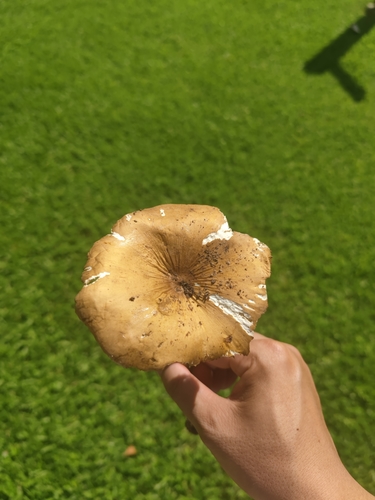
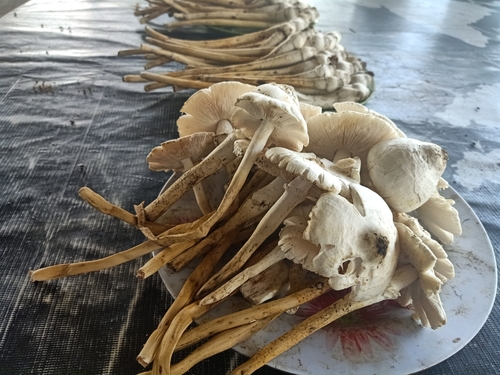
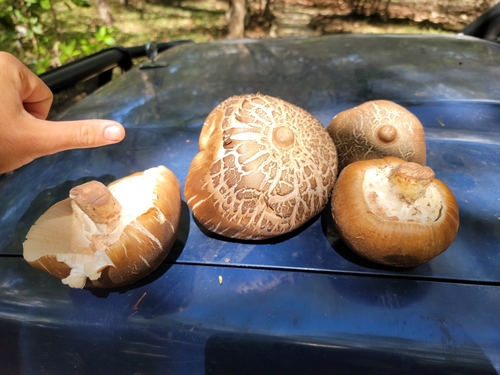
(c) lizziepop, some rights reserved (CC BY-NC)
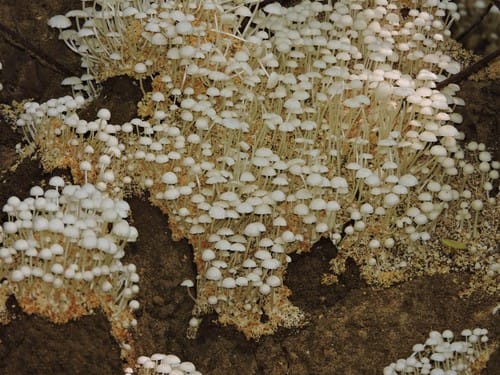
(c) Mahathi Narayanaswamy, some rights reserved (CC BY-NC)
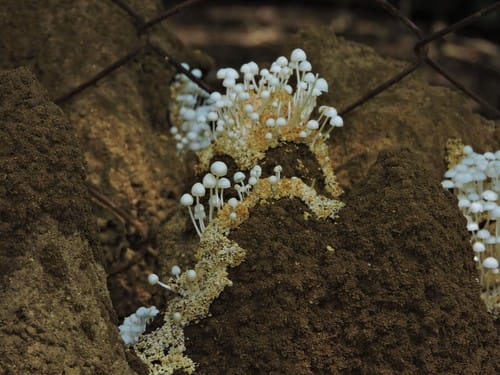
(c) Mahathi Narayanaswamy, some rights reserved (CC BY-NC)
What to Eat
Edible parts: Fungus, Mushroom
The mushroom fruiting bodies are eaten as food.
Where to Find It
A tropical plant. It grows on termite mounds.
Africa, Angola, Asia, Benin, Burundi, Cameroon, Central Africa, Central African Republic, CAR, China, Congo DR, East Africa, Gabon, Himalayas, Hong Kong, India, Indochina, Indonesia, Kenya, Laos, Malawi, Malaysia, Mozambique, Nigeria, Pakistan, Philippines, Rwanda, SE Asia, Sierra Leone, South Africa, Southern Africa, Sri Lanka, Tanzania, Thailand, Uganda, West Africa, Zambia, Zimbabwe,
How to Identify
A tropical mushroom growing on termite mounds, with fruiting bodies 3-6 cm across. It is sold in local markets.
Nutrition Score: 55/100
| Part | Moisture | kJ | kcal | Protein | Vit A | Vit C | Iron | Zinc |
|---|---|---|---|---|---|---|---|---|
| Mushroom | 9.6 | — | 261 | 33.4 | — | — | — | — |
Wikipedia
Source ↗Termitomyces microcarpus is a species of agaric fungus in the family Lyophyllaceae. An edible species, it is found in Africa and Asia, where it grows in groups or clusters in deciduous forests near the roots of bamboo stumps associated with termite nests.
Production
They can be dried and stored for later use.
Other Information
It is sold in local markets.
Notes
Also put in the family Agaricaceae.
Names & Synonyms
Het kai noy, Huo ba ji zong, Kulat tali, Mohi, N'kpame kekpeka, Nzawu, Obuoch-omegre, Oron, Puo' me fufu, Ubumegeri, Unyakigulu, Unzawu, Xiaoyichaosan
References (33)
- Abdullah, F. & Rusea, G., 2009, Documentation of inherited knowledge on wild edible fungi from Malaysia. Blumea 54, 35-38
- Acipa, A. et al, 2013, Nutritional Profile of some Selected Food Plants of Otwal and Ngai Counties, Oyam District, Northern Uganda. African Journal or Food, Agriculture, Nutrition and Development. 13(2)
- Aletor, V. A., 1995, Compositional studies on edible tropical species of mushrooms. Food Chemistry 54 (1995) 265-268
- Ambasta, S.P. (Ed.), 2000, The Useful Plants of India. CSIR India. p 137 (As Collybia microcarpa)
- Burkill, I.H., 1966, A Dictionary of the Economic Products of the Malay Peninsula. Ministry of Agriculture and Cooperatives, Kuala Lumpur, Malaysia. Vol 1 (A-H) p 647 (As Collybia microcarpa)
- Anon., 2000, The Role of Non Wood Forest products in Food Security and Income Generation. Report. Tanzania. p 19
- Bels and Pataragetvit, 1982,
- Bloesch, U., 2008, Mushroom study, The potential of wild edible mushrooms. GTZ project. p 16
- Boa, E. R., 2004, Wild edible fungi and their importance to people. FAO Non Wood Forest Products Booklet 17
- Burkill, I.H., 1966, A Dictionary of the Economic Products of the Malay Peninsula. Ministry of Agriculture and Cooperatives, Kuala Lumpur, Malaysia. Vol 1 (A-H) p 647 (As Collybia microcarpa)
- Buyck, B., & Nzigidahera, B., 1995, Ethnomycological Notes from Western Burundi. Belg. Journ. Bot. 128(2): 131-138
- Degreef, J., et al, 2016, Wild edible mushrooms, a valuable resource for food security and rural development in Burundi and Rwanda. Biotechnol. Agron. Soc. Environ. 2016 20(4), 441-452
- efta-online.org, Edible Fungi of Tropical Africa, Jardin botanique Meise
- Grivetti, L. E., 1980, Agricultural development: present and potential role of edible wild plants. Part 2: Sub-Saharan Africa, Report to the Department of State Agency for International Development. p 34
- Gryzenhout, M., 2010, Mushrooms of South Africa. Pocket Guide. Struik. p 57
- Hall, I. R., et al, 2003, Edible and Poisonous Mushrooms of the World. Timber Press. p 315
- Kiple, K.F. & Ornelas, K.C., (eds), 2000, The Cambridge World History of Food. CUP p 318, 321
- Kokwaro, J. O. and Johns. T., Luo Biological Dictionary. p 79
- Johns, T., and Kokwaro, J.O., 1991, Food Plants of the Luo of Siayo District, Kenya. Economic Botany 45(1), pp 103-113
- Latham, P & Mbuta, A., 2017, Useful Plants of Central Province, Democratic Republic of Congo. Volume 2. Salvation Army p 254
- Liu, D., et al, 2018, An ethnobotanical survey of edible fungi in Chuxiong City, Yunnan, China. Journal of Ethnobiology and Ethnomedicine (2018) 14:42
- Luczaj, L., et al, 2021, Wild food plants and fungi sold in the markets of Luang Prabang, Lao PDR. Journal of Ethnobiology and Ethnomedicine (2021) 17:6
- Mawunu, M., et al, 2020, First Survey of the Edible Non-Wood Forest Products Sold in Uige Province, Northern Angola. European Journal of Agriculture and Food Sciences. Vol. 2, No. 6
- Msola, D. K., 2007, The role of Wild Foods in Household Income and Food Security in Mufundi District, Tanzania. Morogoro, Tanzania. p 48
- Nakalembe, I., et al, 2015, Comparative nutrient composition of selected wild edible mushrooms from two agro‐ecological zones, Uganda. SpringerPlus (2015)4:433
- Njouonkou, A.L., et al, 2016, Diversity of Edible and Medicinal Mushrooms used in the Noun Division of the West Region of Cameroon. International Journal of Medicinal Mushrooms, 18(5): 387-396
- Purkayastha, 1978,
- Pegler, D. N. & Piearce, G. D., 1980, The Edible Mushrooms of Zambia. Kew Bulletin. 35(3): 475-491
- See, L. S., et al, 2008, Utilization of Macrofungi by some Indigenous Communities for Food and Medicine in Peninsular Malaysia. Sustainable Forest Management and Poverty Alleviation: Roles of Traditional Forest-related Knowledge IUFRO World Series Volume 21
- Semwal, K. C., et al, 2014, Edible mushrooms of the Northwestern Himalaya, India: a study of indigenous knowledge, distribution and diversity. Mycosphere 5(3): 440–461
- Sun, L. et al, 2017, Comparison of Free Total Amino Acid Compositions and Their Functional Classifications in 13 Wild Edible Mushrooms. Molecules 2017, 22, 350
- Thatoi, H. & Singdevsachan, S. K., 2014, Diversity, nutritional composition and medicinal potential of Indian mushrooms: A review. African Journal of Biotechnology 13(4): 523-545
- Tibuhwa, 2013, Wild Mushroom - an underutilized healthy food resource and income generator: experience from Tanzania rural areas. Journal of Ethnobiology and Ethnomedicine 9:49