Triumfetta annua
L.
Paroquet Bur

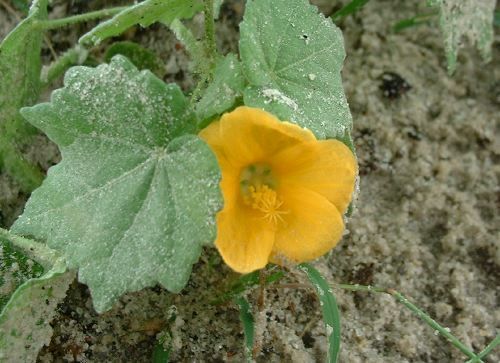
(c) Linda Loffler, some rights reserved (CC BY-NC), uploaded by Linda Loffler

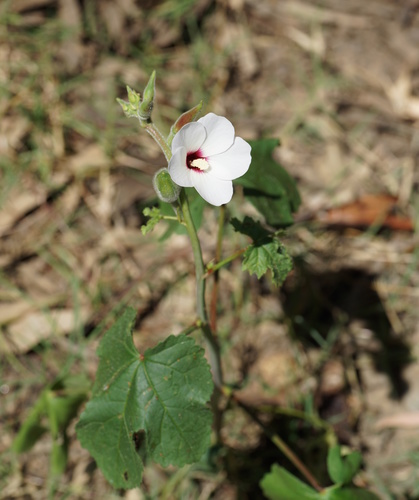
(c) Dinesh Valke, some rights reserved (CC BY-SA)
What to Eat
Edible parts: Leaves, Vegetable
The leaves are occasionally cooked as a side dish but require thorough cooking. The bark of young green stems produces a slimy exudate used in soup—the stems are heated until the bark loosens, then peeled and squeezed into hot water with salt and spices (vegetable oil should not be added).
Where to Find It
A tropical plant. It can tolerate shade. It grows in bushland and grows up to 2,150 m altitude. It grows in the lowlands. In Sichuan and Yunnan.
Africa, Angola, Asia, Bhutan, Botswana, Burundi, Cameroon, Central Africa, Central African Republic, CAR, China, Congo, East Africa, Eritrea, Eswatini, Ethiopia, Himalayas, India, Indochina, Kenya, Madagascar, Malawi, Malaysia, Mozambique, Myanmar, Namibia, Nepal, Nigeria, Pakistan, Rwanda, SE Asia, South Africa, Southern Africa, Sudan, Swaziland, Tanzania, Uganda, Vietnam, West Africa, Zambia, Zimbabwe,
How to Identify
An annual herb. It grows up to 60 cm high. The leaves are simple and undivided and have teeth along the edge. The leaves are 10 cm long by 7 cm wide. They have simple hairs. The leaves are on long stalks. The flowers are small and yellow. They occur in clusters where the leaf stalk meets the stem. The fruit occur as round globules with hooks. They are 1.5 cm across.
Nutrition Score: 43/100
| Part | Moisture | kJ | kcal | Protein | Vit A | Vit C | Iron | Zinc |
|---|---|---|---|---|---|---|---|---|
| Leaves | 78.9 | 298 | 71 | 4.2 | — | — | 29.2 | — |
How to Grow
Cuttings of young stems 15-20 cm long are often used. They are planted in the shade of a tree. The cuttings need to be planted straight upwards.
Other Uses
The fibrous bark is used as string.
Production
Young leaves are picked when required. Stems are cut just above the ground when they are 75-100 cm long. New shoots start as soon the the rainy season arrive.
Other Information
It is occasionally cultivated.
Notes
There are about 150 Triumfetta species. They are mostly in the tropics and subtropics. There are about 50 species in tropical America. It has also been put in the family Sparmanniaceae. It may eventually be put in the family Malvaceae.
Names & Synonyms
Burweed, Cipopo, Gaidau nhatnien, Hombo, Katsine, Khatambuzi, Kibosa, Kifutuma, Libube, Liwube, Munamu, Sungini, Therere, Tshimbvumbvu, Ugunga
References (22)
- Ambasta, S.P. (Ed.), 2000, The Useful Plants of India. CSIR India. p 654
- Exell, A.W. et al, (Ed), 1963, Flora Zambesiaca Vol 2 Part 1 Crown Agents, London. p 75
- Fowler, D. G., 2007, Zambian Plants: Their Vernacular Names and Uses. Kew. p 46
- Goode, P., 1989, Edible Plants of Uganda. FAO p 30
- Grivetti, L. E., 1980, Agricultural development: present and potential role of edible wild plants. Part 2: Sub-Saharan Africa, Report to the Department of State Agency for International Development. p 48
- Grubben, G. J. H. and Denton, O. A. (eds), 2004, Plant Resources of Tropical Africa 2. Vegetables. PROTA, Wageningen, Netherlands. p 535
- Harkonen, M. & Vainio-Mattila, K., 1998, Some examples of Natural Products in the Eastern Arc Mountains. Journal of East African Natural History 87:265-278
- Jardin, C., 1970, List of Foods Used In Africa, FAO Nutrition Information Document Series No 2.p 108
- Magwede, K., van Wyk, B.-E., & van Wyk, A. E., 2019, An inventory of Vhavenḓa useful plants. South African Journal of Botany 122 (2019) 57–89
- Malaisse, F., 1997, Se nourrir en floret claire africaine. Approche ecologique et nutritionnelle. CTA., p 69
- Martin, F.W. & Ruberte, R.M., 1979, Edible Leaves of the Tropics. Antillian College Press, Mayaguez, Puerto Rico. p 221
- Mutie, F. M., et al, 2023, Important Medicinal and Food Taxa (Orders and Families) in Kenya, Based on Three Quantitative Approaches. Plants 2023, 12, 1145
- Peters, C. R., O'Brien, E. M., and Drummond, R.B., 1992, Edible Wild plants of Sub-saharan Africa. Kew. p 194
- Pham-Hoang Ho, 1999, An Illustrated Flora of Vietnam. Nha Xuat Ban Tre. p 488
- Schippers, R.R., 2004. Triumfetta annua L. [Internet] Record from Protabase. Grubben, G.J.H. & Denton, O.A. (Editors). PROTA (Plant Resources of Tropical Africa), Wageningen, Netherlands. < http://database.prota.org/search.htm>. Accessed 23 October 2009
- Swaziland's Flora Database http://www.sntc.org.sz/flora
- Vainio-Mattila, K., 2000, Wild vegetables used by the Sambaa in the Usumbara Mountains, NE Tanzania. Ann. Bot. Fennici 37:57-67
- Vernon, R., 1983, Field Guide to Important Arable Weeds of Zambia. Dept of Agriculture, Chilanga, Zambia. p 50
- Welcome, A. K. & Van Wyk, B.-E., 2019, An inventory and analysis of the food plants of southern Africa. South African Journal of Botany 122 (2019) 136–179
- Wild, 1975,
- Williamson, J., 2005, Useful Plants of Malawi. 3rd. Edition. Mdadzi Book Trust. p 251
- World Checklist of Useful Plant Species 2020. Royal Botanic Gardens, Kew