Abelmoschus manihot
(L.) Medik.
Aibika, Edible Hibiscus

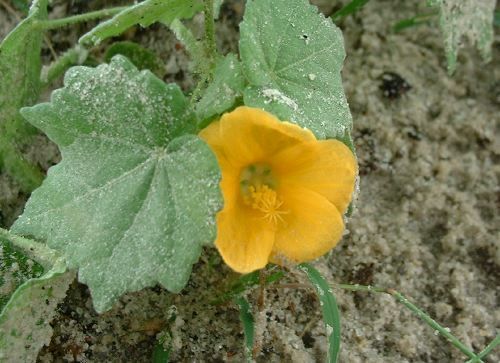
(c) chiragmunje, some rights reserved (CC BY), uploaded by chiragmunje
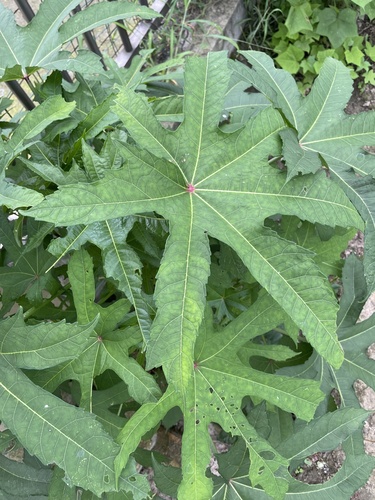
(c) duonix, some rights reserved (CC BY-NC)

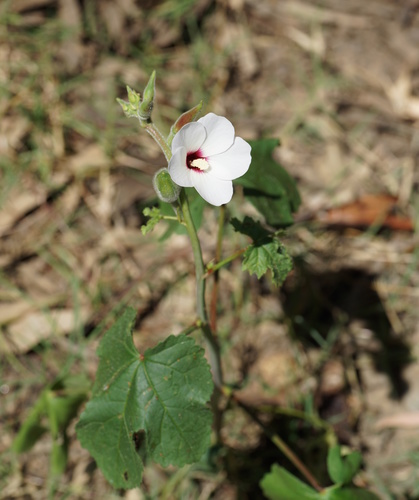
(c) Ton Rulkens, some rights reserved (CC BY-SA)
What to Eat
Edible parts: Leaves, Flower buds, Vegetable, Root, Fruit, Pods
Young leaves can be eaten raw or cooked — they are sweet and mucilaginous, high in vitamins A and C and iron, and contain 2% protein by dry weight. They work well as a substitute for lettuce or spinach. Young shoots are harvested at around 15cm long. Flower buds can be eaten raw or cooked.
Where to Find It
A tropical plant. It is well suited to the tropical lowlands but grows only poorly at 1800 metres. It needs fertile soil. The plant occurs in countries from India, China, Japan, Malaysia and Indonesia to the Pacific Islands. Plants will withstand occasional short-lived temperatures down to about -5°C so long as they are in a very well-drained soil. It suits areas with high humidity. It does not do well on atoll soils. It grows in humid places in Africa usually between 12°N and 12°S. It does best in well drained sandy loams. It suits hardiness zones 10-12. Hobart Botanical Gardens. In Sichuan and Yunnan.
Africa, Andorra, Asia, Australia, Benin, Bhutan, Bougainville, Cameroon, Central Africa, Congo DR, China, Cook Islands, Côte d'Ivoire, East Africa, East Timor, Fiji, FSM, Gabon, Guinea, Guinée, Haiti, Hawaii, Himalayas, India, Indochina, Indonesia, Ivory Coast, Japan, Kiribati, Korea, Laos, Liberia, Malaysia, Micronesia, Mozambique, Myanmar, Nauru, Nepal, Niger, Nigeria, North America, Northeastern India, Pacific, Pakistan, Palau, Papua New Guinea, PNG, Philippines, Pohnpei, Rotuma, Sahel, Samoa, SE Asia, Sierra Leone, Sikkim, Slovenia, Solomon Islands, Taiwan, Tanzania, Tasmania, Thailand, Timor-Leste, Togo, Tokelau, Tonga, Tuvalu, Uganda, USA, Vanuatu, Vietnam, West Africa, West Indies, West Papua,
How to Identify
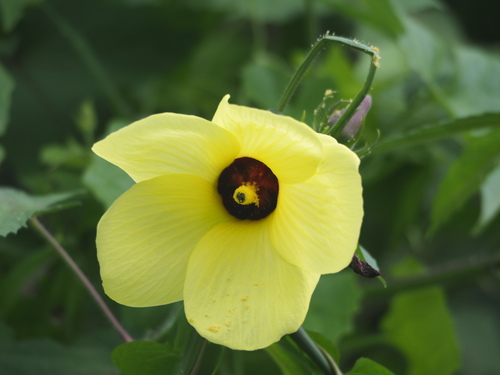
A shrub or small tree. It grows 5 m tall. There are prickles along the stem. The leaves are twice divided and there are 8-18 pairs of pinnae. There are up to 50 pairs of pinnules on each pinnae. The flowers are yellow. They are in large clusters at the ends of branches. The pods are flattened.
Nutrition Score: 36/100
| Part | Moisture | kJ | kcal | Protein | Vit A | Vit C | Iron | Zinc |
|---|---|---|---|---|---|---|---|---|
| Leaves | 88 | 120 | 29 | 3.4 | 1 | 7 | 1.5 | 1.2 |
| Flower buds | — | — | — | — | — | — | — | — |
How to Grow
It is grown from cuttings. Cuttings with 2-3 nodes are sufficient. It can be grown from seeds. The narrow leafed types tend to compete less well with weeds. In some areas people tend to put the narrow leafed types in the middle of the garden, intercropped with sweet potato, and the broad leafed kinds near stumps or logs and around the edges of gardens. The pale green leafed kinds that occur only grow very slowly. Aibika is normally grown from cuttings. Lengths of about 25 cm (2 or 3 leaf joints or "nodes") of fresh green stem cuttings are used. These are simply stuck in the ground. A fertile soil is needed. Therefore Aibika can be planted in good soil in a newly cleared garden site, or it can be planted near houses where the soil fertility can be built up by adding scraps and compost and ashes. The growth and colour of Aibika leaves can be improved greatly by spraying the leaves each 2 or 3 weeks with a very small amount of the nitrogen fertiliser called urea, dissolved in water. (A 0.5% solution). This uses less fertiliser than putting it on the ground where it can wash away in the rain. Picking out the tips off branches of Aibika plants encourages the plant to produce more branches and therefore more leaves. But when you are harvesting leaves, you should not pick too many off the one bush at the one time. This is because it slows down the growth of more leaves. If the soil is very fertile, older bushes, which are only growing a few leaves, can be chopped off. The stump left in the ground can then re-grow into a new bush.
Propagation: Sow seed in March in a warm greenhouse. Germination should occur within two weeks. Prick seedlings into individual pots once large enough to handle, and plant out after the last expected frosts. In areas with warm summers, seed can also be sown in situ in late April.
Medicinal Uses
The bark is considered emmenagogue. A bark paste is applied to wounds and cuts, with fresh paste reapplied every 2–3 days for approximately 3 weeks. In Nepal, root juice is warmed and applied to sprains. The juice of the flowers is used to treat chronic bronchitis and toothache.
Other Uses
The root of this plant is used in Japan as a size (a binding or stiffening agent) for handmade papers made from the inner bark of Edgeworthia gardneri and various forms of paper mulberry (Broussonetya papyrifera). To prepare the mucilage, roots are washed, soaked in fresh water for several hours, then crushed. The crushed material is placed in a linen bag and soaked again in water. By manipulating the bag in a vat already containing the paper pulp, mucilage is released into the water; the bag must be squeezed periodically as the mucilage does not seep out on its own. The papermaker can gauge adequate mucilage concentration by the glutinous feel of the water. This plant is considered the most widely used mucilaginous plant in Japanese papermaking.
Wikipedia
Source ↗Abelmoschus manihot, commonly known as aibika, is a flowering plant in the family Malvaceae. It is also known as the sunset muskmallow, sunset hibiscus, or hibiscus manihot. It is a tropical subshrub or shrub native to Asia, New Guinea, and Queensland. It is cultivated and eaten as a leaf vegetable, among other uses.
Production
Leaves are ready to harvest after about 80 days. Yields of 6.7-7.3 tons/ha/crop have been recorded. It flowers in 50-110 days. This gets longer with increasing daylength. Plants can take 4 to 12 months until fruit are ready. Production can continue to an extended time.
Other Information
The most important edible leafy green in coastal areas of Papua New Guinea, the Pacific and SE Asia. They are an important vegetable in Africa. It is a commercially cultivated vegetable. Leaves are sold in local markets.
Notes
There are about 15 Abelmoschus species. They are tropical and subtropical. It is high in folates.
Names & Synonyms
Aelan kapis, Alek, Asa alek, Aso, Baera, Baero, Bamia, Ban nalu, Barakue, Bele, Dahk pool, De’e, Degi, Egarani, Ga-ana, Geba wagia, Gabe, Gedi, Glikway, Gnahi, Hapia, Huang shu kui, Huangqiu kui, Huwshiy, Jangali bhindi, Kena, Kon-kado, Kookona, Lagikway, Lata lasturi, Lema, Lope, Nambere, Nating saluyot, Neka, Ngache, Nibi, Nyahi, Olsumbe, Pangai, Paura, Pele, Po-fai, Qiu kui, Ran Bhendi, Sa are, Slimy cabbage, Slippery cabbage, Some, Soragele, Takaiya, Thakhlao maikhri gajao, Totomu, Usipak, Van lasun, Vati, Vauvau, Vauvau vati, Waci, Weko, West African Okra
References (109)
- Aibika references Abelmoschus manihot Syn Hibiscus manihot.
- Altschul, S.V.R., 1973, Drugs and Foods from Little-known Plants. Notes in Harvard University Herbaria. Harvard Univ. Press. Massachusetts. no. 2763
- Ambasta S.P. (Ed.), 2000, The Useful Plants of India. CSIR India. p 1
- Army Veterinary Medicine Edible Wild Plants, 1944.
- Backer, 1911, Schoolflora voor Java p 126
- Backer, and Bakhuizen, 1963, Flora Java Vol. 1 p 434.
- Barrau, J., 1958, Subsistence Agriculture in Melanesia. Bishop Museum Bulletin 219 p 56 (As Hibiscus manihot)
- Barrau, J., 1976, Subsistence Agriculture in Polynesia and Micronesia. Bernice P. Bishop Museu, Bulletin 223 Honolulu Hawaii. Kraus reprint. p 58
- Bates, D.M., Notes on the cultivated Malvaceae 2. Abelmoschus Baileya 16:99-122
- Borssum-Waalkes, van J., 1966, Malesian Malvaceae revised. Blumea 14(1) p23
- Bull. Mus. Natl. Hist. Nat., B, Adansonia 10:138. 1988 (As Abelmoschus callei)
- Burkill, H. M., 1985, The useful plants of west tropical Africa, Vol. 4. Kew. (As Abelmoschus callei)
- Burkill, I.H., A Dictionary of the Economic Products of the Malay Peninsula p
- Cavanilles, 1787, Diss. 3:172, t 168 fl H. palmatus
- Cherikoff V. & Isaacs, J., The Bush Food Handbook. How to gather, grow, process and cook Australian Wild Foods. Ti Tree Press, Australia p 198
- Clarke, W.C. & Thaman, R.R., 1993, Agroforestry in the Pacific Islands: Systems for sustainability. United Nations University Press. New York. p 236 (As Hibiscus manihot)
- Cowie, I, 2006, A Survey of Flora and vegetation of the proposed Jaco-Tutuala-Lore National Park. Timor-Lests (East Timor) www.territorystories.nt/gov.au p 50
- Cundall, P., (ed.), 2004, Gardening Australia: flora: the gardener's bible. ABC Books. p 67
- De Clerq, 1909, Niew Plantk Woordenb p 254 no 1794
- De Clerq, 1927, Niew Plantk Woordenb. 2 nd ed p 79 no 1844.
- Dobriyal, M. J. R. & Dobriyal, R., 2014, Non Wood Forest Produce an Option for Ethnic Food and Nutritional Security in India. Int. J. of Usuf. Mngt. 15(1):17-37
- ecocrop.fao.org
- Elliot, W.R., & Jones, D.L., 1982, Encyclopedia of Australian Plants suitable for cultivation. Vol 2. Lothian. p 4
- Facciola, S., 1998, Cornucopia 2: a Source Book of Edible Plants. Kampong Publications, p 146
- Filet, 1888, Plantk Woordenb. 2nd ed p 78 no 1844
- Franklin, J., Keppel, G., & Whistler, W., 2008, The vegetation and flora of Lakeba, Nayau and Aiwa Islands, Central Lau Group, Fiji. Micronesica 40(1/2): 169–225, 2008
- French, B and Bridle, C., 1978, Food Crops of Papua New Guinea p 32, 33.
- French, B.R., 1982, Growing Food in the Southern Highlands Province, PNG. SHRDP, Mendi PNG
- French. B.R., 1986, Food Plants of PNG A compendium. PNG Biological Foundation. p 56.
- French, B.R., 2010, Food Plants of Solomon Islands. A Compendium. Food Plants International Inc. p 151
- Furusawa, T., et al, 2014, Interaction between forest biodiversity and people's used of forest resources in Roviana, Solomon Islands: implications for biocultural conservation under socioeconomic changes. Journal of Ethnobiology and Ethnomedicine, 10:10
- Gamble, G., 1935 Flora of Madras Vol 1 p 69
- Grubben, G. J. H. and Denton, O. A. (eds), 2004, Plant Resources of Tropical Africa 2. Vegetables. PROTA, Wageningen, Netherlands. p 21 (As Abelmoschus callei)
- Hale, P.R., and Williams, B.D., 1977, Aibika in Liklik Buk p 19 Melanesian Council of Churches.
- Hamilton, L., 1955, Indigenous versus Introduced Vegetables in the Village Dietary. PNG Ag. J. , Oct. 1955.
- Hamon, S. et al 1987, Collecting Abelmoschus germplasm in Thailand IBPGR SE Asian Newsletter April ‘ 87 p 3-5
- Hamon, S., and Yapo, A., 1986, Pertubations induced within the genus Abelmoschus by the discovery of a second edible okra species in West Africa. Acta Horticulturae 182 p 133.
- Heyne, 1927, Nutt. Plant. p1037
- Hochreutiner, 1900, Ann. Cons. Jard. Bot. Geneve 4:153
- Hochreutiner, 1924, Candollea 87
- Hu, Shiu-ying, 2005, Food Plants of China. The Chinese University Press. p 538
- IBPGR , 1987, Ecogeographic survey of wild Abelmoschus IBPGR Rome
- IBPGR report 133, Solomons 1986, in Pl. Genetics res Newsletter 69 p 51
- Joshi, N., et al, 2007, Traditional neglected vegetables of Nepal: Their sustainable utilization for meeting human needs. Tropentag 2007. Conference on International Agricultural Research for Development.
- Kays, S. J., and Dias, J. C. S., 1995, Common Names of Commercially Cultivated Vegetables of the World in 15 languages. Economic Botany, Vol. 49, No. 2, pp. 115-152
- Kesavan, V., 1980, Aibika (Hibiscus manihot (L.)) in PNG in IBPGR SE Asian Newsletter 4(1):9
- Kesavan, V., List of Descriptors for Aibika. In IBPGR Newsletter p 8,9
- Kiple, K.F. & Ornelas, K.C., (eds), 2000, The Cambridge World History of Food. CUP p 1861
- Kiran, K. C., et al, 2019, Diversity and Seasonal Availability of Potential Wild Edible Plants from Vidarbha Region of Maharashtra State, India. Int.J.Curr.Microbiol.App.Sci (2019) 8(2): 1434-1446
- Kuvar, S. D. & Shinde, R. D., 2019, Wild Edible Plants used by Kokni Tribe of Nasik District, Maharashtra. Journal of Global Biosciences. Volume 8, Number 2, 2019, pp. 5936-5945
- Kuwada, H., 1957, Cross compatibility in the reciprocal crosses between amphiploid and its parents (Abelmoschus esculentus and A.manihot ) and the characters and meiotic division in their hybrids obtained among them. Jap. J. Breed., 7, 103-111.
- Latham, P. & Mbuta, A. K., 2017, Plants of Kongo Central Province, Democratic Republic of Congo. 3rd ed p 9
- Lim, T. K., 2015, Edible Medicinal and Non Medicinal Plants. Volume 9, Modified Stems, Roots, Bulbs. Springer p 2
- Linne, 1753, Hibisucs manihot L. Sp Pl 696
- Maghirang, R. G., et al, 2018. Ethnobotanical Studies of Some Plants Commonly Used as Vegetables in Selected Provinces of the Philippines. Journal of Nature Studies. 17(2), 30-43.
- Makino, 1962, Makino’s New Illustrated Flora of Japan. Hokuryukan Co. Tokyo p 389
- Manandhar, N.P., 2002, Plants and People of Nepal. Timber Press. Portland, Oregon. p 63
- Martin, F.W. & Ruberte, R.M., 1979, Edible Leaves of the Tropics. Antillian College Press, Mayaguez, Puerto Rico. p 45
- Martin, F.W. and Rhodes, A.M., 1983, Seed characteristics of okra and related Abelmoschus species. Qualitas Plantarum Plant Foods for Human Nutrition 33(1):41-49
- Massal, E. and Barrau, J., 1973, Food Plants of the South Sea Islands. SPC Technical Paper No 94. Noumea, New Caledonia. p 35
- McClatchey, W. C., 2012, Wild food plants of Remote Oceania. Acta Societatis Botanicorum Poloniae. 81(4):371-380
- Medhi, P. & Borthakur, S. K., 2012, Phytoresources from North Cachur Hills of Assam -3: Edible plants sold at Hflong market. Indian Journal or Natural Products and Resources. 3(1) pp 84-109
- Medic, 1787, Abelmoschus manihot (L.)Medic. Kunstl. Geschl. Malvenfam. - Fam 46
- Mendoza, 1959, Philippines J. Sci. 88:260
- Milliken, W., 2,000, Ethnobotany of the Yali of West Papua. Royal Botanic Garden, Edinburgh (near Baliem)
- Monsalud, M.R., Tongacan, A.L., Lopez, F.R., & Lagrimas, M.Q., 1966, Edible Wild Plants in Philippine Forests. Philippine Journal of Science. p 492 (As Abelmoschus manihot subsp. manihot fo. speculatus)
- Nerkar, Y.S., and Jambhale, N.D., 1985, Transfer of Resistance to yellow vein mosaic from related species into okra (Abelmoschus esculentus (L.)Moench. Indian J. Genet. 45(2):261-270.
- Ochse, J.J. et al, 1931, Vegetables of the Dutch East Indies. Asher reprint. p 464
- Oomen, H.A.P.C., & Grubben, G.J.H., 1978, Tropical Leaf Vegetables in Human Nutrition, Communication 69, Department of Agricultural research, RTI Amsterdam, p 97
- Parham, B. E. V., 1972, Plants of Samoa. New Zealand Department of Scientific and Industrial Research. Information Series. No. 85 p 99
- Peekel, P.G., 1984, (Translation E.E.Henty), Flora of the Bismarck Archipelago for Naturalists, Division of Botany, Lae, PNG. p 365, 366
- Pham-Hoang Ho, 1999, An Illustrated Flora of Vietnam. Nha Xuat Ban Tre. p 530
- Powell, J.M., 1976, Ethnobotany in Paijmans, K., (ed.), New Guinea Vegetation. Elsevier. p124.
- Plants for a Future database, The Field, Penpol, Lostwithiel, Cornwall, PL22 0NG, UK. http://www.scs.leeds.ac.uk/pfaf/
- Prafulla, S., 2017, Wild Food Diversity of Nawegaon-Nagzira Tiger Reserve in Gondia-Bhandara district of Maharashtra, India. Int. J. of Life Sciences, 2017, Vol. 5 (4): 620-626
- Prakash, V., & Megrotra B.N., 1987, Ethnobotanical Studies on the Flora of Khandala, Maharashtra State. J. Econ. Tax. Bot. Vol. 9 No. 1 pp 205-208
- (PROSEA) Plant Resources of South East Asia 8:58. 1993 (As Abelmoschus callei)
- Plant Resources of Tropical Africa Protabase record. http://database.prota.org (As Abelmoschus callei)
- Shimizu, N.; Tomoda, M., 1985, Carbon 13 nuclear magnetic resonance spectra of alditol-form oligosaccharides having the fundamental structural units of the Malvaceae plant mucilages and a related polysaccharide. Chemical and Pharmaceutical Bulletin 33(2): 5539-5542.
- Siemonsma, J. S. and Piluek, K. (Eds), 1994, Plant Resources of South-East Asia No. 8 Vegetables. Prosea Foundation, Bogor, Indonesia, p 60
- Sims, 1815, in Curtis, Bot Mag. 42 t 1702
- Sillitoe, P. 1995, An Ethnobotanical Account of the Plant Resources of the Wola Region, Southern Highlands Province, Papua New Guinea. J. Ethnobiol. 15(2): 201-235 (As Hibiscus)
- Staples, G.W. and Herbst, D.R., 2005, A tropical Garden Flora. Bishop Museum Press, Honolulu, Hawaii. p 384
- Sujatha, V.S., Madaan, T.R. and Seshadri, V.S. 1986, Oil content and its quality in seeds of wild and cultivated species of Abelmoschus. Indian J of Sci. (India) v 56(9) p657-660.
- Tanaka, T., 1976, Tanaka’s Cyclopedia of Edible Plants of the World p1
- Tang ya, Malvaceae. Flora of China. p
- Terra, G.J.A., 1966, Tropical Vegetables. Communication 54 e Royal tropical Institute, Amsterdam. p 52
- Thaman, R.R., 1976, The Tongan Agricultural System, University of the South Pacific, Suva, Fiji. p 403
- Thaman, R. R., 1987, Plants of Kiribati: A listing and analysis of vernacular names. Atoll Research Bulletin No. 296
- Thaman, R. R., et al, 1994, The Flora of Nauru. Atoll Research Bulletin No. 392. Smithsonian Institute p 39
- Thaman, R. R, 2016, The flora of Tuvalu. Atoll Research Bulletin No. 611. Smithsonian Institute p 97
- Tindall, H.D., 1983, Vegetables in the Tropics, Macmillan p 328
- Ulian, T., et al, 2020, Unlocking plant resources to support food security and promote sustainable agriculture. Plants, People, Planet. 2020;2:421–445.
- Umerura, J., 1906, Flora of Edible Plants.
- USDA, ARS, National Genetic Resources Program. Germplasm Resources Information Network - (GRIN). [Online Database] National Germplasm Resources Laboratory, Beltsville, Maryland. Available: www.ars-grin.gov/cgi-bin/npgs/html/econ.pl (10 April 2000) (Also as Abelmoschus callei)
- Walters, C.L. (ed), 1961-62. Survey of Indigenous Agriculture and Ancillary Surveys. Bureau of Statistics. Papua.
- Walter, A. & Lebot, V., 2007, Gardens of Oceania. ACIAR Monograph No. 122. p 111
- Weinberger, K., Msuya J., 2004, Indigenous Vegetables in Tanzania. Significance and Prospects. Technical Bulletin No. 31 AVRDC, Taiwan/FAO p 4 (As Abelmoschus callei)
- Westwood, V., and Kesavan, V., 1981, Traditional Leafy vegetables of PNG: aibika (Hibiscus manihot (L.)) in Bourke, M., (ed), Proc. PNG Food Crops Conf.
- Whistler, W. A., 1988, Ethnobotany of Tokelau: The Plants, Their Tokelau Names, and Their Uses. Economic Botany 42(2): 155-176
- Wiggins, I.L., and Porter, M.M., 1971, Abelmoschus manihot (L.) Medic in Flora of the Galapagos. p 668.
- Woodward, P., 2000, Asian Herbs and Vegetables. Hyland House. p 9
- Wahyudi, 2017, Non-timber Forest Product (NTFP) Commodities Harvested and Marketed by Local People at the Local Markets in Manokwari - West Papua. Indonesian Journal of Forestry Research Vol. 4, No. 1, 27-35
- Wiersema, J. H. & Leon, B., 2013, World Economic Plants. A Standard Reference CFC Press. 2nd Ed. p 1 (As Abelmoschus caillei)
- Wiriadinata, H., 1995, Ethnobotany of Economic Plants in the Baliem Valley, Jayawijaya, Irian Jaya, Indonesian Institute of Science, Bogor, Indonesia (As Hibiscus)
- World Checklist of Useful Plant Species 2020. Royal Botanic Gardens, Kew
- Xu, Z., Tao, G. & Tan, J., 1988, Tropical Wild Flowers and Plants in Xishuangbanna, Agricultural Publishing House. photo 97
- Yuncker, T.G., 1959, Plants of Tonga, Bernice P. Bishop Museum, Hawaii, Bulletin 220. p 185
- Zeven, A. C. & de West, J. M. J., 1982, Dictionary of cultivated plants and their regions of diversity. Wageningen. p 76