Triumfetta rhomboidea
Jacq.
Burweed, Chinese burr
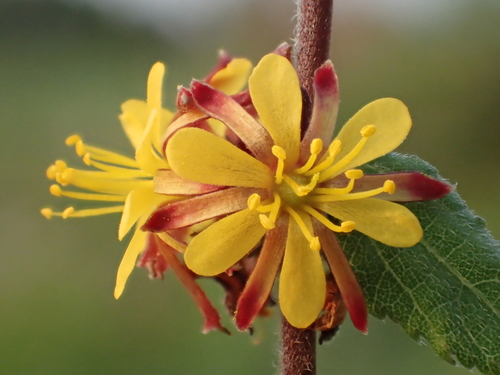
no rights reserved, uploaded by 葉子

(c) ONG SOS Biodiversity, some rights reserved (CC BY), uploaded by ONG SOS Biodiversity
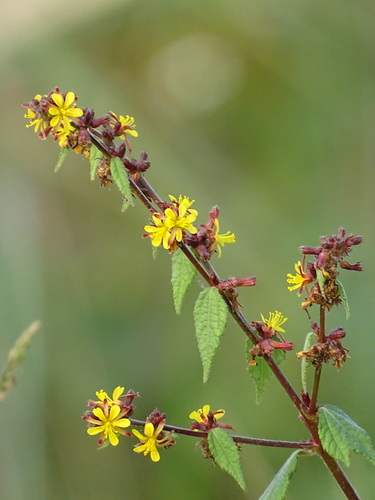
no rights reserved, uploaded by 葉子
What to Eat
Edible parts: Leaves, Roots, Stem, Vegetable
Leaves - occasionally eaten in soups. Used as a famine food. Around Livingstone (Zambia) it was used and was considered to be very palatable because its tomato-like taste. The stem and green bark are a source of mucilage used for making slimy soups and sauces. The mucilage is often used as baby food and for young children not yet able to eat coarse starchy foods. Because of its high energy value, the soup is often the first dish given to women who have delivered a child. It is also used as appetizer. The mucilage is extracted by softening the bark in hot water, followed by kneading it in a small amount of clean water. During kneading, the mucilage is released into the water, which is then added to stews to make them sticky. Bark peeled from the stem can be stored for later use.
Where to Find It
A tropical plant. It grows naturally in grassland and re-growth situations. It is more common in tropical places with seasonal rainfall. It grows in savannah woodland and in palm groves. It grows between 5-1,280 m above sea level. In Ethiopia it grows between 400-2,750 m above sea level. It can grow in arid places. In Yunnan.
Africa, American Samoa, Angola, Asia, Australia, Belize, Botswana, Brazil, Burkina Faso, Burundi, Cameroon, Central Africa, Central African Republic, CAR, Central America, China, Comoros, Congo, Côte d'Ivoire, Cuba*, Dominican Republic, East Africa, Equatorial Guinea, Eswatini, Ethiopia, Fiji, Gabon, Ghana, Guinea, Guinée, Guinea-Bissau, Guyana, Haiti, Hawaii, India, Indochina, Indonesia, Ivory Coast, Jamaica, Kenya, Laos, Lesser Antilles, Madagascar, Malawi, Malaysia, Marquesas, Mauritius, Middle East, Mozambique, Myanmar, Namibia, New Caledonia, Nigeria, Norfolk Island, Pacific, Pakistan, Papua New Guinea, PNG, Philippines, Reunion, Rotuma, Rwanda, Samoa, Sao Tome and Principe, SE Asia, Senegal, Seychelles, Sierra Leone, Solomon Islands, South Africa, South America, Southern Africa, South Sudan, Sri Lanka, St Helena, Sudan, Swaziland, Taiwan, Tanzania, Thailand, Tonga, Trinidad-Tobago, Uganda, USA, Vanuatu, Venezuela, Vietnam, West Africa, West Indies*, Yemen, Zambia, Zimbabwe,
How to Identify
A herb or small shrub. It keeps growing from year to year. Plants can be 1.5 m high. The bark is tough and fibrous. The younger stems and leaves and flowers are covered densely with hairs. The leaves are alternate and the edges of the leaves have teeth. The lower leaves have 3 lobes. The flowers occur in small clusters opposite the axils of leaves. The stalks carrying the flowers are 20-40 cm long. There are 5 yellow petals. The fruit are brown and hairy and covered with hooked spines. The fruit are round and about 5 mm across. They contain 2-4 seeds. The fruit cling to clothing.
Nutrition Score: 43/100
| Part | Moisture | kJ | kcal | Protein | Vit A | Vit C | Iron | Zinc |
|---|---|---|---|---|---|---|---|---|
| Leaves | 78.4 | 284 | 68 | 4.2 | — | — | 29.2 | — |
How to Grow
The plant produces seed capsules covered in hooked spines that adhere strongly to animal fur, clothing etc, and are thus easily transported to new sites. The plant has spread widely through the tropics and has become a noxious weed in many areas, where it invades pastures and disturbed areas in forests. It has been shown to prevent the establishment of native species in disturbed forest sites. Stems for mucilage are harvested by cutting them just above ground level when they are 75 - 100 cm long. They are prepared by removing all leaves and the terminal part where the stem has a diameter of less than 1cm. The resulting sticks are either taken to the homestead or tied into bundles and brought to the market.
Propagation: Seed - When cultivated for the mucilage in the stems, cuttings of 15 - 20cm long are taken from the top end of the harvested stems. Since the crop does not perform well under direct sunlight, the cuttings are usually planted in the shade of a tree. They are planted in a circle with a spacing of 10 - 15cm. If the cutting is not planted straight upward, adventitious roots may develop, causing a reduced capacity to produce slime. Therefore, some farmers tie the cuttings to a taller plant, e.g. plantain, to ensure that they grow upright.
Medicinal Uses
A decoction of the root is used as a remedy for internal ulcerations. The leaves are antihypertensive, astringent, diuretic, mucilaginous and emollient. A decoction of the plant in rice water, or of the root and bark, is used to treat diarrhoea, dysentery, internal haemorrhages and gonorrhoea. The leaves and flowers are used as a treatment against leprosy. Patients with severe colds are treated by giving them a daily sauna with the boiling leaves. The fruit and pounded roots are believed to promote childbirth. The crushed flowers may be applied as a poultice on boils.
Other Uses
A soft, glossy fibre is obtained from the bark. The fibre is rather similar to Jute (Corchorus spp).
Wikipedia
Source ↗Triumfetta rhomboidea, commonly known as diamond burbark, Chinese bur, or kulutkulutan in Tagalog, is a shrub that is extensively naturalised in tropical regions. It is thought that to have come to Australia from China. Its bark—sometimes called burbark—makes a kind of jute. The taxon was first formally described in 1760 by botanist Nikolaus von Jacquin.
Other Information
Famine food
Notes
There are about 150 Triumfetta species. They are mostly in the tropics and subtropics. It has also been put in the family Sparmanniaceae. It may eventually be put in the family Malvaceae. These have also been in the family Tiliaceae.
Names & Synonyms
Adik, Agra, Banokra, Barrule, Bhora, Bojoramuli, Burbush, Champadang, Chikti, Chirusitorika, Chitenso, Churukuny, Dzunzo, Jhinjharita, Jhinjhira, Jhipato, Jotojuti, Kadubende, Kasni, Katsine-galay, Klitsbossia, Mautofu, Mulembu, Ottupullu, Pulut-pulut, Pungpurutan, Puramutti, Seng, Sukupan, Tiam, Tsembanhe, Weeo, Wiyo
References (37)
- Abbiw, D.K., 1990, Useful Plants of Ghana. West African uses of wild and cultivated plants. Intermediate Technology Publications and the Royal Botanic Gardens, Kew. p 42
- Ambasta, S.P. (Ed.), 2000, The Useful Plants of India. CSIR India. p 655
- Awas, T., 1997, A Study on the Ecology and Ethnobotany of Non-cultivated Food Plants and Wild Relatives of Cultivated crops in Gambella Region, Southwestern Ethiopia. Addis Ababa University. p 72
- Borrell, O.W., 1989, An Annotated Checklist of the Flora of Kairiru Island, New Guinea. Marcellin College, Victoria Australia. p 141
- Burkill, I.H., 1966, A Dictionary of the Economic Products of the Malay Peninsula. Ministry of Agriculture and Cooperatives, Kuala Lumpur, Malaysia. Vol 2 (I-Z) p 2228 (As Triumfetta bartramia)
- Busson, 1965,
- Dalziel, J. M., 1937, The Useful plants of west tropical Africa. Crown Agents for the Colonies London.
- Enum. syst. pl. 22. 1760 (Select. stirp. amer. hist. 147, t. 90. 1763)
- Exell, A.W. et al, (Ed), 1963, Flora Zambesiaca Vol 2 Part 1 Crown Agents, London. p 73
- FAO Corporate Document Repository. The Major Significance of 'Minor' Forest Products. Appendix 3
- Flora of Australia Volume 49, Oceanic Islands 1, Australian Government Publishing Service, Canberra. (1994) p 107
- Flora of Pakistan. www.eFloras.org
- Grubben, G. J. H. and Denton, O. A. (eds), 2004, Plant Resources of Tropical Africa 2. Vegetables. PROTA, Wageningen, Netherlands. p 536
- Henty, E.E., & Pritchard, G.S., 1973, Weeds of New Guinea and their control. Botany Bulletin No 7, Division of Botany, Lae, PNG. p 154 (Drawing)
- Jackes, B.R., 2001, Plants of the Tropics. Rainforest to Heath. An Identification Guide. James Cook University. p 85
- Jardin, C., 1970, List of Foods Used In Africa, FAO Nutrition Information Document Series No 2.p 108
- Lazarides, M. & Hince, B., 1993, Handbook of Economic Plants of Australia, CSIRO. p 242
- Long, C., 2005, Swaziland's Flora - siSwati names and Uses http://www.sntc.org.sz/flora/
- Lulekal, E., et al, 2011, Wild edible plants in Ethiopia: a review on their potential to combat food insecurity. Afrika Focus - Vol. 24, No 2. pp 71-121
- Magwede, K., van Wyk, B.-E., & van Wyk, A. E., 2019, An inventory of Vhavenḓa useful plants. South African Journal of Botany 122 (2019) 57–89
- Martin, F.W. & Ruberte, R.M., 1979, Edible Leaves of the Tropics. Antillian College Press, Mayaguez, Puerto Rico. p 221
- Martin, F.W. & Ruberte, R.M., 1979, Edible Leaves of the Tropics. Antillian College Press, Mayaguez, Puerto Rico. p 221 (As Triumfetta bartramia)
- Peekel, P.G., 1984, (Translation E.E.Henty), Flora of the Bismarck Archipelago for Naturalists, Division of Botany, Lae, PNG. p 355, 354
- Peters, C. R., O'Brien, E. M., and Drummond, R.B., 1992, Edible Wild plants of Sub-saharan Africa. Kew. p 194
- Plants of Haiti Smithsonian Institute http://botany.si.edu/antilles/West Indies
- Royal Botanic Gardens, Kew (1999). Survey of Economic Plants for Arid and Semi-Arid Lands (SEPASAL) database. Published on the Internet; http://www.rbgkew.org.uk/ceb/sepasal/internet [Accessed 11th June 2011]
- Ruiters-Welcome, A. K., 2019, Food plants of southern Africa. Ph.D. thesis. Univ. of Johannesburg p 77
- Singh, H.B., Arora R.K.,1978, Wild edible Plants of India. Indian Council of Agricultural Research, New Delhi. p 40
- Smith, A.C., 1981, Flora Vitiensis Nova, Lawaii, Kuai, Hawaii, Volume 2 p 378
- Swaziland's Flora Database http://www.sntc.org.sz/flora
- Termote, C., et al, 2014, Assessing the potential of wild foods to reduce the cost of a nutritionally adequate diet: An example from eastern Baringo District, Kenya. Food and Nutrition Bulletin, vol. 35, no. 4
- von Katja Rembold, 2011, Conservation status of the vascular plants in East African rain forests. Dissertation Universitat Koblenz-Landau p 185
- Welcome, A. K. & Van Wyk, B.-E., 2019, An inventory and analysis of the food plants of southern Africa. South African Journal of Botany 122 (2019) 136–179
- Wheeler, J.R.(ed.), 1992, Flora of the Kimberley Region. CALM, Western Australian Herbarium, p 174
- Wild, 1975,
- Williamson, J., 2005, Useful Plants of Malawi. 3rd. Edition. Mdadzi Book Trust. p 251
- World Checklist of Useful Plant Species 2020. Royal Botanic Gardens, Kew