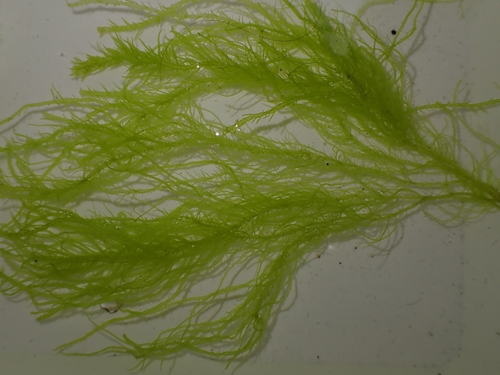
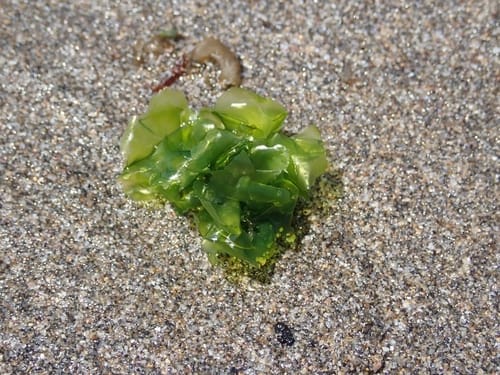
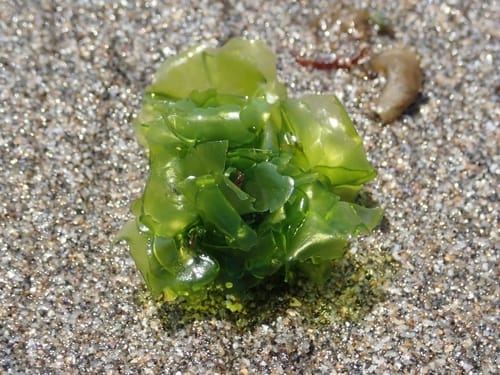
Ulva conglobata
Kjellman
Green algae

iNaturalist · pd
Frans Reinhold Kjellman (1846–1907), no known copyright restrictions (public domain)
Frans Reinhold Kjellman (1846–1907), no known copyright restrictions (public domain)
iNaturalist · cc-by-nc
(c) yah_japan, some rights reserved (CC BY-NC)
(c) yah_japan, some rights reserved (CC BY-NC)
iNaturalist · cc-by-nc
(c) yah_japan, some rights reserved (CC BY-NC)
(c) yah_japan, some rights reserved (CC BY-NC)
What to Eat
Edible parts: Fronds - tea, Seaweed, Algae
The fronds are eaten as tea or used as seaweed/algae.
Where to Find It
It is a tropical plant.
Asia, China, India, Indochina, Japan, Korea, Malaysia, SE Asia, Taiwan, Vietnam,
Countries: United Arab Emirates, Afghanistan, Armenia, Azerbaijan, Bangladesh, Bahrain, Brunei, Bhutan, China, Georgia, Indonesia, Israel, India, Iraq, Iran, Jordan, Japan, Kyrgyzstan, Cambodia, North Korea, South Korea, Kuwait, Kazakhstan, Laos, Lebanon, Sri Lanka, Myanmar, Mongolia, Maldives, Malaysia, Nepal, Oman, Philippines, Pakistan, Qatar, Saudi Arabia, Singapore, Syria, Thailand, Tajikistan, Timor-Leste, Turkmenistan, Turkey, Taiwan, Uzbekistan, Vietnam, Yemen
How to Identify
A tropical seaweed in the family Ulvaceae.
Medicinal Uses
Its methanol extract is used to treat Alzheimer's disease while its ethanol have polysaccharides which contains 23.04-35.20% of sulfate ester with 10.82-14.91% of uronic acid, and 3.82-451% of protein. It also produces crude enzyme when its mixed with linoleic acid which is widely used to fight influenza.
Wikipedia
Source ↗Ulva conglobata is a species of seaweed in the family Ulvaceae that can be found on Jeju Island of Korea, Qingdao province of China and Yokohama, Japan.
References (3)
- Kiple, K.F. & Ornelas, K.C., (eds), 2000, The Cambridge World History of Food. CUP p 235
- Wang, Wei-Lung and Chiang, Young-Meng, 1994, Potential Economic Seaweeds of Hengchun Peninsula, Taiwan, Economic Botany, Vol. 48, No. 2, pp. 182-189
- Xia, B., and Abbott, I. A., 1987, Edible seaweeds of China and their place in the Chinese diet. Economic Botany 41:341-53