Ulva lactuca
L.
Sea Lettuce, Green algae, Green laver, Green nori

(c) artzerphotog, some rights reserved (CC BY-NC)

(c) Misha Zitser, some rights reserved (CC BY-NC)

(c) Kristian Peters, some rights reserved (CC BY-NC-SA)
What to Eat
Edible parts: Seaweed, Frond, Algae
In Scotland, U. lactuca is used in soups and salads. In Hawaiʻi, U. lactuca is also called limu pālahala and eaten in different ways: mixed with other algae, salted and served with raw fish, boiled in water and served as a soup, or served with chili pepper, onions, soy sauce and sugar. Additionally, U. lactuca has traditional uses in Hawaiʻi as fertilizer and as adornment for hula. When U. lactuca is used for hula it is called limu pāpahapaha. As an alternative to vegetable oil crops, U. lactuca can be a source of biofuels, suitable for transesterification in biodiesel production, and does not require arable land and fertilizers. It can grow in saline and waste water and has a higher ability in sequestering atmospheric carbon dioxide than terrestrial energy crops.
Where to Find It
It grows in tropical and temperate places. They are gathered from rocks along the seacoast. It grows in rock pools and muddy beaches and enters estuaries. It grows well in areas with reduced salinity and thrives where there is not pollution.
Africa, Algeria, Andaman Islands, Angola, Asia, Australia, Azores, Barbados, Belize, Bermuda, Brazil, Britain, Canada, Canary Islands, Cape Verde, Caribbean, Central Africa, Central America, Chile, China, Colombia, Costa Rica, Côte d'Ivoire, Denmark, East Africa, Egypt, Equatorial Guinea, Europe, Faroe Islands, France, French Polynesia, Ghana, Greece, Guinea, Guinée, Hawaii, Hispaniola, Iceland, India, Indochina, Indonesia, Iran, Ireland, Israel, Italy, Ivory Coast, Jamaica, Japan, Kenya, Korea, Lesser Antilles, Liberia, Libya, Madagascar, Martinique, Mauritania, Mauritius, Mediterranean, Mexico, Middle East, Morocco, New Zealand, North Africa, North America, Norway, Pacific, Pakistan, Papua New Guinea, PNG, Peru, Philippines, Puerto Rico, Reunion, Samoa, Sao Tome and Principe, Scandinavia, SE Asia, Senegal, Seychelles, Singapore, Somalia, South Africa, South America, Sri Lanka, Taiwan, Tanzania, Thailand, Trinidad & Tobago, Tunisia, Turkey, Türkiye, Uruguay, USA, Venezuela, Vietnam, Virgin Islands, West Africa, West Indies, Western Sahara, Worldwide,
How to Identify
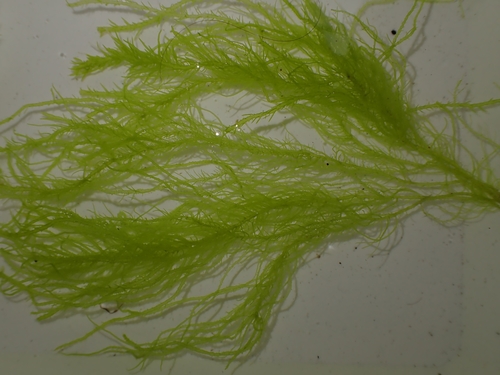
A seaweed. It is bright green. The blades are leaf like. The fronds are broad and ribbon like.
Nutrition Score: 65/100
| Part | Moisture | kJ | kcal | Protein | Vit A | Vit C | Iron | Zinc |
|---|---|---|---|---|---|---|---|---|
| Frond | 16.9 | 544 | 130 | 22.1 | — | 10 | 5.3 | 1.2 |
Wikipedia
Source ↗Ulva lactuca, also known by the common name sea lettuce, is an edible green alga in the family Ulvaceae. It is the type species of the genus Ulva. A synonym is U. fenestrata, referring to its "windowed" or "holed" appearance.
Notes
The species in Australia may be Ulva australis.
Names & Synonyms
Hai ts'ai, Havsalat, Luche verde, Sea grass, Sosa
References (40)
- Ambasta, S.P. (Ed.), 2000, The Useful Plants of India. CSIR India. p 660 (Also as Ulva fasciata)
- Bonney, N., 2012, Edible Wild Native Plants for Southern Australia. p 96
- Brooker, 1986,
- Brooker, S.G., Combie, R.C., and Cooper, R.C., 1989, Economic Native Plants of New Zealand. Economic Botany 43:79-106
- Burkill, H. M., 1985, The useful plants of west tropical Africa, Vol. 5. Kew.
- Cherry, P., et al, 2019, Risks and benefits of consuming edible seaweeds. Nutrition ReviewsVR Vol. 77(5):307–329
- Crowe, A., 1997, A Field Guide to the Native Edible Plants of New Zealand. Penguin. p 152
- Cribb, A.B. & J.W., 1976, Wild Food in Australia, Fontana. p 196
- Cribb, A.B., 1996, Seaweeds of Queensland A Naturalist's Guide. The Queensland Naturalists' Club Handbook No. 2. p 35
- Facciola, S., 1998, Cornucopia 2: a Source Book of Edible Plants. Kampong Publications, p 261 (Also as Ulva fasciata)
- Food Composition Tables for use in East Asia FAO http://www.fao.org/infoods/directory No. 726
- Girard, N. J., 2020, Sustainable Foraging of Wild Edible Plants in Norway. A Biocultural Approach. M. Sc. thesis Norwegian University. p 135
- Goodrich, J., Lawson, C., and Lawson, V.P., 1980, Kasharya pomo plants. Los Angeles.
- Gunther, E., 1945, Ethnobotany of western Washington. Seattle.
- http://www.seavegetables.com
- Hu, Shiu-ying, 2005, Food Plants of China. The Chinese University Press. p 258
- Irving, M., 2009, The Forager Handbook, A Guide to the Edible Plants of Britain. Ebury Press p 368
- Kiple, K.F. & Ornelas, K.C., (eds), 2000, The Cambridge World History of Food. CUP p 232, 1850, p 232, 235 (As Ulva fasciata)
- Lee, B., 2008, Seaweed Potential as a marine vegetable. RIRDC Publication No. 08/009
- Low, T., 1992, Bush Tucker. Australia’s Wild Food Harvest. Angus & Robertson. p 161
- Ohni, H., 1968, Edible seaweeds in Chile. Japanese Society of Physiology Bulletin 16:52-4
- Mabey, R., 1973, Food for Free. A Guide to the edible wild plants of Britain, Collins. p 118
- Marsham, S., et al, 2007, Comparison of nutritive chemistry of a range of temperate seaweeds. Food Chemistry 100: 1331-1336
- Masuda, S., 1981, Cochayuyo. Macha camaron y higos chargueados. In Estudios etnograficos del Peru meridional ed S Masuda 173-92. Tokyo.
- Masuda, S., 1981, Cochayuyo. Macha camaron y higos chargueados. In Estudios etnograficos del Peru meridional ed S Masuda 173-92. Tokyo. (As Ulva fasciata)
- Michael, P., 2007, Edible Wild Plants and Herbs. Grub Street. London. p 208
- Pereira, L., 2011, A Review of the Nutrient Composition of Selected Edible Seaweeds. In Seaweed. Pomin V. H., (Ed.) Nova Science Publishers, Inc
- Schonfeld-Leber, B., 1979, Marine algae as human food in Hawaii, with notes on other Polynesian islands. Ecology of Food and Nutrition 8:47-59 (As Ulva fasciata)
- Surey-Gent, S. & Morris G., 1987, Seaweed. A User's Guide. Whirret Books. London. p 26, 122.
- Svanberg, I., et al, 2012, Edible wild plant use in the Faroe Islands and Iceland. Acta Societatis Botanicorum Poloniae 81(4): 233-238
- Tseng, C.K., 1933, Gloiopeltis and other economic seaweeds of Amoy, China. Lingnan Science Journal 12:43-63.
- Turner, 1974,
- Uphof, (As Ulva fasciata)
- Van Ginneken, V. JT., et al, 2011, Polyunsaturated fatty acids in various macroalgal species from north Atlantic and tropical seas. Lipids in Health and Disease 10:104
- Velasquez, G.T., 1972, Studies and utilization of the Philippine marine algae. In Proceedings of the Seventh International Seaweed Symposium, ed. K Nisizawa, 62-5. New York.
- Wang, Wei-Lung and Chiang, Young-Meng, 1994, Potential Economic Seaweeds of Hengchun Peninsula, Taiwan, Economic Botany, Vol. 48, No. 2, pp. 182-189 (Also as Ulva fasciata)
- Xia, B., and Abbott, I.A., 1987, Edible seaweeds of China and their place in the Chinese diet. Economic Botany 41:341-53 (Also as Ulva fasciata)
- Yangthong, M. et al, 2009, Antioxidant Activities of Four Edible Seaweeds from the Southern Coast of Thailand. Plant Foods for Human Nutrition 64:218-223
- Zaneveld, J.S., 1955, Economic marine algae of tropical South and East Asia and their utilization. Indo-Pacific Special Publications, No 3 Bangkok.
- Zemke-White, W. L. & Ohno, M., 1999, World seaweed utilisation: An end-of-century summary. Journal of Applied Phycology 11: 369-376