Bactris maraja
Mart.
Maraja
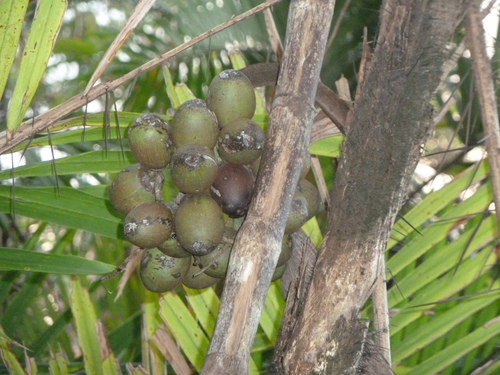
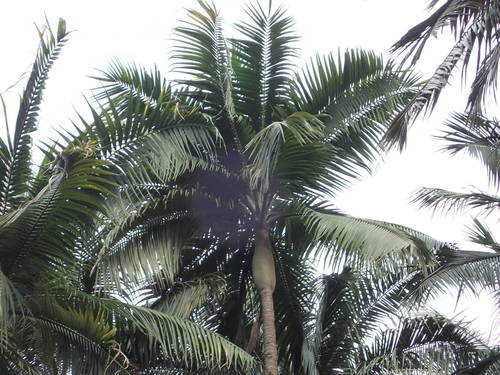
(c) Eduardo Chacón Madrigal, some rights reserved (CC BY), uploaded by Eduardo Chacón Madrigal
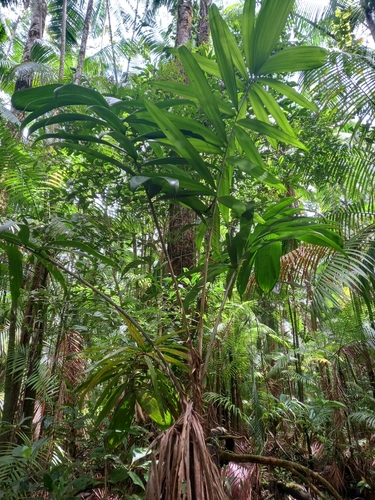
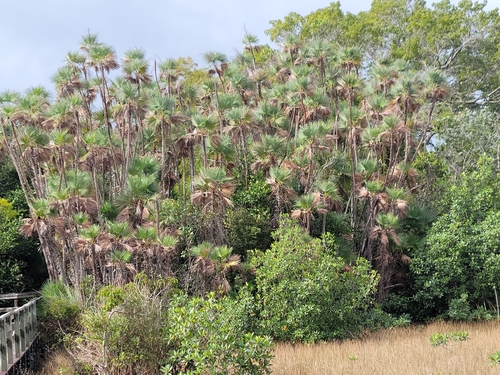
(c) Robin Heymans, some rights reserved (CC BY-NC), uploaded by Robin Heymans
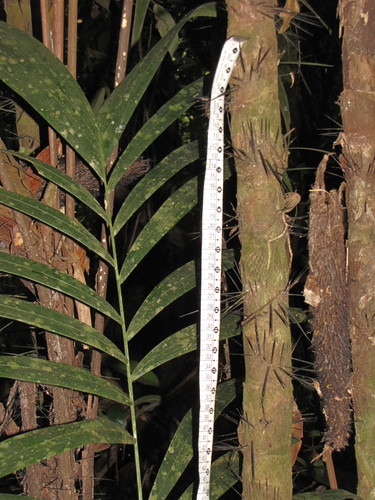
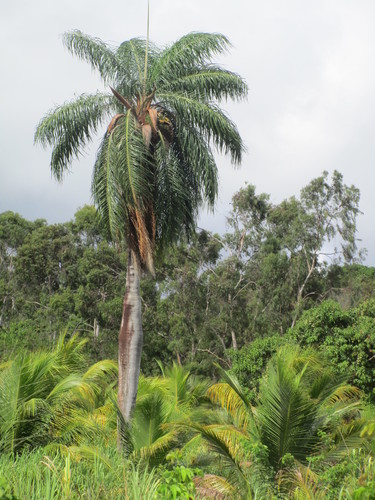
(c) Marcus Athaydes, some rights reserved (CC BY-NC), uploaded by Marcus Athaydes
What to Eat
Edible parts: Fruit, Palm hearts, Cabbage, Seeds
The acidic fruits are commonly eaten fresh and used to make wine. Palm hearts, cabbage, and seeds are also edible portions and are sold in local markets.
Where to Find It
A tropical plant. It grows in forest usually on non flooded soils. It grows at low elevations but can be up to 1000 m altitude.
Amazon, Bolivia*, Brazil*, Central America, Colombia*, Costa Rica, Ecuador, Guiana, Guianas, Guyana, Panama, Peru*, South America, Suriname, Venezuela*, West Indies,
How to Identify
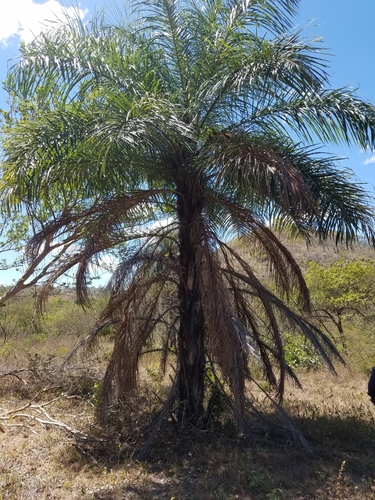
A clump forming palm. It has an underground creeping rhizome. The trunks are 4-8 m high and 3-5 cm across. They are covered with dense rings of flattened black spines. Each crown has several leaves. These are 1.5-3 m long. The leaflets point forward and droop. They are shiny and mid green. The midrib is spiny. There are black prickles along the edges of the leaflets. The flowering stalks are 30-50 cm long. The flowers are yellowish. The fruit are rounded and purple-black. They are about 1.5 cm across. The fruit are acid.
How to Grow
Plants are grown from seed.
Propagation: Seed - pre-soak for 24 hours in warm water and sow in containers. Germination takes 2 months or more. The seed has a limited viability and needs to be sown as fresh as possible. Division.
Other Uses
A useful fibre is obtained from the leaves. The trunk of this palm is used locally by the Indian inhabitants for the terminal portion of the arrow.
Other Information
The fruit are commonly eaten. It is sold in local markets.
Notes
There are 239 Bactris species. There are 75 species in tropical America. Most Bactris have fruit that are edible but many are not attractive.
Names & Synonyms
Alar, Bi ni, Chacarra, Chambira neja, Chirqui, Chontilla, Chontilla conguillo, Dageypemoe, Emetogahue, Espina, Kiskismaka, Lata sabanera, Maraja-assu, Mogor, Muraya kamancha, Nanaguemo, Nieja, Niejilla, Palmeirinha, Piritu, Tana, Tucum-bravo, Uva del Montana, Uvita
References (26)
- Balick, M.J. and Beck, H.T., (Ed.), 1990, Useful palms of the World. A Synoptic Bibliography. Colombia p 120, 161, 594,
- Bircher, A. G. & Bircher, W. H., 2000, Encyclopedia of Fruit Trees and Edible Flowering Plants in Egypt and the Subtropics. AUC Press. p 52
- Blomberry, A. & Rodd, T., 1982, Palms. An informative practical guide. Angus & Robertson. p 61
- Etkin, N.L. (Ed.), 1994, Eating on the Wild Side, Univ. of Arizona. p 136
- Facciola, S., 1998, Cornucopia 2: a Source Book of Edible Plants. Kampong Publications, p 27
- Gilmore, M. P., et al, 2013, The socio-cultural importance of Mauritia flexuosa palm swamps (aguajales) and implications for multi-use management in two Maijuna communities of the Peruvian Amazon. Journal of Ethnobiology and Ethnomedicine 2013, 9:29
- Grandtner, M. M., 2008, World Dictionary of Trees. Wood and Forest Science Department. Laval University, Quebec, Qc Canada. (Internet database http://www.WDT.QC.ca)
- Grandtner, M. M. & Chevrette, J., 2013, Dictionary of Trees, Volume 2: South America: Nomenclature, Taxonomy and Ecology. Academic Press p 57
- Haynes, J., & McLaughlin, J., 2000, Edible palms and Their Uses. University of Florida Fact sheet MCDE-00-50-1 p 3
- Hedrick, U.P., 1919, (Ed.), Sturtevant's edible plants of the world. p 90
- Henderson, A., Galeano, G and Bernal, R., 1995, Field Guide to the Palms of the Americas. Princeton. p 193
- Hist. nat. palm. 2:93, t. 71, fig. 1. 1826
- Janick, J. & Paul, R. E. (Eds.), 2008, The Encyclopedia of Fruit & Nuts. CABI p 103
- Johnson, D.V., 1998, Tropical palms. Non-wood Forest products 10. FAO Rome. p 20, 91
- Jones, D.L., 1994, Palms throughout the World. Smithtonian Institution, Washington. p 52, 55
- Lopez-Diago, D. & Garcia, N., 2021, Wild edible fruits of Colombia. Biota ColomBiana 22 (2) p 31
- Lorenzi, H., Bacher, L., Lacerda, M. & Sartori, S., 2006, Brazilian Fruits & Cultivated Exotics. Sao Paulo, Instituto Plantarum de Estuados da Flora Ltda. p 70
- Marcia, M. J., et al, 2011, Palm Uses in Northwestern South America: A Quantitative Review. Bot. Rev. (2011) 77:462-570
- NYBG Herbarium "edible" (As Bactris maraja var. trichospatha)
- Paz, F. S., et al, 2021, Edible Fruit Plant Species in the Amazon Forest Rely Mostly on Bees and Beetles as Pollinators. Journal of Economic Entomology, XX(XX), 2021, 1–13
- Roa, J. A. G. & Boada, D. S. G., 2018, Fundación para el Fortalecimiento de la Fruticultura y Plantas Alimenticias no Convencionales en Colombia.
- Smith, N., et al, 2007, Amazon River Fruits. Flavors for Conservation. Missouri Botanical Gardens Press. p 62
- Torre, de la L., et al, 2008, Enciclopedia de las Plantas Útiles del Ecuador. Herbario QCA. Pontificia Universidad Católica del Ecuador. p 197
- van Roosmalen, M.G.M., 1985, Fruits of the Guianan Flora. Utrecht Univ. & Wageningen Univ. p 346
- Vasquez, R. and Gentry, A. H., 1989, Use and Misuse of Forest-harvested Fruits in the Iquitos Area. Conservation Biology 3(4): 350f
- World Checklist of Useful Plant Species 2020. Royal Botanic Gardens, Kew