Loxococcus rupicola
(Thwaites) H. Wendl. & Drude
Dotalu
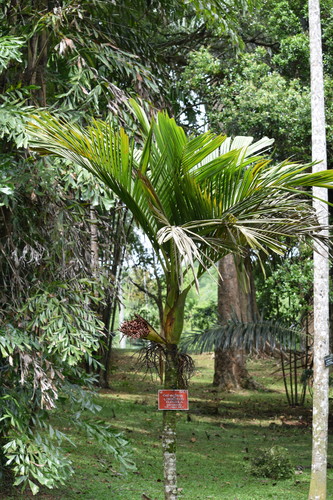
(c) Nick Belliveau, some rights reserved (CC BY-NC), uploaded by Nick Belliveau

Wikimedia Commons - AntanO
What to Eat
Edible parts: Palm heart, Fruit, Cabbage
The palm heart is edible, the fruit is eaten, and it is harvested for cabbage. The nut is chewed as a substitute for betel nut.
Known Hazards
Where to Find It
A tropical plant. It grows in mountainous rainforest between 330 and 1660 m altitude. It needs a moist acid soil. The soil needs to be well drained.
Asia, Sri Lanka,
How to Identify
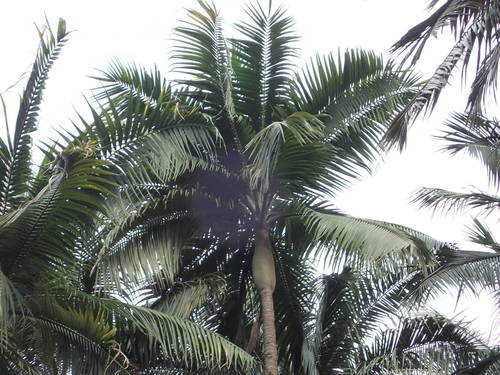
A solitary palm. The leaves have leaflets along the stalk. The trunk is slender and grey. It grows 7 m high. It has distinct rings on younger parts. The crown-shaft is 65 cm long. It is deep green and smooth. The leaf crown forms a half circle. There are 10 or less leaves. The leaves are 3.1 m long. They arch over. The leaflets are widely spaced, narrow and deep green. The leaflets are 60 cm long. Young leaves form a V shape. The flowering stalk grows beneath the crown-shaft. It is short and stiff with spreading branches with both male and female flowers. The fruit are 2.5 cm across. They are egg shaped. They are reddish-brown when mature.
How to Grow
Loxococcus rupicola is a native of the humid tropics, growing in a region of Sri Lanka that experiences rain almost every nght. Plants appear to like growing in constantly wet soils that are also well drained - the more friable and loamy the sand the better! It might not like waterlogged soils! It can grow at low elevations but demands shade and humid conditions to keep healthy.
Production
It is slow growing.
Notes
There is only one Loxococcus species. It is an endangered species.
References (6)
- Balick, M.J. and Beck, H.T., (Ed.), 1990, Useful palms of the World. A Synoptic Bibliography. Colombia p 301
- Haynes, J., & McLaughlin, J., 2000, Edible palms and Their Uses. University of Florida Fact sheet MCDE-00-50-1 p 10
- Johnson, D.V., 1998, Tropical palms. Non-wood Forest products 10. FAO Rome. p 40
- Jones, D.L., 1994, Palms throughout the World. Smithtonian Institution, Washington. p 56
- Linnaea 39:185. 1875 (ex Hook. f., Bot. Mag. 104: t. 6358. 1878)
- Riffle, R.L. & Craft, P., 2003, An Encyclopedia of Cultivated Palms. Timber Press. p 382