Phoenix acaulis
Buch.-Ham ex Roxb.
Stemless Date palm

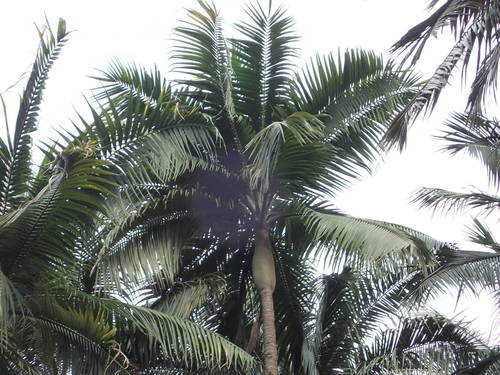
(c) Zein et Carlo, some rights reserved (CC BY-NC), uploaded by Zein et Carlo

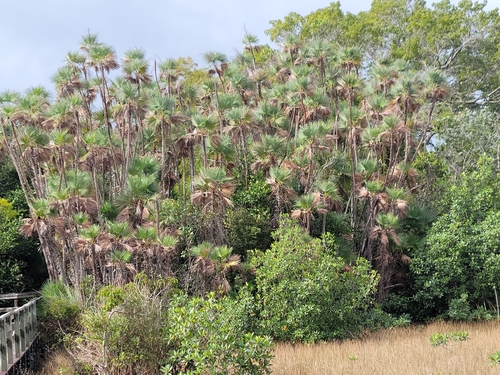
(c) Zein et Carlo, some rights reserved (CC BY-NC), uploaded by Zein et Carlo
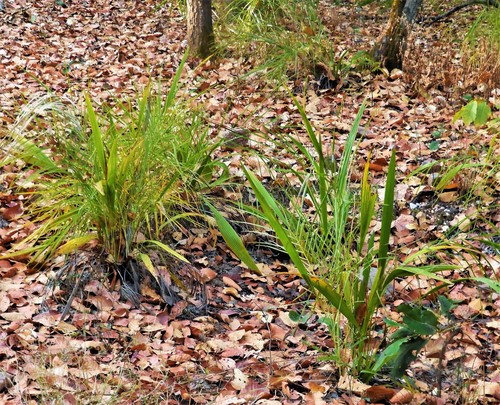
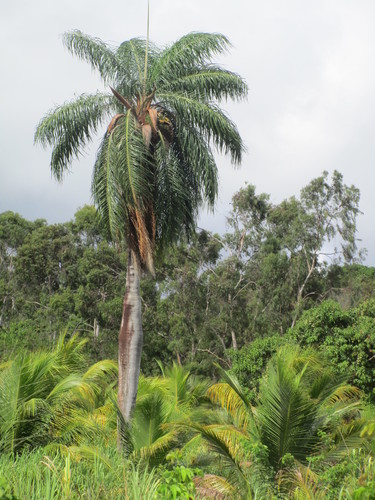
(c) c michael hogan, some rights reserved (CC BY-NC-SA), uploaded by c michael hogan
What to Eat
Edible parts: Fruit, Palm heart, Starch, Roots
The bright red, oval fruit with sweet edible flesh are eaten fresh or used to make curry. The tender fruit stalks, palm heart, and peeled underground leaf stalks (rootstock) are cooked and eaten. An edible starch can also be extracted from the stem.
Known Hazards
Where to Find It
A tropical plant. It grows in tropical and subtropical places. It usually grows on poor stony soils. It grows between 400-1600 m altitude. In Townsville palmetum.
Asia, Australia, Bangladesh, Bhutan, Himalayas, India, Indochina, Laos, Myanmar, Nepal, Northeastern India, NW India, SE Asia, Sikkim, Thailand,
How to Identify
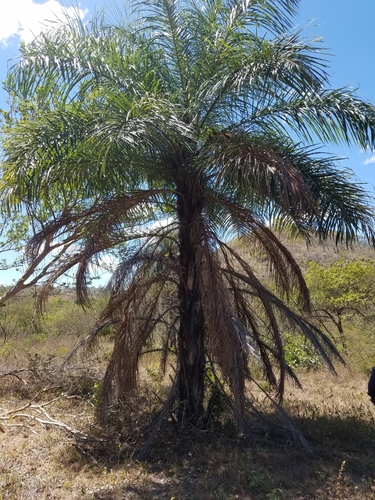
A solitary palm. It has a short swollen trunk. This is mostly underground. It is densely covered with the leaf stalk bases. The fronds arch over. They have leaflets along the stalk. The fronds are 1-2 m long. The leaflets are dark green and 30-45 cm long. They are grouped in small bundles. The flowering stalk is 30-60 cm long and often trails on the ground. The fruit are bright red and oval. They have sweet edible flesh.
How to Grow
The seed are oval and grooved. They germinate soon after planting.
Propagation: Seed - pre-soak for 24 hours prior to sowing. The seed germinates best at a temperature of 21 - 27°c. Division of offsets.
Medicinal Uses
None mentioned.
Wikipedia
Source ↗Phoenix acaulis (acaulis, Latin, trunkless) the dwarf date palm or stemless date palm, is a species of flowering plant in the palm family, native to northern India, Bhutan and Nepal. Found at altitudes from 350 to 1,500 m (1,150 to 4,920 ft), Phoenix acaulis grows in scrubland, savannas and in pine forests. Trunks in this species remain underground or, at most, grow to a few inches in height. Leaves are 11.5 m (4 ft 11 in) long, gray-green, with 25 cm (9.8 in), pinnately arranged leaflets on short, armed petioles.
Production
Seedling growth is slow. In Sikkim fruit are available March to May.
Notes
There are 13-17 Phoenix species.
Names & Synonyms
Adavi eetha, Bana khajuri, Betgera, Bhui shindi, Bhuin kojiri, Boichind, Chindi, Dagsha, Jangli khajur, Khajur, Khudi khejur, Kojiri, Metta heendi, Palo, Schap, Shevra, Shilind, Takul, Thakal, Thakul, Yita
References (37)
- Ambasta, S.P. (Ed.), 2000, The Useful Plants of India. CSIR India. p 447
- Amoros, A., et al, 2014, Physico-chemical and functional characteristics of date fruits from different Phoenix species (Arecaceae). Fruits, Vol. 69, p. 315-323
- Anderson, E. F., 1993, Plants and people of the Golden Triangle. Dioscorides Press. p 217
- Balick, M.J. and Beck, H.T., (Ed.), 1990, Useful palms of the World. A Synoptic Bibliography. Colombia p 607
- Dangol, D. R. et al, 2017, Wild Edible Plants in Nepal. Proceedings of 2nd National Workshop on CUAOGR, 2017.
- Dobriyal, M. J. R. & Dobriyal, R., 2014, Non Wood Forest Produce an Option for Ethnic Food and Nutritional Security in India. Int. J. of Usuf. Mngt. 15(1):17-37
- Gautam, R. S., et al, 2020, Wild Edible Fruits of Nepal. Int. J. Appl. Sci. Biotechnol. Vol 8(3): 289-304
- Gautam, R. S., et al, 2022, Ethnobotanical Review of Wild Edible Plants of Nepal. Journal of Natural History Museum Volume 32, 2021-22 p 105
- Ghimeray, A. K., Lamsal, K., et al, 2010, Wild edible angiospermic plants of the Illam Hills (Eastern Nepal) and their mode of use by local community. Korean J. Pl. Taxon. 40(1)
- Gibbons, M., 2003, A pocket guide to Palms. Chartwell Books. p 156
- Haynes, J., & McLaughlin, J., 2000, Edible palms and Their Uses. University of Florida Fact sheet MCDE-00-50-1 p 11
- Hedrick, U.P., 1919, (Ed.), Sturtevant's edible plants of the world. p 487
- Johnson, D.V., 1998, Tropical palms. Non-wood Forest products 10. FAO Rome. p 42, 48
- Jones, D.L., 1994, Palms throughout the World. Smithtonian Institution, Washington. p 54, 285
- Jones, D.L., 2000, Palms of Australia 3rd edition. Reed/New Holland. p 193
- Joshi, N., et al, 2007, Traditional neglected vegetables of Nepal: Their sustainable utilization for meeting human needs. Tropentag 2007. Conference on International Agricultural Research for Development.
- Kachenchart, B., et al, 2008, Phenology of Edible Plants at Sakaerat Forest. In Proceedings of the FORTROP II: Tropical Forestry Change in a Changing World. Bangkok, Thailand.
- Kala, C. P., 2009, Aboriginal uses and management of ethnobotanical species in deciduous forests of Chhattisgarh state in India. Journal of Ethnobiology and Ethnomedicine. 5:32
- Misra, R. C., et al, 2013, Genetic resources of wild tuberous food plants traditionally used in Similipal Biosphere Reserve, Odisha, India. Genetic Resources and Crop Evolution. Vol. 60 No. 2. Springer
- Misra S. & Misra M., 2016, Ethnobotanical and Nutritional Evaluation of Some Edible Fruit Plants of Southern Odisha, India. International Journal of Advances in Agricultural Science and Technology, Vol.3 Issue.1, March- 2016, pg. 1-30
- Mukhia, P.K., et al, 2013, Wild plants as Non Wood Forest Products used by the rural community of Dagana, a southern foothill district of Bhutan, SAARC Journal, 27 pages
- Pasha, M. K. & Uddin, S. B., 2019, Minor Edible Fruits of Bangladesh. Bangladesh J. Plant Taxon. 26(2): 299–313
- Pl. Coromandel 3:70, t. 273. 1820
- PROSEA handbook Volume 9 Plants yielding non-seed carbohydrates. p 178
- Ramakrishna, N. & Singh, DSR, R., 2020, Ethno-Botanical Studies of Edible Plants Used by Tribal Women in Nirmal District. IJSRSET p 308
- Rashid, A., Anand, V.K. & Serwar, J., 2008, Less Known Wild Plants Used by the Gujjar Tribe of District Rajouri, Jammu and Kashmir State. International Journal of Botany 4(2):219-244
- Reddy, K. N. et al, 2007, Traditional knowledge on wild food plants in Andhra Pradesh. Indian Journal of Traditional Knowledge. Vol. 6(1): 223-229
- Riffle, R.L. & Craft, P., 2003, An Encyclopedia of Cultivated Palms. Timber Press. p 400
- Setiya, A. V., et al, 2016, Exploration and documentation of some wild edible plants used by the aboriginals from Gadchiroli District (M.S.) India. International Advanced Research Journal in Science, Engineering and Technology. 3(7)
- Singh, H.B., Arora R.K.,1978, Wild edible Plants of India. Indian Council of Agricultural Research, New Delhi. p 68
- Singh, V. B., et al, (Ed.) Horticulture for Sustainable Income and Environmental Protection. Vol. 1 p 217
- Sundriyal, M., et al, 1998, Wild edibles and other useful plants from the Sikkim Himalaya, India. Oecologia Montana 7:43-54
- Sundriyal, M., et al, 2004, Dietary Use of Wild Plant Resources in the Sikkim Himalaya, India. Economic Botany 58(4) pp 626-638
- Thapa, L. B., et al, 2014, Wild Edible Plants used by endangered and Indigenous Raji Tribe in Western Nepal. International Journal of Applied Sciences and Biotechnology. Vol 2(3):243-252
- Upreti, K., et al, 2010, Diversity and Distribution of Wild Edible Fruit Plants of Uttarakhand. Bioversity Potentials of the Himalaya. p 179
- Uprety, Y., et al, 2016, Traditional use and management of NTFPs in Kangchenjunga Landscape: implications for conservation and livelihoods. Journal of Ethnobiology and Ethnomedicine (2016) 12:19
- www.desert-tropicals.com