Borassodendron borneense
J. Dransf.
Bindang palm

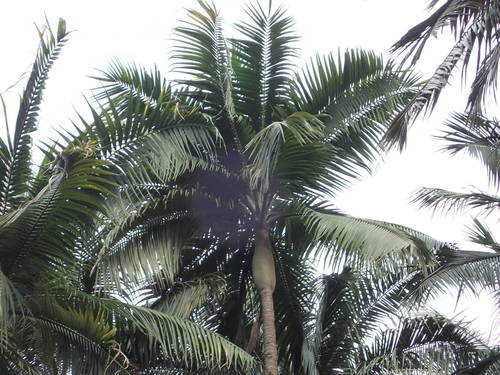
(c) Luis Mata, some rights reserved (CC BY-NC), uploaded by Luis Mata
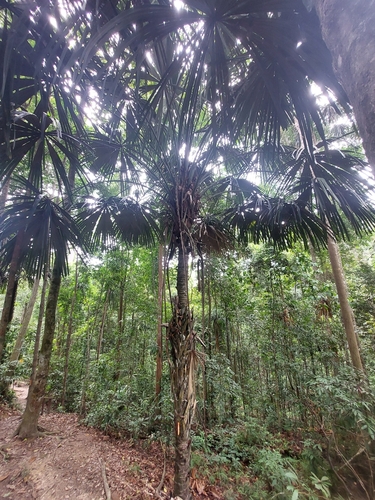
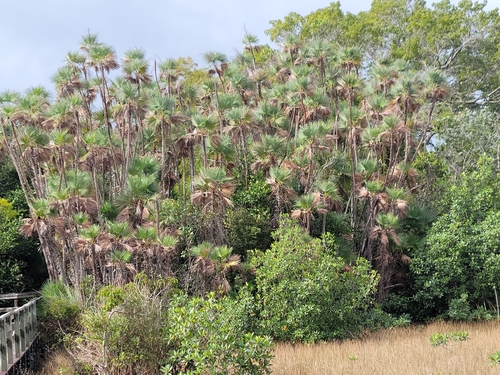
(c) Akhsan Baihaqi, some rights reserved (CC BY-NC)
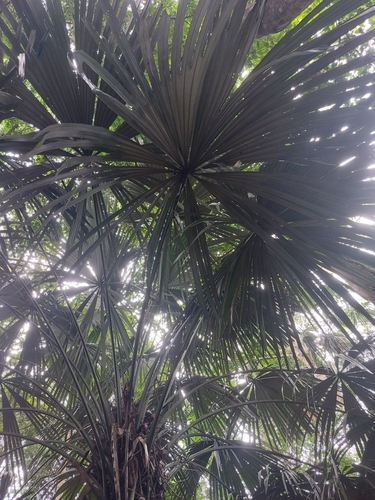
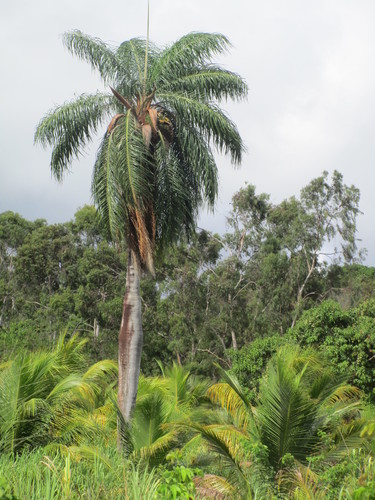
(c) Akhsan Baihaqi, some rights reserved (CC BY-NC)
What to Eat
Edible parts: Palm heart, Fruit, Cabbage
The immature fruit is edible, as is the palm heart, which has a crisp, sweet, and fragrant taste. The cabbage (inner core) is also edible.
Where to Find It
A tropical plant. It grows in lowland rainforest.
Asia, Indonesia, Malaysia, Sarawak, SE Asia,
How to Identify
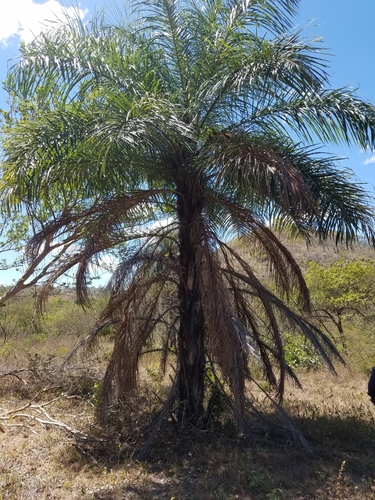
A solitary fan palm. It grows 20 m tall. The trunk is 30 cm across. The leaves spread out like fingers on a hand. The flowering stalks come from among the leaf bases. The male flower is a long thick branch which hangs down. It is branched. The female flower is unbranched. The fruit are round and glossy. They are 8 cm across. They are green to purple.
How to Grow
Plants can be grown from seeds.
Other Uses
The stems are sawn into boards and used for house construction.
Production
It is a slow growing palm.
Notes
There are 2 Borassodendron species.
Names & Synonyms
Mudor, Palem bindang
References (7)
- Balick, M.J. and Beck, H.T., (Ed.), 1990, Useful palms of the World. A Synoptic Bibliography. Colombia p 214
- Davis, S.D., Heywood, V.H., & Hamilton, A.C. (eds), 1994, Centres of plant Diversity. WWF. Vol 1 or 2. p 363
- Dransfield, J., 1972, The genus Borassodendron (Palmae) in Malesia. Reinwardtia 8(2):351-363
- Haynes, J., & McLaughlin, J., 2000, Edible palms and Their Uses. University of Florida Fact sheet MCDE-00-50-1 p 3
- Johnson, D.V., 1998, Tropical palms. Non-wood Forest products 10. FAO Rome. p 44
- Riffle, R.L. & Craft, P., 2003, An Encyclopedia of Cultivated Palms. Timber Press. p 274
- Sukarya, D. G., (Ed.) 2013, 3,500 Plant Species of the Botanic Gardens of Indonesia. LIPI p 759