Calamus viminalis
Willd.
Bitter rattan, Chair-bottom cane

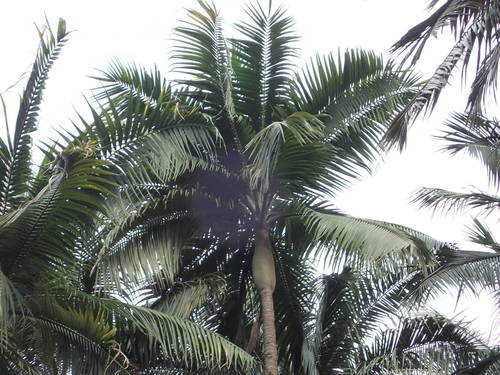
(c) mihailovujic, some rights reserved (CC BY-NC)

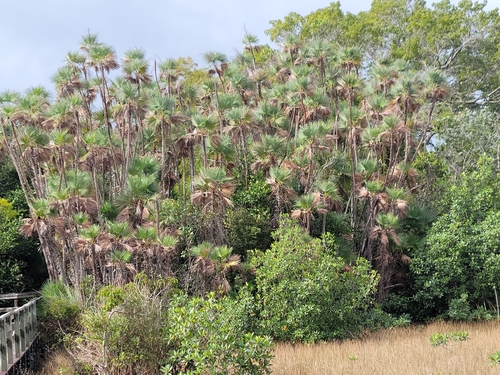
(c) mihailovujic, some rights reserved (CC BY-NC)
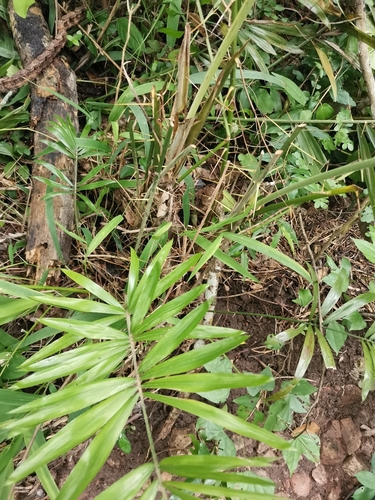
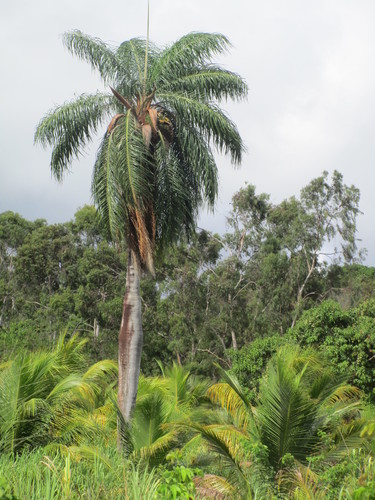
(c) Wich’yanan (Jay) Limparungpatthanakij, some rights reserved (CC BY-NC)
What to Eat
Edible parts: Fruit, Shoots, Vegetable
The shoots are cooked and used as a vegetable in curry, and the ripe fruit are eaten raw. Shoots are sold in local markets.
Where to Find It
A tropical plant. It grows in tropical and warm temperate regions. In Asia it grows from sea level to 600 m altitude. It grows in open areas and near streams. It suits hardiness zones 11-12. In Yunnan.
Andaman Is., Asia, Australia, Bangladesh, Cambodia, China, India, Indochina, Indonesia, Laos, Malaysia, Myanmar, Northeastern India, SE Asia, Thailand, Vietnam,
How to Identify
A vigorous climbing palm. It has fairly stout, prickly stems. The stems climb with the aid of flagella. The leaf sheaths are woolly white. The leaves are spreading and pale green. They are about 1 m long. They are divided into many narrow leaflets. These leaflets are grouped in small clusters along the stem. The fruit are about 1 cm across. They are yellow when ripe and round with a pointed beak.
How to Grow
Plants can be grown by seeds or suckers.
Propagation: Seed - it has a fairly short viability and is best sown as soon as it is ripe.
Other Uses
A very useful stem, it is used in basketry, furniture making, as a tying material, and for weaving into mats etc. Several stems are intertwined and used as cables for ships' anchors. The long and slender stems of Calamus species are put to various uses according to their size, length, flexibility, elasticity and toughness. The most slender canes are employed entire for binding purposes, and in making chairs, blinds, mats, wicker or basketwork, fishing implements, etc. Twisted together, they make very strong cables. The largest and more resistent canes are used entire as cables, the framework of wicker chairs etc. Usually, however, for many purposes the stems are split throughout their length into 2 - 4 or more strips from which the inner soft brittle and spongy portion is removed by means of a knife or same other instrument, so as to leave the external portion, which is hard, tough, flexible, elastic and has its outer surface very clean and smooth as if it had been varnished. Strips vary in width according to the use to which they are to be put. Those for delicate work, such as the network of furniture, small bags, hats, etc, are from 1 - 3mm wide; those employed as lashings in native housebuilding or in fastening the removable head of the Malay axe to its handle are from 5-6 mm wide. Collecting and preparing the stems is very simple. The stem is cut near the ground and detached from the trees by taking a strong hold of its base and thus pulling down the entire plant with its leaves. The most recent growth at the top of the plant is removed and then, handling it from the upper end, the stem is forcibly drawn in the opposite direction between two pieces of wood, thus removing the spiny coverings. It is then cut into lengths of about 5 metres, each piece is bent into two equal parts and the stems are fastened into bundles ready for market. The most valued stems are not thicker than a man's little finger and have a fine polished straw-yellow glassy surface.
Wikipedia
Source ↗Calamus viminalis, one of many Calamus species commonly referred to as rattan, is a plant of the Arecaceae, or palm, family native to: Java and Bali in Indonesia; Peninsular Malaysia; all parts of Thailand; Cambodia; Cochinchina and Central Annam in Vietnam; all parts of Laos; Myanmar; Bangladesh; Andaman and Nicobar Islands; North-east, North-central, and South India; and probably north-west and south Yunnan in China. The plant grows with clustered stems, either climbing on other plants or forming thickets. The stems can reach 35m with a diameter up to 4 cm. The whitish or yellowish globose fruit, up to 1 cm in diam., are sometimes borne in pairs. In Tripura state, India, the palm flowers and fruits from November to January. It grows at village margins and in scrub, forest edge and (locally) inside evergreen forest, from 0-600m elevation. In Cambodia it occurs in semi-dense forests and at the rear of mangrove formations. As the palm is favoured by forest loss and tolerates harvesting well, it is of no conservation concern. Vernacular names include: Thai, wai ngamkhao, wai namhang, wai sambai, wai mon, wai som, wai dong; Khmer phdau kraek (phdau=rattan), phdao chhvaing krek; Hmong, katengparua; Alak, rebou; Lao, wai ton, wai nyair, wai na, wai khom, wai namhang, wai keethao, wai nang, wai tiudeet, wai namleuang; Khamu, blong chang; Andaman Islands dudh beth (beth is common to rattans); in Tripura state, India, bet gota, rigorusam; in Songhason Hills, Assam, pri; Chinese 柳条省藤 liu tiao sheng teng. The rattan or cane is of moderate quality, and is used in many places for handicrafts and sometimes traded. In Cambodia it is described as being used to make rough baskets, ropes and canes. Villages in Kampong Chhnang, Mondulkiri and Ratanakiri provinces in Cambodia grow this palm in plantations, and use the stems for making furnishings, it is regarded as having medium market value and conservation value. The shoot of the germinating plant is edible, in Southeast Asia they are about 1m long when harvested, and sold in bundles with the leaf sheaths in place, if the sheaths are removed the shoot must be cooked immediately, otherwise they can remain fresh for a week. The fruit is sometimes sold for food. In the Andaman Islands, the stem is not used for commercial purposes, though may be used for domestic items, it is regarded as easily breakable, but the fruit is eaten. Amongst forest-dwelling people of Tripura state, India, the sour-tasting ripe fruit is eaten with salt and chili. In the Songhason Hills of Karbi Anglong District of Assam the fruit and shoots are used as food while the stems are used for construction and craft, it is suggested that the plant has potential for horticultural production.
Production
In India it produces fruit September to April.
Other Information
Shoots are sold in local markets. It is cultivated.
Notes
There are 375-400 Calamus species. There are 175 species in tropical Asia.
Names & Synonyms
Bara bet, Beta Iaye, Bet gota, Beth pata, Karak bet, Karath, Katengparua, Khorkoijja bet, Kyein ka, Kyein-kha, May cat, Panibeta, Pemu, Penjalin cacing, Pepa, Perambu, Riama, Rigorusam, Ro-tae-sa-po, Rotan cacing, Rotan gelatik, Waan kom dong, Wai kom, Wai mon, Wai namhang, Wai ngamkhao, Wai sambai, Wai som, Wai toon
References (25)
- A Rapid Participatory Biodiversity Assessment. 2007, Southern Lao PDR. IUCN p 45
- Ambasta S.P. (Ed.), 2000, The Useful Plants of India. CSIR India. p 95 (As Calamus viminalis var. fasciculatus subvar. andamanicus)
- Ara, R. I. T., 2015, Leafy Vegetables in Bangladesh. Photon eBooks. p 97
- Awasthi, A.K., 1991, Ethnobotanical studies of the Negrito Islanders of Andaman Islands, India - The Great Andamanese. Economic Botany 45(2) pp274-280. (As Calamus viminalis var. fasciculatus subvar. andamanicus)
- Cundall, P., (ed.), 2004, Gardening Australia: flora: the gardener's bible. ABC Books. p 278
- Dransfield, J., et al, 2004, A preliminary checklist to Thai Palms. Thai For. Bull. (Bot.) 32:32-72
- Eiadthong, W., et al, 2010, Management of the Emerald Triangle Protected Forests Complex. Botanical Consultant Technical Report. p 22
- Evans, T. D., et al, 2002, A Synopsis of the Rattans (Arecaceae: Calamoideae) of Laos and Neighbouring Parts of Indochina. Kew Bulletin, Vol. 57, No. 1 (2002), pp. 1-84
- Johnson, D.V., 1998, Tropical palms. Non-wood Forest products 10. FAO Rome. p 66
- Jones, D.L., 1994, Palms throughout the World. Smithtonian Institution, Washington. p 158
- Jones, D.L., 2000, Palms of Australia 3rd edition. Reed/New Holland. p 129
- Kew Plants of the World On line
- Luczaj, L., et al, 2021, Wild food plants and fungi sold in the markets of Luang Prabang, Lao PDR. Journal of Ethnobiology and Ethnomedicine (2021) 17:6
- Majumdar, K and Datta, N., 2009, Traditional wild edible fruits for the forest dwellers of Tripura, India. Pleione 3(2) 167-178
- Martin, M.A., 1971, Introduction L'Ethnobotanique du Cambodge. Centre National de la Recherche Scientifique. Paris.
- Misra S. & Misra M., 2016, Ethnobotanical and Nutritional Evaluation of Some Edible Fruit Plants of Southern Odisha, India. International Journal of Advances in Agricultural Science and Technology, Vol.3 Issue.1, March- 2016, pg. 1-30
- Misra, S., 2020, Survey of edible plants for human consumption in south Odisha, India. Journal of Emerging Technologies and Innovative Research (JETIR) Vol. 7, Issue 12 p 278
- Pasha, M. K. & Uddin, S. B., 2019, Minor Edible Fruits of Bangladesh. Bangladesh J. Plant Taxon. 26(2): 299–313
- Phatlamphu, N., et al, 2021, Ethnobotany of edible plants in Muang District, Kalasin Province, Thailand, Biodiversitas Vol. 22, No. 12 pp 5432-5444
- Sang, D. T., & Mizoue, K. O. N., 2012, Use of Edible Forest Plants among Indigenous Ethnic Minorities in Cat Tien Biosphere Reserve, Vietnam. Asian Journal of Biodiversity Vol. 3 (1), p 23-49
- Sp. pl. 2(1):203. 1799
- Sukarya, D. G., (Ed.) 2013, 3,500 Plant Species of the Botanic Gardens of Indonesia. LIPI p 765
- Turreira Garcia, N., et al, 2017, Ethnobotanical knowledgeof the Kuy and Khmer people in Prey Lang, Cambodia. Cambodian Journal of Natural History 2017 (1): 76-101
- Wiersema, J. H. & Leon, B., 2013, World Economic Plants. A Standard Reference CRC Press. 2nd Ed. p 128
- World Checklist of Useful Plant Species 2020. Royal Botanic Gardens, Kew