Attalea crassispatha
(Mart.) Burret
Carossier

(c) Martin Reith, some rights reserved (CC BY-NC), uploaded by Martin Reith

Wikimedia Commons - Photo by David J. Stang
What to Eat
Edible parts: Seeds, Fruit
The seeds of Attalea crassispatha are edible; the flavour is reported to be similar to that of coconut, but it is richer in fats and denser. The nuts are also a good source of cooking oil. The bract is used as a bowl for feeding pigs. The leaves are used for thatch and weaving, but only when the more common fan palms Sabal causiarum and Coccothrinax argentea are unavailable. It is also used as a source of lumber and as a boundary marker between farmers' fields due to its longevity and ability to survive hurricanes.
Where to Find It
A tropical plant. It grows in low limestone hills in dry savannas in Haiti. It is damaged by frost. It needs a fertile, well-drained soil. It needs shade when young but can then grow in full sun. It can tolerate drought once mature.
Central America, Haiti*, USA, West Indies*,
How to Identify
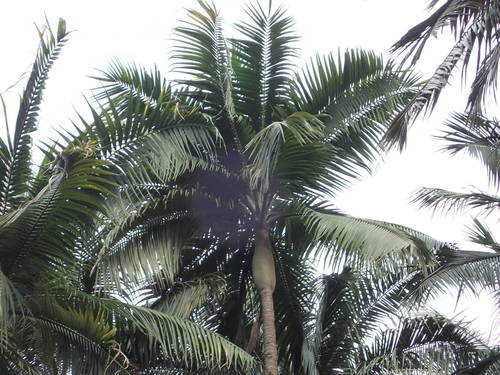
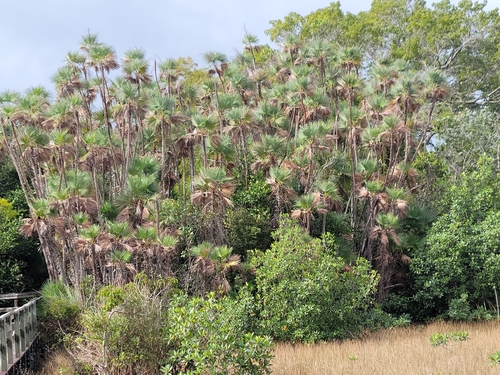
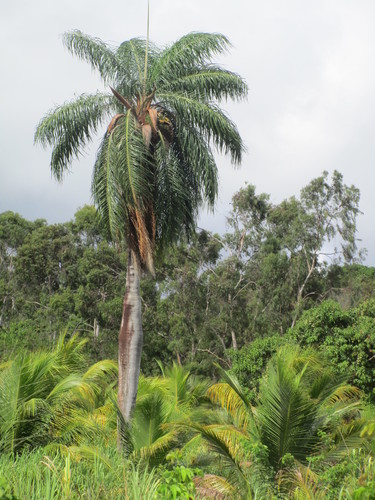
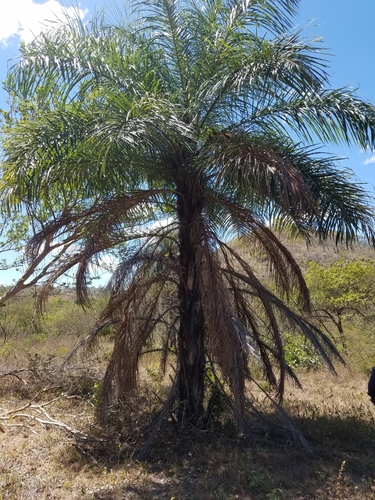
A tall palm. It grows 20 m high. The trunk can be 25-35 cm wide. The crown is nearly rounded. There are 15-19 leaves. The leaves are 3.1-4 m long. There are regularly spaced leaflets. They grow in a single flat plane. The flowering stalk is borne among the leaves. They are crowded among the leaf bases. The fruit have one seed. They are oval and 3.5-4 cm long by 2 cm wide. They are reddish.
How to Grow
Grows best in a sunny position. Requires a well-drained soil.
Other Uses
The stem is durable. It is sometimes used in the construction of traditional buildings.
Wikipedia
Source ↗Attalea crassispatha is a palm which is endemic to southwest Haiti. The most geographically isolated member of the genus, it is considered a critically endangered species and has been called one of the rarest palms in the Americas.
Production
It is slow to establish.
Other Information
They are especially eaten by children. It is endangered in the wild.
Notes
There are between (22) 30-71 Attalea species. Some authorities divide them among Attalea, Orbignya, Scheela and Maximiliana. This one is seriously endangered. The fruit are eaten by children.
Names & Synonyms
References (9)
- Glassman, A Taxonomic Treatment of the Palm Subtribe Attaleinae (Tribe Cocoeae). p 94 (As Orbignya oleifera)
- Haynes, J., & McLaughlin, J., 2000, Edible palms and Their Uses. University of Florida Fact sheet MCDE-00-50-1 p 3
- Henderson, A., Galeano, G and Bernal, R., 1995, Field Guide to the Palms of the Americas. Princeton. p 160
- Johnson, D.V., 1998, Tropical palms. Non-wood Forest products 10. FAO Rome. p 85
- Kongl. Svenska Vetenskapsakad. Handl. ser. 3. 6(7):23. 1929
- Marinelli, J. (Ed), 2004, Plant. DK. p 360
- Oldfield, S., et al, 1998, The World List of Threatened Trees. World Conservation Press. p 72
- Plants of Haiti Smithsonian Institute http://botany.si.edu
- Riffle, R.L. & Craft, P., 2003, An Encyclopedia of Cultivated Palms. Timber Press. p 43, 266