Syagrus smithii
H. E. Moore
Catole

(c) Riley Fortier, some rights reserved (CC BY-NC), uploaded by Riley Fortier
What to Eat
Edible parts: Seeds
The seeds are eaten.
Where to Find It
A tropical plant. It grows in the rainforest. In Brazil it grows to 650 m altitude.
Amazon, Brazil, Colombia, Peru, South America,
How to Identify
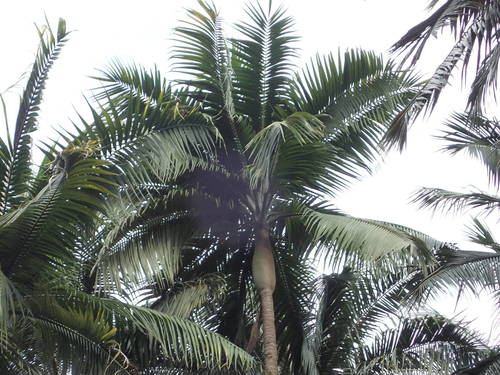
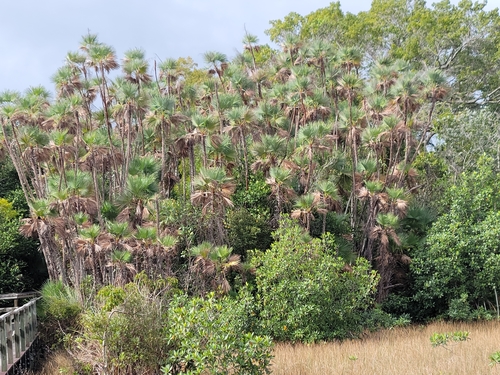
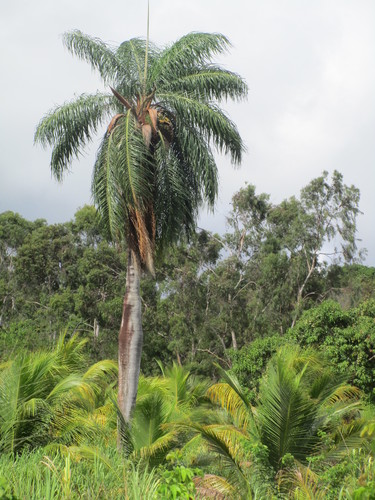
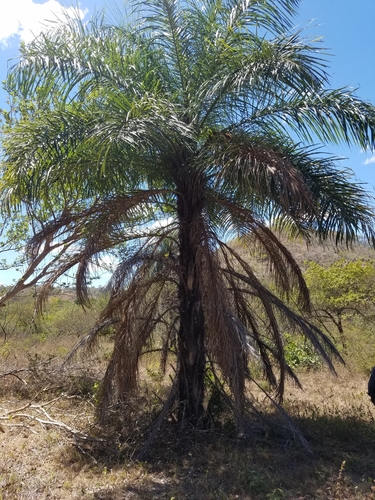
A solitary palm. It can be 10-16 m tall. The trunk is grey with indistinct rings. The trunk is 8 cm across. The crown is rounded with arching fronds. The leaves are dark green. They are 2.6-3.1 m long. The leaflets are 60 cm long and with long tips. The leaves can also be undivided. The flowers have a sweet scent. The fruit are oval and 7 cm long by 4 cm across. They occur in heavy clusters. The seed are triangle shaped in cross section. They end abruptly.
Other Uses
The leaves are used for thatching temporary shelters.
Wikipedia
Source ↗Syagrus smithii is a species of palm tree found in Brazil, Colombia, Ecuador and Peru.
Notes
There are about 30 Syagrus species.
Names & Synonyms
Coco, Kuik, Tookee
References (10)
- Henderson, A., Galeano, G and Bernal, R., 1995, Field Guide to the Palms of the Americas. Princeton. p 148
- Haynes, J., & McLaughlin, J., 2000, Edible palms and Their Uses. University of Florida Fact sheet MCDE-00-50-1 p 13
- Janick, J. & Paul, R. E. (Eds.), 2008, The Encyclopedia of Fruit & Nuts. CABI p 159
- Johnson, D.V., 1998, Tropical palms. Non-wood Forest products 10. FAO Rome. p 86
- Jones, D.L., 1994, Palms throughout the World. Smithtonian Institution, Washington. p 362
- Kermath, B. M., et al, 2014, Food Plants in the Americas: A survey of the domesticated, cultivated and wild plants used for Human food in North, Central and South America and the Caribbean. On line draft. p 844
- Marcia, M. J., et al, 2011, Palm Uses in Northwestern South America: A Quantitative Review. Bot. Rev. (2011) 77:462-570
- Riffle, R.L. & Craft, P., 2003, An Encyclopedia of Cultivated Palms. Timber Press. p 461
- Roa, J. A. G. & Boada, D. S. G., 2018, Fundación para el Fortalecimiento de la Fruticultura y Plantas Alimenticias no Convencionales en Colombia.
- World Checklist of Useful Plant Species 2020. Royal Botanic Gardens, Kew