Leopoldinia piassaba
Wallace
Piassaba

no rights reserved, uploaded by w_endo
What to Eat
Edible parts: Fruit, Seeds
The mesocarp of the fruits is eaten raw or made into a refreshing drink. Agitating the thin fruit flesh with water produces a popular local beverage.
Where to Find It
A tropical plant suiting wet climates. They grow along rivers and in lowlands that are seasonally flooded. It grows in the shade.
Amazon, Brazil, Colombia, South America, Venezuela,
How to Identify
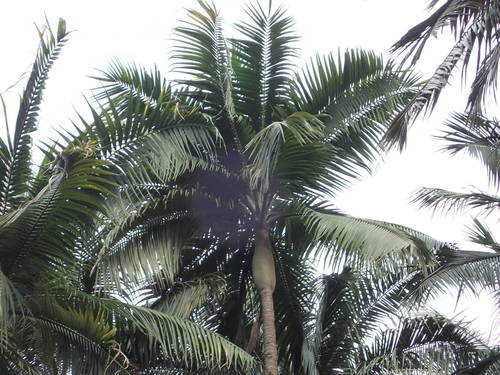
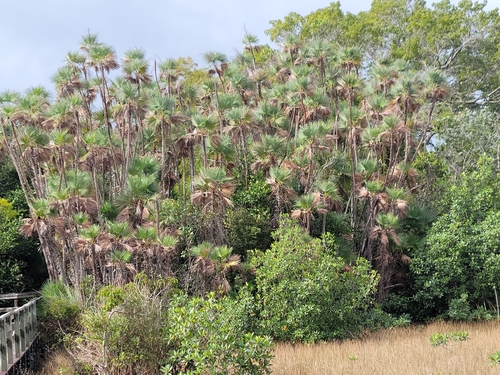
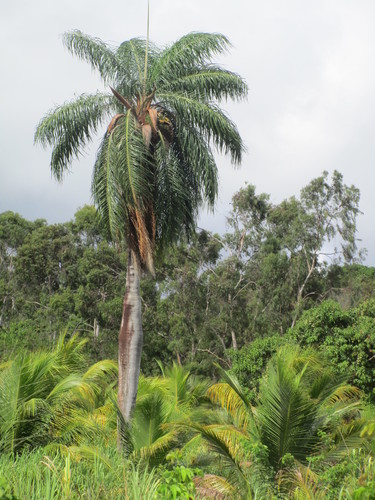
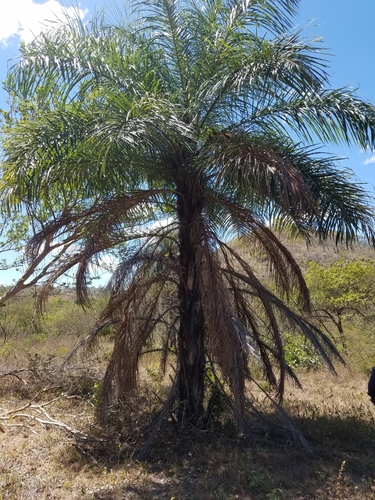
A small palm. It grows 5 m high. It has masses of long hanging brown fibres. The trunk is 12 cm wide but has 80 cm of fibres. The leaves are 4-5 m long. The leaflets are regularly and widely spaced. They are stiff and sword shaped. They are light green and 60-100 cm long. They have wavy edges. The fruit are kidney shaped and flattened. They are edible.
How to Grow
Not known
Propagation: Seed.
Medicinal Uses
None known
Other Uses
A fibre known as piassaba fibre is obtained from the leaf sheath. It is used to make heavy ropes as a substitute for manila hemp (Musa textilis), and is also made into brushes, brooms, and baskets. The fibre resists rotting even after long periods of immersion in water; Brazilians historically used it to make cables for navigating the Amazon. The foliar sheaths terminate in long pendulous fibres of 0.5–1.5 metres. These initially appear as light brown ribbon-like strips 2–10cm wide, later splitting into dark brown to greyish-brown individual fibres that hang down and entirely conceal the stem, giving the tree a distinctive appearance. The leaves are used for thatching and resist rotting even after prolonged wetting, making them the most sought-after thatching material among local palms. The nuts, encased in a hard botryoidal shell 3–4cm in diameter and 5–8cm long, are a source of vegetable ivory. The shells take a fine polish. The nuts themselves are smaller and sit loose within the shells; they have delicate dark veining and are quite beautiful when turned or polished.
Wikipedia
Source ↗Leopoldinia piassaba, the Para piassava, piassava fiber palm or piassava palm, is a palm native to black water rivers in Amazonian Brazil and Venezuela, from which is extracted piassava, a high caliber and water resistant fiber. Piassaba fiber is made into brooms, baskets and other products. This plant is also a natural habitat of the Rhodnius brethesi which is a potential vector of Chagas disease and it is cited in Flora Brasiliensis by Carl Friedrich Philipp von Martius.
Notes
There are 3 Leopoldinia species.
Names & Synonyms
Chiquechique, Chiquichiqui, Fibra, Maarama, Marama, Palma piassava, Piassaba, Piassaba-amazonica
References (14)
- Balick, M.J. and Beck, H.T., (Ed.), 1990, Useful palms of the World. A Synoptic Bibliography. Colombia p 50, 223,
- Etkin, N. L. (Ed.), 1994, Eating on the Wild Side, Univ. of Arizona. p 139
- Grandtner, M. M. & Chevrette, J., 2013, Dictionary of Trees, Volume 2: South America: Nomenclature, Taxonomy and Ecology. Academic Press p 346
- Haynes, J., & McLaughlin, J., 2000, Edible palms and Their Uses. University of Florida Fact sheet MCDE-00-50-1 p 7
- Henderson, A., Galeano, G and Bernal, R., 1995, Field Guide to the Palms of the Americas. Princeton. p 120
- Johnson, D.V., 1998, Tropical palms. Non-wood Forest products 10. FAO Rome. p 93
- Jones, D.L., 1994, Palms throughout the World. Smithtonian Institution, Washington. p 52
- Kermath, B. M., et al, 2014, Food Plants in the Americas: A survey of the domesticated, cultivated and wild plants used for Human food in North, Central and South America and the Caribbean. On line draft. p 479
- Lopez-Diago, D. & Garcia, N., 2021, Wild edible fruits of Colombia. Biota ColomBiana 22 (2) p 32
- Marcia, M. J., et al, 2011, Palm Uses in Northwestern South America: A Quantitative Review. Bot. Rev. (2011) 77:462-570
- Palm trees Amazon 17, t. 6. 1853
- Riffle, R.L. & Craft, P., 2003, An Encyclopedia of Cultivated Palms. Timber Press. p 364
- Roa, J. A. G. & Boada, D. S. G., 2018, Fundación para el Fortalecimiento de la Fruticultura y Plantas Alimenticias no Convencionales en Colombia.
- World Checklist of Useful Plant Species 2020. Royal Botanic Gardens, Kew