Oenocarpus mapora
H. Karst
Bacaba

(c) Reinaldo Aguilar, some rights reserved (CC BY-NC-SA)

(c) Reinaldo Aguilar, some rights reserved (CC BY-NC-SA)

(c) Reinaldo Aguilar, some rights reserved (CC BY-NC-SA)
What to Eat
Edible parts: Fruit, Cabbage, Palm heart, Nuts, Fruit - oil, Seeds
The fruit are slightly cooked before eating and are used to make drinks. The seeds and terminal bud (palm heart/cabbage) are edible. The fruit also yield an oil. Fruit are sold in local markets.
Where to Find It
A tropical plant. It suits the tropics and the subtropics. In South America it grows in rainforests at low altitude. It occasionally grows to 1,000 m altitude. It is often found in swamps.
Amazon, Asia, Australia, Bolivia, Brazil, Central America*, Colombia, Costa Rica, Ecuador, Honduras, Indonesia, Panama, Peru, SE Asia, South America, Venezuela,
How to Identify
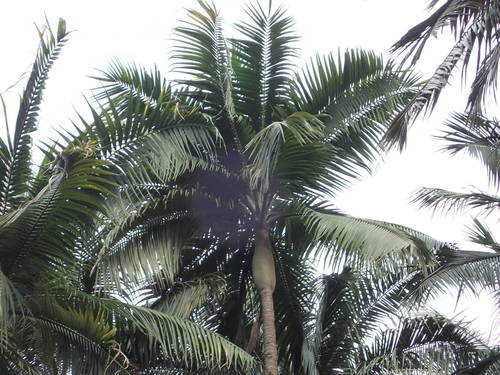
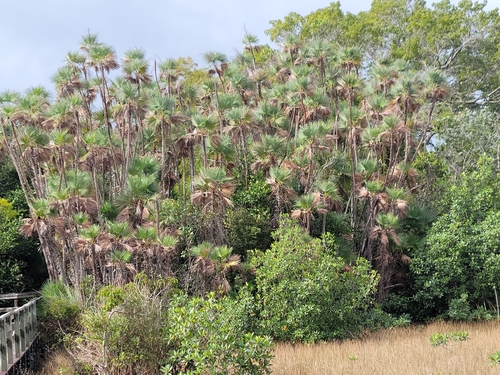
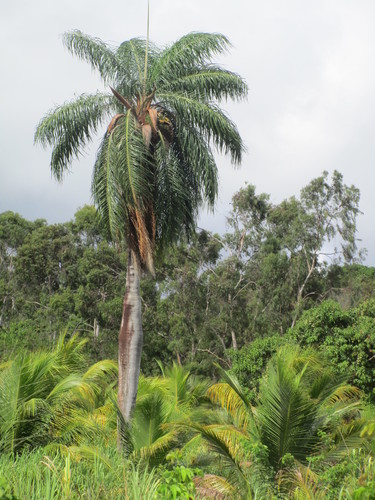
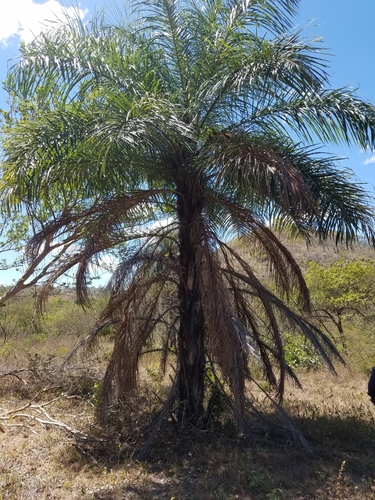
A clumping palm. It can have 12 slender trunks in one clump. These can be 10-20 m tall. The trunks are 15 cm across. The trunks are spiny. There is a false crown-shaft which is like a narrow upside-down pyramid. It is 1 m long. The fronds are dark green above and silvery underneath and arching. They can be 1.3-5 m long on leafstalks 30-100 cm long. The leaflets droop. They are 60-100 cm long and regularly spaced. The new shoots are red. The flowering stalk is like a horse's tail. The flowers are creamy white. The fruit are mauve to purple. They are the size and shape or olives. They are 2.5 cm long.
Nutrition Score: 32/100
| Part | Moisture | kJ | kcal | Protein | Vit A | Vit C | Iron | Zinc |
|---|---|---|---|---|---|---|---|---|
| Fruit | 85.4 | 299 | 73 | 0.9 | — | 10.1 | 1.2 | 0.4 |
How to Grow
Plants are grown from seed. It can be grown from suckers. It is useful for producing edible shoots or cabbage as the harvested shoots are replaced by new suckers.
Medicinal Uses
The terminal bud is used as cabbage.
Other Uses
The midveins of the leaflets are used in basketry.
Other Information
Fruit are sold in local markets.
Notes
There are 9 Oenocarpus species.
Names & Synonyms
Bacabai, Bacabilla, Bacabinha, Bi bosa ni, Ciame, Cimba, Cinamillo, Dompedrito, Jejhue isa, Jora, Majillo, Manqueque, Mapora, Maquenque, Milpesillo, Pusuy, Quebo itsama, Shimpi, Shinpi, Sinamillo, Turu palm, Uyaachi
References (37)
- Aguilar, S.& Condit, R., 2001, Use of Native Tree Species by an Hispanic Community in Panama. Economic Botany 55(2) pp 223-235.
- Balick, M.J. and Beck, H.T., (Ed.), 1990, Useful palms of the World. A Synoptic Bibliography. Colombia p 110, 161 (As Oenocarpus multicaulis), 332 (As Oenocarpus multicaulis), 402, 561,
- Brazil: Biodiversity for Food and Nutrition. http://www.b4fn.org/countries/brazil/
- Castaneda, H., & Stepp, J. R., 2007, Ecosystems as Sources of Useful Plants for the Guaymi People of Costa Rica. Ethnobotany Journal. 5:249-257
- Condit, R., et al, 2011, Trees of Panama and Costa Rica. PrincetonField Guides. p 82
- Etkin, N.L. (Ed.), 1994, Eating on the Wild Side, Univ. of Arizona. p 157
- Eynden, Van den, V., & Cueva E., Cabrera, O., 2004, Edible Palms of Southern Ecuador. Palms. Vol 48(3):141-147
- Facciola, S., 1998, Cornucopia 2: a Source Book of Edible Plants. Kampong Publications, p 30 (As Oenocarpus multicaulis)
- Gibbons, M., 2003, A pocket guide to Palms. Chartwell Books. p 152
- Gilmore, M. P., et al, 2013, The socio-cultural importance of Mauritia flexuosa palm swamps (aguajales) and implications for multi-use management in two Maijuna communities of the Peruvian Amazon. Journal of Ethnobiology and Ethnomedicine 2013, 9:29
- Grandtner, M. M., 2008, World Dictionary of Trees. Wood and Forest Science Department. Laval University, Quebec, Qc Canada. (Internet database http://www.wdt.qc.ca)
- Grandtner, M. M. & Chevrette, J., 2013, Dictionary of Trees, Volume 2: South America: Nomenclature, Taxonomy and Ecology. Academic Press p 460
- Grayum, M. H., 2000, MBG: Research: Manual de Plantas de Costa Rica: Draft Treatments p 17
- Haynes, J., & McLaughlin, J., 2000, Edible palms and Their Uses. University of Florida Fact sheet MCDE-00-50-1 p 10
- Henderson, A., Galeano, G and Bernal, R., 1995, Field Guide to the Palms of the Americas. Princeton. p 130
- Johnson, D.V., 1998, Tropical palms. Non-wood Forest products 10. FAO Rome. p 93
- Johnson, D.V., 1998, Tropical palms. Non-wood Forest products 10. FAO Rome. p 20 (As Oenocarpus multicaulis)
- Jones, D.L., 1994, Palms throughout the World. Smithtonian Institution, Washington. p 278
- Jones, D.L., 2000, Palms of Australia 3rd edition. Reed/New Holland. p 188
- Kermath, B. M., et al, 2014, Food Plants in the Americas: A survey of the domesticated, cultivated and wild plants used for Human food in North, Central and South America and the Caribbean. On line draft. p 579
- Langlois, H. C., 2004, Ethnobotanical analysis of different successional stages as sources of wild edible plants for the Guaymi people in Costa Rica. M. Sc. thesis University of Florida.
- Lopez-Diago, D. & Garcia, N., 2021, Wild edible fruits of Colombia. Biota ColomBiana 22 (2) p 32
- Macbride, J. F., 1960, Flora of Peru. Vol. 8, Part 1 No. 2 p 382 (As Oenocarpus muticaulis)
- Marcia, M. J., et al, 2011, Palm Uses in Northwestern South America: A Quantitative Review. Bot. Rev. (2011) 77:462-570
- Paz, F. S., et al, 2021, Edible Fruit Plant Species in the Amazon Forest Rely Mostly on Bees and Beetles as Pollinators. Journal of Economic Entomology, XX(XX), 2021, 1–13
- Philips, O., 1992, The potential for harvesting fruits in tropical rainforests: new data from Amazonian Peru. Biodiversity and Conservation 2, 18-38
- Riffle, R.L. & Craft, P., 2003, An Encyclopedia of Cultivated Palms. Timber Press. p 395
- Roa, J. A. G. & Boada, D. S. G., 2018, Fundación para el Fortalecimiento de la Fruticultura y Plantas Alimenticias no Convencionales en Colombia.
- Smith, N., et al, 2007, Amazon River Fruits. Flavors for Conservation. Missouri Botanical Gardens Press. p 84
- Sukarya, D. G., (Ed.) 2013, 3,500 Plant Species of the Botanic Gardens of Indonesia. LIPI p 797
- Tomchinsky, B., et al, 2021, Food Composition Data: Edible Plants from the Amazon. in M. C. M. Jacob, U. P. Albuquerque (eds.), Local Food Plants of Brazil, Ethnobiology, Springer p 275
- Torre, de la L., et al, 2008, Enciclopedia de las Plantas Útiles del Ecuador. Herbario QCA. Pontificia Universidad Católica del Ecuador. p 206
- Van den Eynden, V., et al, 2003, Wild Foods from South Ecuador. Economic Botany 57(4): 576-603
- Van den Eynden, V. et al, 2004, Edible Palms of Southern Ecuador. Palms Volume 48(3):142-148
- Vasquez, R. and Gentry, A. H., 1989, Use and Misuse of Forest-harvested Fruits in the Iquitos Area. Conservation Biology 3(4): 350f
- World Checklist of Useful Plant Species 2020. Royal Botanic Gardens, Kew
- Zambrana, P, et al, 2017, Traditional knowledge hiding in plain sight – twenty-first century ethnobotany of the Chácobo in Beni, Bolivia. Journal of Ethnobiology and Ethnomedicine (2017) 13:57