Hyphaene compressa
H. A. Wendl.
African Doum Palm
no rights reserved, uploaded by Adam Kranz

(c) Heinrich Human, some rights reserved (CC BY-NC)

(c) Heinrich Human, some rights reserved (CC BY-NC)
What to Eat
Edible parts: Fruit, Sap, Seedlings, Nuts, Leaves
The pulp of ripe fruit is eaten raw; juice from young fruit is drunk and used to make beer; the dried, ground outer fruit coat is mixed with blood and eaten; the nut kernel is eaten; and the embryo of young germinating seedlings is eaten.
Where to Find It
A tropical plant. It grows on the coast and extends inland along streams and rivers. It grows to 1500 m altitude in East Africa. They need full sun. They can grow on poor soils and survive in drier climates. It grows in areas with an annual rainfall of 200-900 mm. It is salt tolerant. It can grow in arid places. It suits hardiness zones 10-11.
Africa, East Africa, Egypt, Ethiopia, Kenya, Mozambique, North Africa, Somalia, Southern Africa, South Sudan, Sudan, Tanzania,
How to Identify
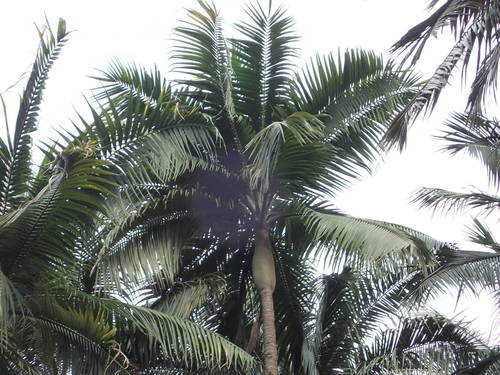
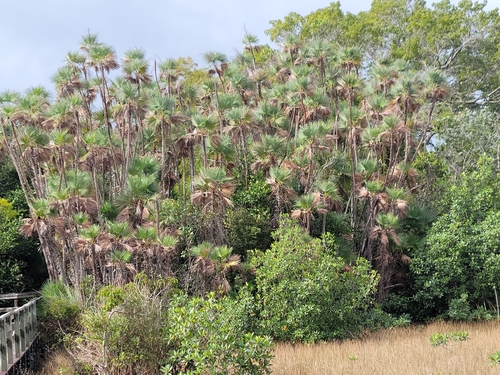
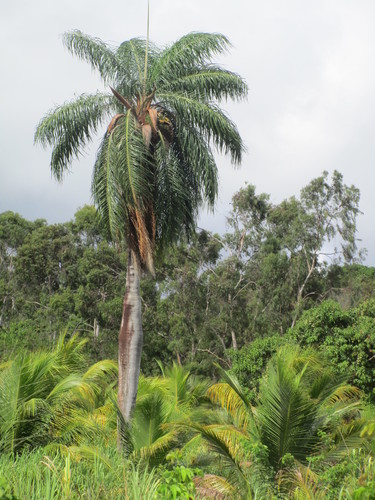
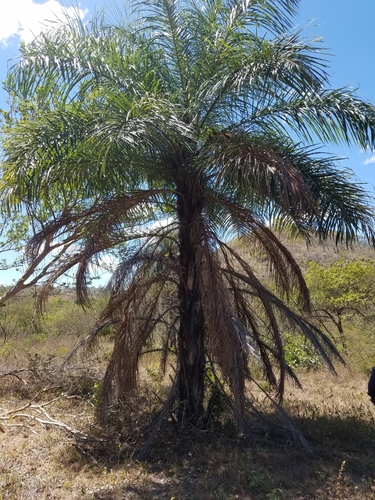
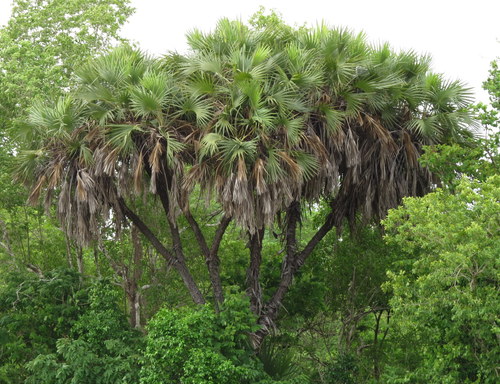
A tall branched palm. It can have 2-4 main stems and these can branch 4 or 5 times. It grows 20 m high. The leaf colour is mostly deep green. It can be silvery or bluish-green. The fruit are oblong or pear shaped. They are orange or light brown. The smell like gingerbread when broken open.
Nutrition Score: 24/100
| Part | Moisture | kJ | kcal | Protein | Vit A | Vit C | Iron | Zinc |
|---|---|---|---|---|---|---|---|---|
| Fruit | 10.7 | — | — | 1.6 | — | 275 | — | — |
How to Grow
Plants are grown from seeds. The pulp is removed. Seeds are slow to germinate and can be improved by breaking the hard seed coat. They should be planted in deep moist sand.
Medicinal Uses
The pulp of the fruit is eaten as a remedy for intestinal worms.
Other Uses
The leaves are used for thatching or for weaving into baskets, mats, hats, fans etc. Seed - used as a source of vegetable ivory. The wood is used for building poles and fuel.
Wikipedia
Source ↗Hyphaene compressa, also known as the East African doum palm, is a palm tree (family Palmae or Arecaceae) in the genus Hyphaene. It is a tree known for its unique dichotomous branching, unlike most palms which are not branched. This palm tree is abundant in Eastern Africa and is a vital socioeconomic resource to the rural pastoralist and agro-pastoralists there.
Production
It is slow growing. In Tanzania fruit are collect during the dry season.
Other Information
The fruit are especially liked by children.
Notes
There are about 9 or 10 Hyphaene species. (Some authorities estimate 40). They are tropical.
Names & Synonyms
Annui, Baar, Eng'oli, Ilala, Kihogolo, Kone, Kulidhe, Kweche, Likweta, Mkoche, Mkoma, Mlala, Mukoma, Mulala, Muruguyu, Olmoroket, Qoone
References (21)
- Bot. Zeitung (Berlin) 36:116. 1878
- Dharani, N., 2002, Field Guide to common Trees & Shrubs of East Africa. Struik. p 290
- FAO, 1988, Traditional Food Plants, FAO Food and Nutrition Paper 42. FAO Rome p 333
- Johnson, D.V., 1998, Tropical palms. Non-wood Forest products 10. FAO Rome. p 131
- Jones, D.L., 1994, Palms throughout the World. Smithtonian Institution, Washington. p 52
- Lulekal, E., et al, 2011, Wild edible plants in Ethiopia: a review on their potential to combat food insecurity. Afrika Focus - Vol. 24, No 2. pp 71-121
- Mahony, D., 1991, Trees of Somalia. A Field Guide for Development Workers. Oxfam Research Paper 3. p 9
- Maundu, P. et al, 1999, Traditional Food Plants of Kenya. National Museum of Kenya. 288p
- Mbuya, L.P., Msanga, H.P., Ruffo, C.K., Birnie, A & Tengnas, B., 1994, Useful Trees and Shrubs for Tanzania. Regional Soil Conservation Unit. Technical Handbook No 6. p 300
- Molla, A., Ethiopian Plant Names. http://www.ethiopic.com/aplants.htm
- Mutie, F. G., 2020, Conservation of Wild Food Plants and Their Potential for Combatting Food Insecurity in Kenya as Exemplified by the Drylands of Kitui County. Plants 2020, 9, 1017
- Mutie, F. M., et al, 2023, Important Medicinal and Food Taxa (Orders and Families) in Kenya, Based on Three Quantitative Approaches. Plants 2023, 12, 1145
- Ngugi, G., 2000, Case Study from Kenya on Indigenous Wild Vegetables. Paper 4 Workshop in Kenya 1999. p 35
- Pakia, M., 2000, Plant Ecology and Ethnobotany of two sacred forests (Kayas) at the Kenya Coast. M. Sc. Thesis.
- Peters, C. R., O'Brien, E. M., and Drummond, R.B., 1992, Edible Wild plants of Sub-saharan Africa. Kew. p 38
- Royal Botanic Gardens, Kew (1999). Survey of Economic Plants for Arid and Semi-Arid Lands (SEPASAL) database. Published on the Internet; http://www.rbgkew.org.uk/ceb/sepasal/internet [Accessed 5th May 2011]
- Ruffo, C. K., Birnie, A. & Tengnas, B., 2002, Edible Wild Plants of Tanzania. RELMA p 388
- Shumsky, S., et al, 2014, Institutional factors affecting wild edible plant (WEP) harvest and consumption in semi-arid Kenya. Land Use Policy 38(2014) 48-69
- Sullivan, S., 1998, People plants and practice in drylands: Socio-political and ecological dimensions of resource-use by Damara farmers in north-west Namibia. Ph.D. Univ. College London.
- Wickens, G.E., 1995, Edible Nuts. FAO Non-wood forest products. FAO, Rome. p166
- World Checklist of Useful Plant Species 2020. Royal Botanic Gardens, Kew