Caryota maxima
Blume ex Mart.
Giant mountain fishtail palm, Burma suwar
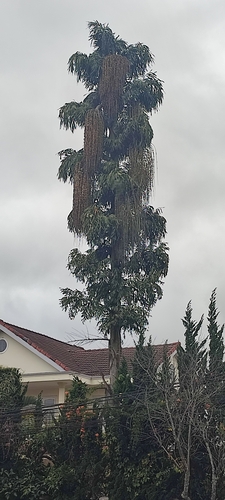
(c) Andrey Efremov, some rights reserved (CC BY-NC), uploaded by Andrey Efremov

(c) Vasilii Dudka, some rights reserved (CC BY-NC)
What to Eat
Edible parts: Seeds, Sago, Stem starch, Sap, Bud, Cabbage, Palm heart
The stem starch is processed for sago. The sap from the flowering stalk is collected for toddy. The heart or terminal bud (palm heart/cabbage) is eaten as a vegetable.
Known Hazards
Where to Find It
A tropical and subtropical plant. It grows in mountains in N India and Thailand. It grows up to 1,000 m altitude. It can tolerate cold. It grows in open forest near Canton in China. They are widely distributed in the Philippines in valleys and on wooded hills. They are occasionally found in dense humid forests. It grows in Sydney Botanical gardens. It suits hardiness zones 9-12. In Yunnan.
Asia, Australia, Bhutan, Cambodia, China, Himalayas, India, Indochina, Indonesia, Laos, Malaysia, Myanmar, Pacific, Philippines, SE Asia, Thailand, Vietnam,
How to Identify
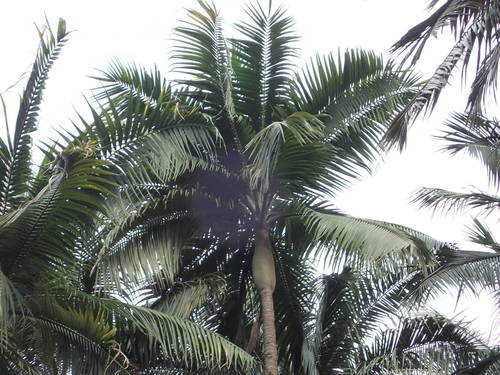
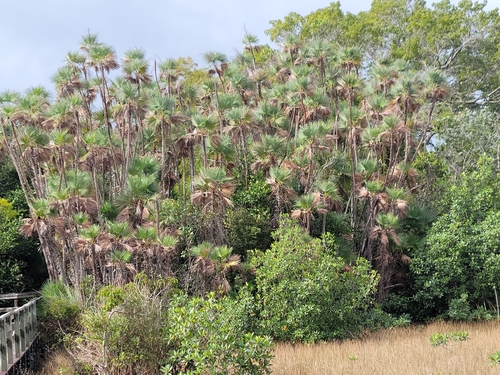
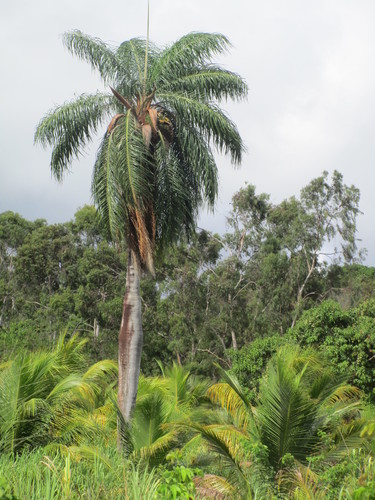
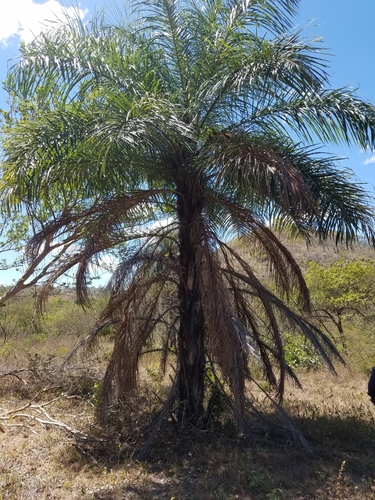
A single stemmed palm. It has a thick ringed trunk. It grows 20 m high. The trunk can be 40-60 cm across. The leaves are large and compound and are twice divided. The leaflets are leathery and are fishtail shaped. The end one is fan shaped. The leaflets are 15-20 cm long. The leaflets are blunt and rounded and shallowly toothed at the tips. The flowering stalks are 3 m long. They hang down. The flowers are of one sex in groups of 3. They are cream. It fruits then dies. The fruit contain stinging crystals. The fruit is reddish pink and up to 4 cm wide with 1-3 seeds. The seeds are smooth and black.
How to Grow
Plants are grown from seed. Seed germinate erratically.
Production
They are very fast growing with warmth and humidity.
Other Information
It is sold in local markets.
Notes
There are 12 Caryota species. They are tropical.
Names & Synonyms
Cluster fishtail palm, Dei din, Dong zong, Guo zhu, Jin xian, Kyauk-minbaw, Takipan-tilos
References (19)
- Bircher, A. G. & Bircher, W. H., 2000, Encyclopedia of Fruit Trees and Edible Flowering Plants in Egypt and the Subtropics. AUC Press. p 88 (As Caryota aequatorialis)
- Burkill, I.H., 1966, A Dictionary of the Economic Products of the Malay Peninsula. Ministry of Agriculture and Cooperatives, Kuala Lumpur, Malaysia. Vol 1 (A-H) p 476 (As Caryota aequatorialis)
- Cao, Y., et al, 2020, Ethnobotanical study on wild edible plants used by three trans-boundary ethnic groups in Jiangcheng County, Pu’er, Southwest China. Journal of Ethnobiology and Ethnomedicine (2020) 16:66
- Cundall, P., (ed.), 2004, Gardening Australia: flora: the gardener's bible. ABC Books. p 336
- Gibbons, M., 2003, A pocket guide to Palms. Chartwell Books. p 67
- Hedrick, U.P., 1919, (Ed.), Sturtevant's edible plants of the world. p 173
- Hu, Shiu-ying, 2005, Food Plants of China. The Chinese University Press. p 301 (As Caryota ochlandra)
- Hui, Y. H., Handbook of Food Science, Technology, and Engineering. Volume 2. Table 98:5 (As Caryota ochlandra)
- Jones, D.L., 1994, Palms throughout the World. Smithtonian Institution, Washington. p 51, 164
- Jones, D.L., 2000, Palms of Australia 3rd edition. Reed/New Holland. p 132
- Kachenchart, B., et al, 2008, Phenology of Edible Plants at Sakaerat Forest. In Proceedings of the FORTROP II: Tropical Forestry Change in a Changing World. Bangkok, Thailand. (As Caryota bacsonensis)
- Menisa, A. A., et al, 2012, Survey and characterization of Indigenous Food Plants in Ilocos Norte, Philippines. SEARCA Discussion Paper series No. 2011-2 (As Caryota rumphiana var. philippensis)
- Menninger, E.A., 1977, Edible Nuts of the World. Horticultural Books. Florida p 131 (As Caryota aequatorialis)
- Monsalud, M.R., Tongacan, A.L., Lopez, F.R., & Lagrimas, M.Q., 1966, Edible Wild Plants in Philippine Forests. Philippine Journal of Science. p 527 (As Caryota rumphiana var. oxydonta and also as Caryota rumphiana var. philippensis))
- Reis, S. V. and Lipp, F. L., 1982, New Plant Sources for Drugs and Foods from the New York Botanical Garden herbarium. Harvard. p 18 (As Caryota ochlandra)
- Wickens, G.E., 1995, Edible Nuts. FAO Non-wood forest products. FAO, Rome. p164
- World Checklist of Useful Plant Species 2020. Royal Botanic Gardens, Kew
- www.ethnobiomed.com
- Xu, You-Kai, et al, 2004, Wild Vegetable Resources and Market Survey in Xishuangbanna, Southwest China. Economic Botany. 58(4): 647-667. (As Caryota ochlandra)