Microcos paniculata
Linn.
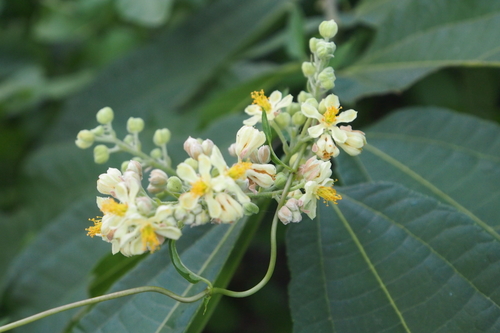
(c) Sunnetchan, some rights reserved (CC BY-NC-ND), uploaded by Sunnetchan
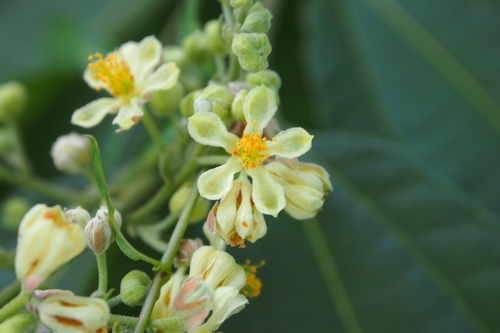
(c) Sunnetchan, some rights reserved (CC BY-NC-ND), uploaded by Sunnetchan
(c) Sunnetchan, some rights reserved (CC BY-NC-ND), uploaded by Sunnetchan
What to Eat
Edible parts: Fruit
The fruit are eaten raw, particularly by children, and are sold in local markets.
Where to Find It
A tropical plant. It grows in Yunnan in China below 1,000 m above sea level. It grows in monsoon forest and secondary forest. In XTBG Yunnan.
Asia, Bangladesh, Cambodia, China, India, Indochina, Indonesia, Laos, Malaysia, Myanmar, Northeastern India, SE Asia, Sri Lanka, Thailand, Timor, Vietnam,
How to Identify
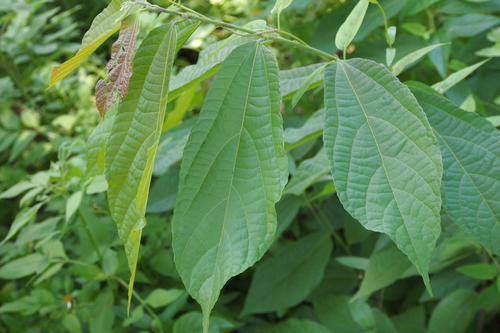
A shrub or small tree. It can grow to 20 m high. The crown is dense and cylinder shaped. The trunk is slightly fluted. The leaves are 12-20 cm long by 6-8 cm wide. They are oblong but taper slightly to the tip. There can be shallow irregular teeth towards the tip. The flowers are bright yellow and about 1 cm across. They are in branched clusters at the ends of twigs. These are 3-10 cm long. The fruit are up to 1.5 cm across. They are dark green and turn black when ripe. They have one large stone.
How to Grow
The plants can be grown from seeds.
Medicinal Uses
The plant is reputed to cure indigestion, eczema, itches, typhoid fever, dysentery and syphilitic ulceration of the mouth. A decoction of the roots is used to treat coughs. An infusion of the leaves is taken as a cooling drink and to remedy indigestion. A drink prepared from the roasted and boiled leaves is given to children as a vermifuge.
Other Uses
The leaves are considered eminently suitable for wrapping cigars, e.g. in the Andaman Islands. Rope can be manufactured from the fibrous bark. The light to medium-weight hardwood is used for cabinet work. Loppings can be used as green manure.
Wikipedia
Source ↗Microcos paniculata is a flowering shrub native to China and south-east Asia including India. It is also included in Indian Ayurveda. It is sometimes added to Chinese herbal tea, having a mildly sour taste. In traditional Chinese medicine the plant is believed to help the digestive system, and it is also used for other health problems including colds, hepatitis, diarrhea, heat stroke, and dyspepsia.
Other Information
The fruit are eaten especially by children. They are sold in local markets.
Notes
They have also been put in the families Tiliaceae and Sparrmanniaceae.
Names & Synonyms
Asar, Bung lai, Guomaihong, Heitup, Jabo, Ka phla, Khom, Kom preow, Laai, Myat-ya, Mya-yar, Myin-kahpan, Ye-mya-yar, Pesondi, Pichandi, Pichla, Pichunti, Pisundi, Tarah
References (13)
- Altschul, S.V.R., 1973, Drugs and Foods from Little-known Plants. Notes in Harvard University Herbaria. Harvard Univ. Press. Massachusetts. no. 2726
- Anderson, E. F., 1993, Plants and people of the Golden Triangle. Dioscorides Press. p 215
- Burkill, I. H., 1966,
- Devi, O.S., P. Komor & D. Das, 2010, A checklist of traditional edible bio-resources from Ima markets of Imphal Valley, Manipur, India. Journal of Threatened Taxa 2(11): 1291-1296
- Gardner, S., et al, 2000, A Field Guide to Forest Trees of Northern Thailand, Kobfai Publishing Project. p 92
- Jin, Chen et al, 1999, Ethnobotanical studies on Wild Edible Fruits in Southern Yunnan: Folk Names: Nutritional Value and Uses. Economic Botany 53(1) pp 2-14
- Majumdar, K and Datta, N., 2009, Traditional wild edible fruits for the forest dwellers of Tripura, India. Pleione 3(2) 167-178
- Partha, P., 2014, Ethnobotany of the Laleng (Patra) Community in Bangladesh. Journal of Pharmacognosy and Phytochemistry. 2(6):173-184
- Pasha, M. K. & Uddin, S. B., 2019, Minor Edible Fruits of Bangladesh. Bangladesh J. Plant Taxon. 26(2): 299–313
- PROSEA
- Singh, H.B., Arora R.K.,1978, Wild edible Plants of India. Indian Council of Agricultural Research, New Delhi. p 66
- Sp. pl. 1:514. 1753
- Sukarya, D. G., (Ed.) 2013, 3,500 Plant Species of the Botanic Gardens of Indonesia. LIPI p 397