Phoenix pusilla
Gaertn.
Ceylon Date Palm

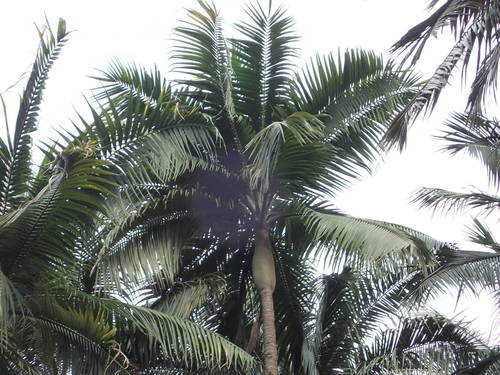
(c) Paulmathi Vinod, some rights reserved (CC BY), uploaded by Paulmathi Vinod
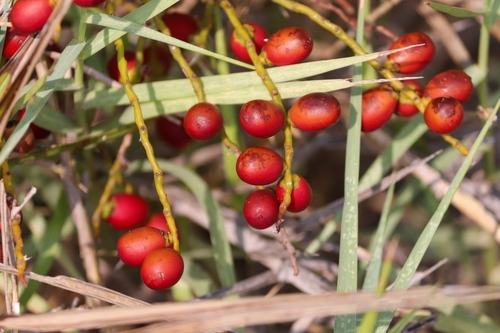
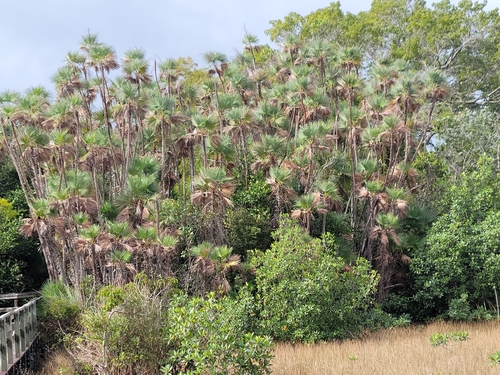
(c) Aravinth, some rights reserved (CC BY), uploaded by Aravinth
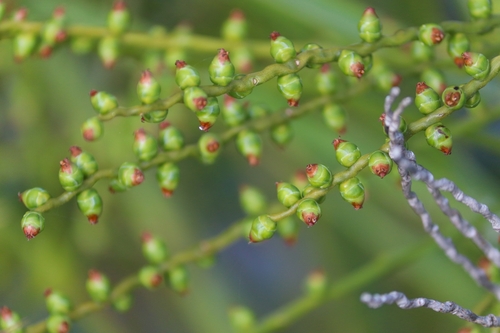
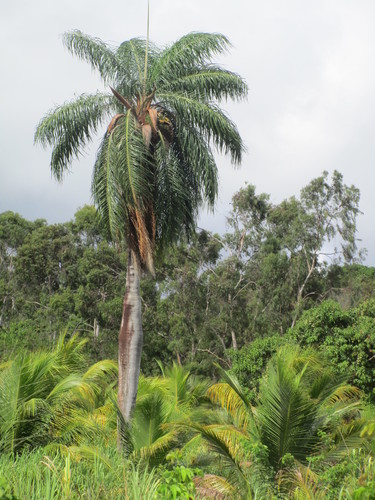
(c) Aravinth, some rights reserved (CC BY), uploaded by Aravinth
What to Eat
Edible parts: Fruit, Stem-starch, Cabbage, Sago, Palm heart
The floury starch from the stem can be baked, the terminal bud or cabbage is cooked and eaten as a vegetable, ripe fruit are eaten fresh, and it can be used to produce palm sugar.
Where to Find It
A tropical plant. It suits the hot humid lowland tropics. It grows in coastal areas and inland along the edges of marshes and paddy fields. It can tolerate cold. It can be grown in temperate regions. It needs well drained soils. A sunny position is essential. It often grows on seashores.
Asia, Australia, China, India, Indonesia, SE Asia, Sri Lanka*,
How to Identify
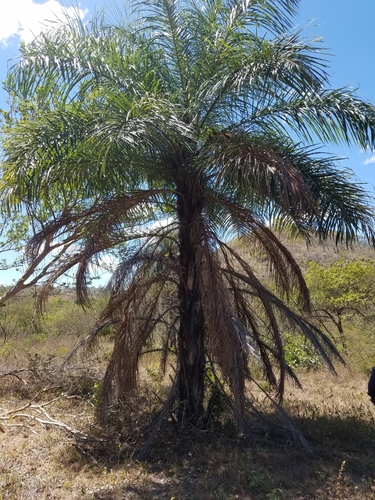
A slender, coarse palm. It forms spiny clumps. It grows about 1-3 m tall. The stems are 15-20 cm across. The trunk is rough and covered with leaf bases. These are densely packed. The fronds are green and often covered with a waxy bloom. They are 2 m long. The fronds arch and the fronds spread in many planes. The leaflets are light green and stiff and sharply pointed. The flowering stalks are amongst the leaf bases. Male and female flowers are on separate trees. The flowers are cream. The fruit are small and about 12 mm long. The fruit ripen to red or violet and have a sweet pulp. Two plants are necessary for viable seed.
How to Grow
Plants are easily grown from seed.
Propagation: Seed - pre-soak for 24 hours prior to sowing. The seed germinates best at a temperature of 21 - 27°c. Division of offsets.
Other Uses
The leaves are woven into ornamental baskets, sleeping mats and pouches. The leaflets are stripped of the midrib, boiled and then sundried before being used for making various woven products. The split petioles are used for making baskets.
Wikipedia
Source ↗Phoenix pusilla (pusilla, Latin: tiny or weak), the Ceylon date palm or flour palm, is a species of flowering plant in the palm family, native to southern India and Sri Lanka (formerly Ceylon). They are found in lowlands, ridges and on hills. No taller than 5 m (16 ft), this species is usually single-stemmed but clumps do occur naturally. At 25 cm (9.8 in) in diameter, the trunks are covered with distinct leaf-base scars, forming a 'wicker' pattern. Their distinguishable trunks have made them popular in cultivation. They are drought tolerant and slow-growing.
Notes
There are 17 Phoenix species.
Names & Synonyms
Chiruta-ita, Chitti-ita, Chittintal, EEchai, Eentha, Ethee, Flour palm, Hullichula, Iechamaram, Iichchampalam, Inchu palm, Indi, Ithi, Palem kurma ceylon, Palem kurma kerdil, Sagi, Sanna-ichalu, Wal-indi
References (26)
- Ambasta, S.P. (Ed.), 2000, The Useful Plants of India. CSIR India. p 448
- Amoros, A., et al, 2014, Physico-chemical and functional characteristics of date fruits from different Phoenix species (Arecaceae). Fruits, Vol. 69, p. 315-323
- Arinathan, V., et al, 2007, Wild edibles used by Palliyars of the western Ghats, Tamil Nadu. Indian Journal of Traditional Knowledge. 6(1) pp 163-168
- Ashton, M. S., et al 1997, A Field Guide to the Common Trees and Shrubs of Sri Lanka. WHT Publications Ltd. p 81 (As Phoenix farinifera)
- Balick, M.J. and Beck, H.T., (Ed.), 1990, Useful palms of the World. A Synoptic Bibliography. Colombia p 121 (As Phoenix farinifera), 576 (As Phoenix farinifera),
- Blomberry, A. & Rodd, T., 1982, Palms. An informative practical guide. Angus & Robertson. p 141
- Burkill, I.H., 1966, A Dictionary of the Economic Products of the Malay Peninsula. Ministry of Agriculture and Cooperatives, Kuala Lumpur, Malaysia. Vol 2 (I-Z) p 1742 (As Phoenix farinifera)
- Dobriyal, M. J. R. & Dobriyal, R., 2014, Non Wood Forest Produce an Option for Ethnic Food and Nutritional Security in India. Int. J. of Usuf. Mngt. 15(1):17-37
- Facciola, S., 1998, Cornucopia 2: a Source Book of Edible Plants. Kampong Publications, p 30
- Fruct. sem. pl. 1:24, t. 9, fig. 2. 1788
- Haynes, J., & McLaughlin, J., 2000, Edible palms and Their Uses. University of Florida Fact sheet MCDE-00-50-1 p 11
- Hedrick, U.P., 1919, (Ed.), Sturtevant's edible plants of the world. p 488 (Also as Phoenix farinifera)
- Johnson, D.V., 1998, Tropical palms. Non-wood Forest products 10. FAO Rome. p 42 (As Phoenix farinifera)
- Jones, D.L., 1994, Palms throughout the World. Smithtonian Institution, Washington. p 286 (As Phoenix farinifera)
- Jones, D.L., 1994, Palms throughout the World. Smithtonian Institution, Washington. p 51, 54, 288
- Jones, D.L., 2000, Palms of Australia 3rd edition. Reed/New Holland. p 195
- Lord, E.E., & Willis, J.H., 1999, Shrubs and Trees for Australian gardens. Lothian. p 98
- Peduruhewa, P. S., et al, 2021, Potential of Underutilized Wild Edible Plants as the Food for the Future – A Review. Journal of Food Security, Vol. 9, No. 4, 136-147
- Rajapaksha, U., 1998, Traditional Food Plants in Sri Lanka. HARTI, Sri Lanka. p 373 (As Phoenix zeylanica)
- Riffle, R.L. & Craft, P., 2003, An Encyclopedia of Cultivated Palms. Timber Press. p 403
- SHORTT, (As Phoenix farinifera)
- Singh, H.B., Arora R.K.,1978, Wild edible Plants of India. Indian Council of Agricultural Research, New Delhi. p 68
- Sivakumar, A. & Murugesan, M., 2005, Ethnobotanical Studies of the wild edible plants used by the tribals of the Anaimalai Hills, the Western Ghats. Ancient Science of Life. XXV(2) Oct-Dec.
- Sukarya, D. G., (Ed.) 2013, 3,500 Plant Species of the Botanic Gardens of Indonesia. LIPI p 801
- WATT, (As Phoenix farinifera)
- World Checklist of Useful Plant Species 2020. Royal Botanic Gardens, Kew