Attalea spectabilis
Mart.
Curua

Wikimedia Commons - Wallace, Alfred Russel

Wikimedia Commons - Bauer, Ferdinand; Martius, Karl Friedrich Philipp von; Mohl, Hugo von; Unger, F.; Weigel, T. O.
What to Eat
Edible parts: Fruit
Fruit - raw or cooked. The layer of creamy pulp that surrounds the hard endocarp is eaten raw, especially by farmers and children who will often snack on them while on their way to or from fields. The pulp is also used to prepare a creamy, somewhat bland drink, and to make a tamale-like meal, where the pulp is mixed with manioc flour, and wrapped in the leaves fronds prior to baking. The brownish, ovoid to ellipsoid fruits are 50 - 60mm long and 30 - 40mm wide. A layer of creamy flesh encloses one or two large seeds[. The fruits are borne in bunches low to the ground and so are very easy to harvest
Where to Find It
A tropical plant. It grows on sandy soils at low elevations.
Amazon, Brazil, Guianas, Guyana, South America, Suriname,
How to Identify
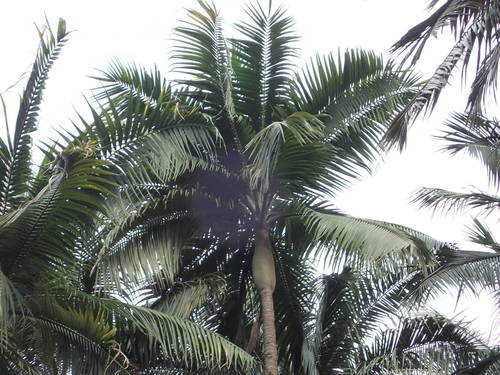
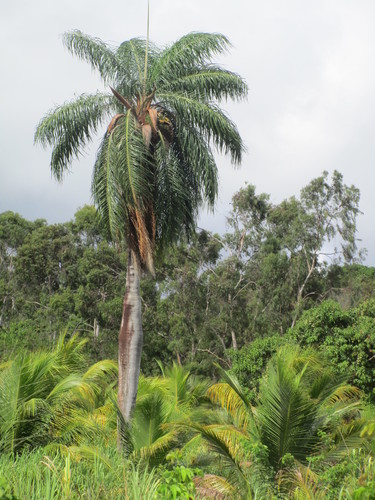
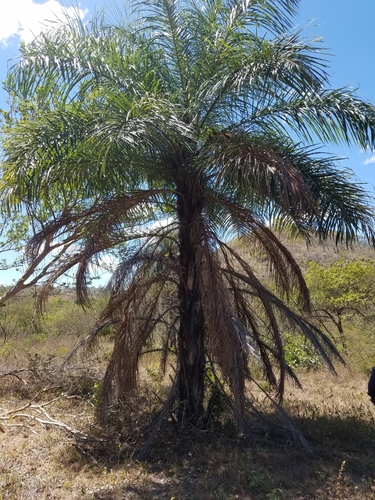
A palm. The stems are short and underground. They are 1 m long. They spread by underground stems. There are 8 leaves. The leaflets are regularly arranged. They spread in the same plane. The flowering stalk is erect. It is borne among the leaves. The stamens of the male flowers are coiled and twisted. The fruit have 1-2 seeds. The fruit are oval and 5-6 cm long by 3-4 cm wide. They are brownish.
How to Grow
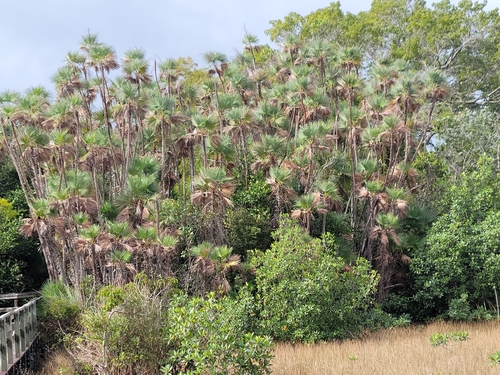
To ranchers, Attalea spectabilis is a weed because it quickly invades pastures, shading out planted grasses. Even the most potent herbicides have failed to curtail the aggressive palm on plantations for pulpwood. Once established, the plant is tenacious and soon re-sprouts after being cut to ground level. Fire has little impact on the roots, and only by allowing the forest to return can it be suppressed.. after cutting. Curua´ is thus found, such as in the outskirts of Arapixuna, where farmers initially clear curua´ only to find it reappearing among their crops several months later.
Other Uses
The leaves are used for thatching. The sizeable leaves make an ideal roof thatch for houses, as well as being used for making interior and exterior walls of houses. The can also be woven to make items such as mats and baskets. Fibre from the leaves is used to make ropes. Smoke from the burning fruits has been used to coagulate latex. In areas where slash-and-burn farmers have been operating for a long time Attalea spectabilis often forms dense stands, which is a nuisance or a blessing, depending on one’s perspective. It is considered to be a weed by ranchers because it quickly invades pastures, shading out planted grasses, but when used as a pioneer for reforestation purposes it is certainly a blessing, providing excellent conditions for the forest trees to become established whilst also providing food and materials
Notes
There are between (22) 30-71 Attalea species. Some authorities divide them among Attalea, Orbignya, Scheela and Maximiliana.
Names & Synonyms
References (7)
- Balick, M.J. and Beck, H.T., (Ed.), 1990, Useful palms of the World. A Synoptic Bibliography. Colombia p 68 (As Orbignya spectabilis), 125, 208,
- Bircher, A. G. & Bircher, W. H., 2000, Encyclopedia of Fruit Trees and Edible Flowering Plants in Egypt and the Subtropics. AUC Press. p 48
- Etkin, N. L. (Ed.), 1994, Eating on the Wild Side, Univ. of Arizona. p 140 (As Orbignya spectabilis)
- Jones, D.L., 1994, Palms throughout the World. Smithtonian Institution, Washington. p 55 (As Orbignya spectabilis)
- Henderson, A., Galeano, G and Bernal, R., 1995, Field Guide to the Palms of the Americas. Princeton. p 164
- Hist. nat. palm. 2:136, 96, fig. 1-2. 1826
- van Roosmalen, M.G.M., 1985, Fruits of the Guianan Flora. Utrecht Univ. & Wageningen Univ. p 342