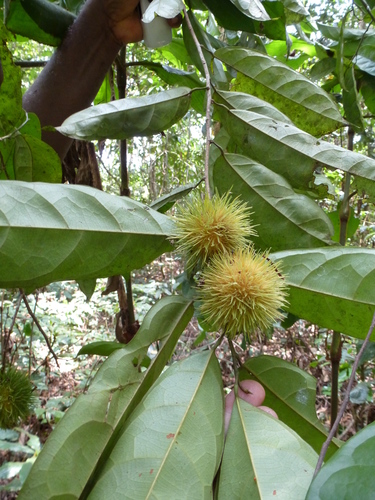
Carpotroche brasiliensis
(Raddi) A. Gray
Brazil carpotroche

(c) thiagolyra, some rights reserved (CC BY-NC)

(c) thiagolyra, some rights reserved (CC BY-NC)

(c) thiagolyra, some rights reserved (CC BY-NC)
What to Eat
Edible parts: Fruit
The fruit pulp is eaten raw and is used to make wine-like drinks.
Where to Find It
A tropical plant. It grows in Brazil in forests near the Atlantic coast
Amazon, Brazil, Colombia, Ecuador, South America, Venezuela,
How to Identify
A tree. It grows 10-20 m high. It has a tall crown. The trunk is 30-40 cm across. The bark is rough. The leaves are simple and hairy when young. They are 14-18 cm long. The flowers occur singly or in small groups. The flowers are white but turn yellow and have a brown throat. Plants can be male, female or have both sexes. The fruit is a large green capsule. The seeds have a yellow aril around them. There are 80-120 seeds in each fruit.
How to Grow
The tree is grown from seed. The ripe fruit are harvested and the seeds removed. Fresh seed are planted and they germinate in 15-30 days.
Propagation: Seed - remove the seeds from the spherical pods and either germinate directly, or remove seed from the hard, outer shell. It can take up to 6 months to germinate. Do not germinate deep in soil. It is also possible to collect seedlings from under tree. Do not take more than 50% of the seedlings.
Medicinal Uses
The seed oil (officinal Oleum Carpotroche) is used externally in the treatment of leprosy and other dermatological conditions. It is also used as a parasiticide, a depilatory and anti-dandruff treatment. The oil contains sulphones, which have been shown to have an anti-leprosy action. It also contains chaulmoogric, hydnocarpic and gorlic acids. Cyanogenic glycosides are found in the seeds and pericarp.
Other Uses
The oil from the seed has insecticidal and parasiticidal properties. The oil is also traditionally used to make a soap. The wood is moderately heavy, compact, difficult to work, splits easily and is moderately durable even under adverse conditions. It is used for internal purposes, cabinet making, carpentry, boxes etc. The wood is used for fuel and is made into charcoal.
Production
Plants grow slowly. Trees may be 1.5 m tall after 2 years.
Notes
There are about 30 Carpotroche species. They are also put in the family Kiggelariaceae and Euphorbiacece. Also put in the Flacourtiaceae family.
Names & Synonyms
Canudo-de-pito, Canudeiro, Fruta-de-babado, Fruta-de-comona, Fruta-de-cotia, Fruta-de-macaco, Fruta-de-lepra, Mata-piolho, Papo-de-anjo, Pau-de-anjo, Pau-de-cachimbo, Pau-de-lepra, Ruchuchu, Sapucainha
References (6)
- Bircher, A. G. & Bircher, W. H., 2000, Encyclopedia of Fruit Trees and Edible Flowering Plants in Egypt and the Subtropics. AUC Press. p 85
- Fouqué, A., 1972, Espèces fruitières d'Amérique tropicale. Institut français de recherches fruitierès outre-mer
- Grandtner, M. M. & Chevrette, J., 2013, Dictionary of Trees, Volume 2: South America: Nomenclature, Taxonomy and Ecology. Academic Press p 102
- Lorenzi, H., 2002, Brazilian Trees. A Guide to the Identification and Cultivation of Brazilian Native Trees. Vol. 01 Nova Odessa, SP, Instituto Plantarum p 129
- Sleumer, H. O. 1980. Flacourtiaceae. In: Organization for Flora Neotropica, ed., Fl. Neotrop. Monogr. 22:33.
- C. Wilkes, U.S. Expl. Exped., Phan. 15:72. 1854