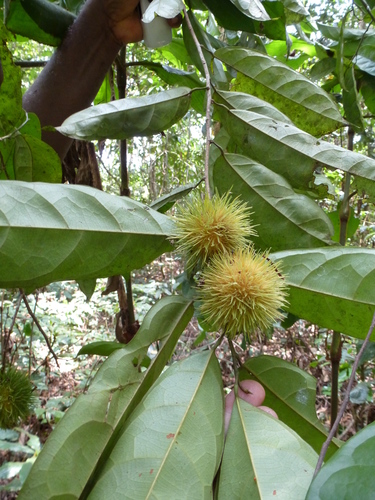
Gynocardia odorata
R. Br.
Chaulmugra tree

no rights reserved, uploaded by S.MORE

(c) pritibangal, some rights reserved (CC BY-NC)
What to Eat
Edible parts: Seeds - oil
The ripe seeds yield an edible oil that can be extracted by roasting. Seeds can also be prepared by boiling and draining several times before consumption.
Known Hazards
Where to Find It
It is a subtropical plant. It suits moist swampy places. In China it grows in mountain valleys in sparse forests between 800-1,000 m above sea level. In Yunnan.
Asia, Bangladesh, Bhutan, China, Himalayas, India, Indonesia, Myanmar, Nepal, Northeastern India, SE Asia, Sikkim, Tibet,
How to Identify
A small evergreen tree. It grows 8 m tall. The bark is brown or greenish and has some lumps. The leaves can be 26 cm long. They are glossy and leathery. The leaves have a short stalk and a pointy tip. The flowers are pale yellow and grow straight from the trunk and old branches. They have 5 petals and have a sweet smell. Male and female flowers grow on separate trees. The fruit are yellowish brown and almost round. They are woody and 10 cm across.
How to Grow
Plants can be grown from seeds.
Production
In Sikkim fruit are available November to January.
Notes
The fruit are used as a fish poison. The oil from the fruit was used to treat leprosy. Also put in the Flacourtiaceae family. There is only one Gynocardia species.
Names & Synonyms
Balibu, Bandarey, Bandre-phal, Bandre, Bonsha, Chavalmungri, Dieng-soh-phailang, Gantay, Gante, Joung-pung, Kadu, Kalaw, Koitur, Lemtem, Pohon melati India, Tuk-kung, Umphu
References (15)
- Ambasta, S.P. (Ed.), 2000, The Useful Plants of India. CSIR India. p 253
- Dangol, D. R. et al, 2017, Wild Edible Plants in Nepal. Proceedings of 2nd National Workshop on CUAOGR, 2017.
- Dobriyal, M. J. R. & Dobriyal, R., 2014, Non Wood Forest Produce an Option for Ethnic Food and Nutritional Security in India. Int. J. of Usuf. Mngt. 15(1):17-37
- Gautam, R. S., et al, 2020, Wild Edible Fruits of Nepal. Int. J. Appl. Sci. Biotechnol. Vol 8(3): 289-304
- Gautam, R. S., et al, 2022, Ethnobotanical Review of Wild Edible Plants of Nepal. Journal of Natural History Museum Volume 32, 2021-22 p 100
- Ghimeray, A. K., Lamsal, K., et al, 2010, Wild edible angiospermic plants of the Illam Hills (Eastern Nepal) and their mode of use by local community. Korean J. Pl. Taxon. 40(1)
- Krishen P., 2006, Trees of Delhi, A Field Guide. DK Books. p 120
- Kumar, A., et al, 2012, Ethnobotanical Edible Plant Biodiversity of Lepcha Tribes. Indian Forester, 138 (9):798-803
- W. Roxburgh, Pl. Coromandel 3(4):95, t. 299. 1820
- Rymbai, H., et al, 2016, Analysis study on potential underutilized edible fruit genetic resources of the foothills track of Eastern Himalayas, India. Genetic. Resourc. Crop Evol. (2016) 63:125-139
- Singh, V. B., et al, (Ed.) Horticulture for Sustainable Income and Environmental Protection. Vol. 1 p 217
- Sundriyal, M., et al, 1998, Wild edibles and other useful plants from the Sikkim Himalaya, India. Oecologia Montana 7:43-54
- Sundriyal, M., et al, 2004, Dietary Use of Wild Plant Resources in the Sikkim Himalaya, India. Economic Botany 58(4) pp 626-638
- Sundriyal, M. & Sundriyal, R. C., 2004, Structure, Phenology, Fruit Yield, and Future Prospects of some Prominent Wild Edible Plant Species of the Sikkim Himalaya, India. Journal of Ethnobiology 24(1): 113-138
- Suresh, C. P. et al, 2014, Wild Edible Tree Fruits of Sikkim Himalayas. Journal of Tree Sciences 33(1): 43-48