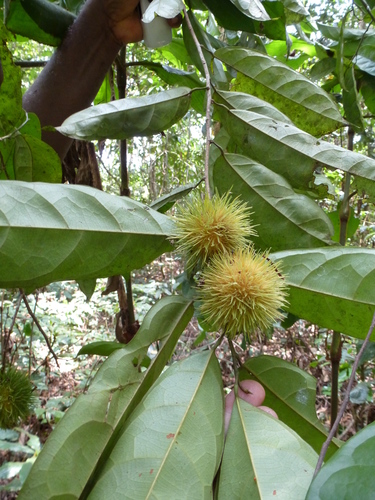
Hydnocarpus castaneus
Hook. f. & Thomson
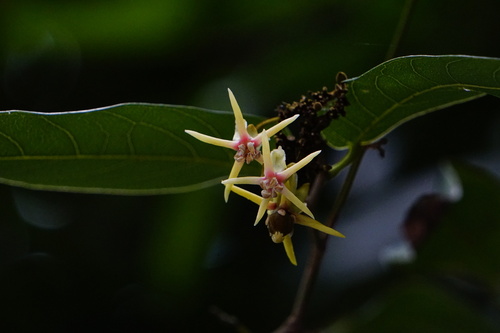
(c) owen688, some rights reserved (CC BY-NC)

(c) Zakaria Al Anshori, some rights reserved (CC BY-NC), uploaded by Zakaria Al Anshori
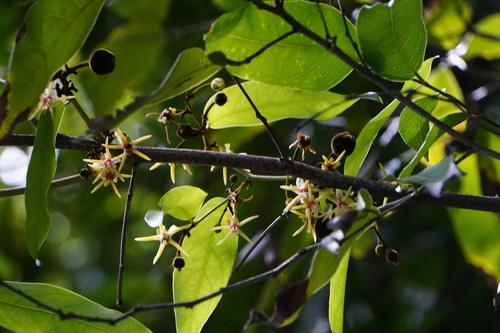
(c) owen688, some rights reserved (CC BY-NC)
What to Eat
Edible parts: Fruit ?
The fruit may be edible.
Known Hazards
Where to Find It
A tropical plant.
Andamans, Asia, India, Indonesia, Malaysia, Myanmar, SE Asia, Thailand,
How to Identify
A tropical tree in the Achariaceae family, possibly also classified in Flacourtiaceae.
How to Grow
Species in this genus generally require well-drained sandy or loamy silt soils and grow best along creek beds or on the banks of streams. Seeds tend to go rancid rather quickly. Therefore ripe fruits should be opened and the fruit pulp and aril removed from the seeds. Seeds are then washed and dried in the sun. Sun-dried seeds, either whole or broken, are cold-pressed or pressed under concurrent heating to extract the oil. The chemical composition of the end-product of these methods varies. A dioecious species, both male and female forms need to be grown if fruit and seed are required
Propagation: Seed - best sown as soon as it is ripe, when it will usually germinate quickly. Germination of stored seed can be slow, with some species in the genus taking up to 2 years. Sow the seed in a shaded position in a nursery seedbed and keep moist. Grow on the seedlings in shade until large enough to plant out.
Medicinal Uses
Also widely known under its name H. anthelminthicus, suggesting anthelmintic properties, the Vietnamese is lọ nồi (sometimes Ðại phong tử). It is one of the 50 fundamental herbs used in traditional Chinese medicine, where it may be called dà fēng zǐ 大风子 or 泰国大风子 tai guo da feng zi.
Other Uses
The wood is whitish. When it attains suitable dimensions, the wood of species in this genus is often used locally for house building (poles), temporary heavy construction, posts, fences, interior finishing, panelling and door and window frames.
Wikipedia
Source ↗Hydnocarpus castaneus is an Asian tree species in the family Achariaceae. It is now accepted that Hydnocarpus anthelminthicus is a synonym and its native range is from Burma, the rest of Indochina through to W. Malesia; this species is now also cultivated in southern China.
Notes
Also put in the Flacourtiaceae family.
Names & Synonyms
Krabao daeng, Krabao khang, Pokok alai batu, Tembikar periyok, Tengkurak lang
References (3)
- Ambasta, S.P. (Ed.), 2000, The Useful Plants of India. CSIR India. p 276
- J. D. Hooker, Fl. Brit. Ind. 1:197. 1872
- World Checklist of Useful Plant Species 2020. Royal Botanic Gardens, Kew