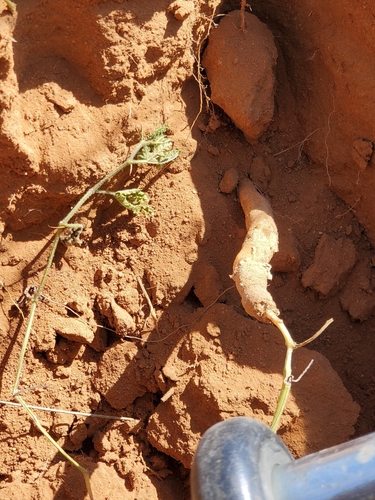
Coccinia palmata
(Sond.) Cogn.

(c) Gail Bowers-Winters, some rights reserved (CC BY-NC)

(c) Gail Bowers-Winters, some rights reserved (CC BY-NC)

(c) Gail Bowers-Winters, some rights reserved (CC BY-NC)
What to Eat
Edible parts: Leaves, Roots, Fruit
The leaves are cooked and eaten. The roots are eaten occasionally, traditionally used as a famine food. The fruit is also edible.
Where to Find It
In Swaziland it grows in the high veld only. It grows at about 1,800 m above sea level. It cannot tolerate frost. It can grow in arid places.
Africa, East Africa, Eswatini, Malawi, South Africa, Southern Africa, Swaziland,
How to Identify
A pumpkin family herb. It is a climber. The stem is smooth. The leaf stalk is 5 cm long. The leaf blade is divided into 5 broad lobes to about half their depth. The leaves are 15 cm long and wide. The leaves have a few hairs and many small black dots. They are wavy along the edge. The flowers occur singly. The flower stalks are 2 cm long. The flowers are yellow. The fruit are long and red. They are 4 cm long by 1 cm wide.
Other Information
The roots are a famine food.
Names & Synonyms
Fwifwi, Gomo, Uthangazane lwehlathi, Uthangazane omncane, Xipapa
References (7)
- Fox, F. W. & Young, M. E. N., 1982, Food from the Veld. Delta Books. p 170
- Grivetti, L. E., 1980, Agricultural development: present and potential role of edible wild plants. Part 2: Sub-Saharan Africa, Report to the Department of State Agency for International Development. p 66
- Long, C., 2005, Swaziland's Flora - siSwati names and Uses http://www.sntc.org.sz/flora/
- Royal Botanic Gardens, Kew (1999). Survey of Economic Plants for Arid and Semi-Arid Lands (SEPASAL) database. Published on the Internet; http://www.rbgkew.org.uk/ceb/sepasal/internet [Accessed 15th April 2011]
- Ruiters-Welcome, A. K., 2019, Food plants of southern Africa. Ph.D. thesis. Univ. of Johannesburg p 48
- Shackleton, S. E., et al, 1998, Use and Trading of Wild Edible Herbs in the Central Lowveld Savanna Region, South Africa. Economic Botany, Vol. 52, No. 3, pp. 251-259
- Swaziland's Flora Database http://www.sntc.org.sz/flora