Morchella elata
E. M. Fries : Fr.
Black Morel, Tall morel
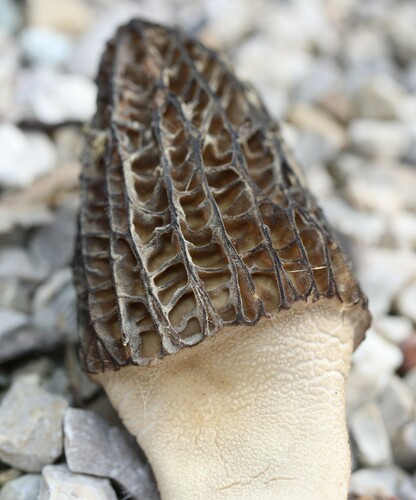
(c) Barbara Klenner, some rights reserved (CC BY-NC), uploaded by Barbara Klenner
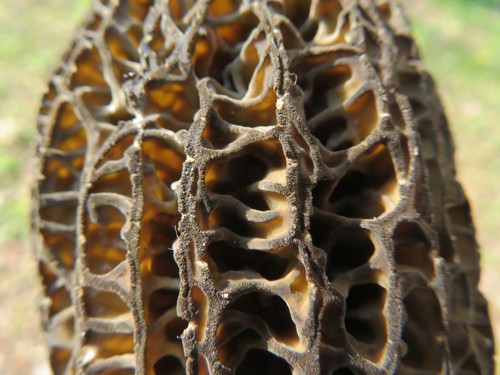
(c) Giorgio Desidera, some rights reserved (CC BY-NC), uploaded by Giorgio Desidera
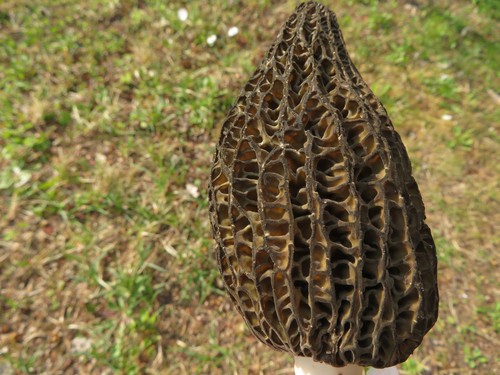
(c) Giorgio Desidera, some rights reserved (CC BY-NC), uploaded by Giorgio Desidera
What to Eat
Edible parts: Mushroom, Fungus
This is an edible species, although like other morels, some individuals may be allergic to it, so it must be cooked before being eaten. It can also be dried for later use. However, according to one field guide it may cause gastrointestinal disorder, and cannot easily be identified without a microscope.
Known Hazards
Dangerous Lookalikes
This plant can be confused with the following toxic species. Always verify identification carefully before consuming any wild plant.


False Morel: Irregular brain-like wrinkles/folds, chambered or solid inside (not hollow), cap often hangs free from stem.
Black Morel: Regular honeycomb/pitted pattern on cap, completely hollow inside, cap attached directly to stem.
Where to Find It
It is a temperate plant. In Peru it grows between 3,600-3,900 m above sea level.
Argentina, Asia, Australia, Britain, Canada, China, Europe, Himalayas, Italy, Mediterranean, Mexico, Nepal, North America, Pakistan, Peru, South America, Tasmania, Turkey, Türkiye, USA.
How to Identify
A morel or mushroom.
Wikipedia
Source ↗Morchella elata is a species of fungus in the family Morchellaceae. It is one of many related species commonly known as black morels, and until 2012 the name M. elata was broadly applied to black morels throughout the globe. Like most members of the genus, M. elata is a popular edible fungus and is sought by many mushroom hunters.
Notes
They have also been put in the family Agaricaceae.
Names & Synonyms
Da kwar guchhi, Gaoyangdujun, Kallampa, Mancita, Mathheuraa, Mazorquita, Organito
References (18)
- Boa, E. R., 2004, Wild edible fungi and their importance to people. FAO Non Wood Forest Products Booklet 17
- Bougher, N.L. & Syme, K., 1998, Fungi of Southern Australia. UWA Press p 100
- Devkota, S., 2008, Distribution and Status of Highland mushrooms: A study from Dolpa, Nepal. J.Nat.Hist.Mus.Vol.23,2008, 51-59
- Ertug, F., 2004, Wild Edible Plants of the Bodrum Area. (Mugla, Turkey). Turk. J. Bot. 28 (2004): 161-174
- Estrada-Martinez, E., et al, 2009, Contribucion al conocimiento etnomicologico de los Hongos Comestibles Silvestres de Mercados Regionales y Comunidades de la Sierra Nevada (Mexico). Intercienca Jan 2009 Vol. 34 No. 1
- Franquemont, C., et al, 1990, The Ethnobotany of Chinchero, an Andean Community in Southern Peru. Fieldiana Botany No. 24 p 32
- Fuhrer, B., 2005, A field guide to Australian Fungi. Bloomings Books. p 329
- http://www.mykoweb.com/CAF/edible.html
- Jordan, P., 2000, The Mushroom Guide and Identifier, Hermes House, p 80
- Kang, J. et al, 2016, Wild food plants and fungi used in the mycophilous Tibetan community of Zhagana (Tewo Country, Gansu, China) Journal of Ethnobiology and Ethnomedicine. 12:21
- Kaufmann, B. et al, 1999, The Great Encyclopedia of Mushrooms. Konemann. p 225
- Montoya, A., et al, 2003, Traditional Knowledge about Mushrooms in a Nahua Community in the State of Tlaxcala, Mexico. Mycologia 95(5) pp. 793-806
- Montoya, A., et al, 2014, Availability of Wild Edible Fungi in La Malinche National park, Mexico. Journal of Mycology. Article ID 241896, 15 pages
- Pace, G., 1998, Mushrooms of the world. Firefly books. p 237
- Perez-Moreno, J., et al, 2009, Social and Biotechnological Studies of Wild Edible Mushrooms in Mexico. Acta Botanica Yunnanica Suppl. XV1: 55-61
- Sher, H. et al, 2011, Ethnobotanical and Economic Observations of Some Plant Resources from the Northern Parts of Pakistan. Ethnobotany research & Applications 9:027-041
- Thomson, G. & Morgan, W., (Ed.) 2001, Access to Asian Foods Newsletter, Vic Govt., Australia Issue 9
- www.plantnames.unimelb.edu.au


