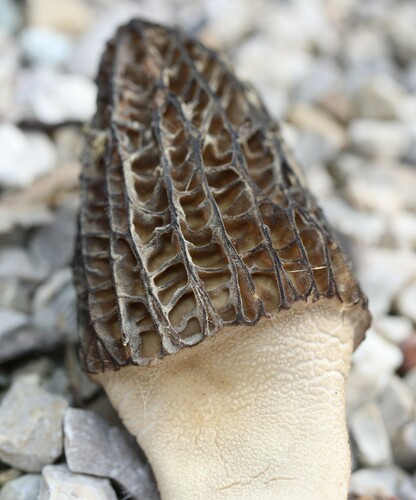
Morchella conica
Pers.

(c) oliviarosen, some rights reserved (CC BY-NC)
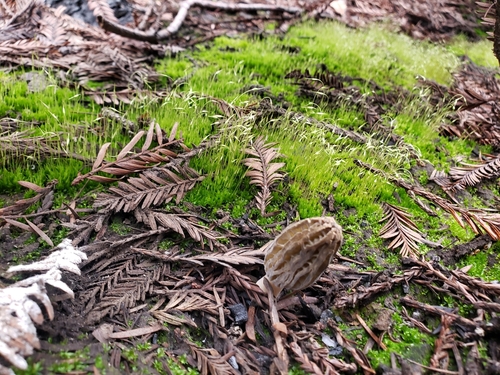
(c) Joe Paquin, some rights reserved (CC BY-NC)
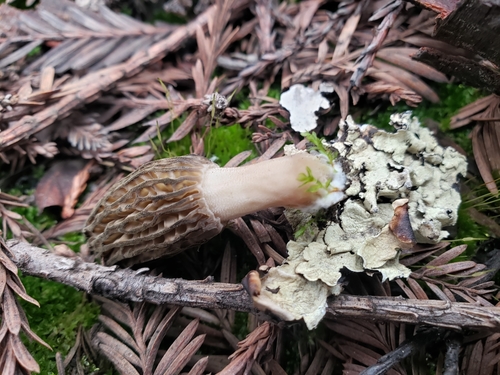
(c) Joe Paquin, some rights reserved (CC BY-NC)
What to Eat
Edible parts: Mushroom, Fungus
The mushroom fruiting body is edible.
Dangerous Lookalikes
This plant can be confused with the following toxic species. Always verify identification carefully before consuming any wild plant.


False Morel: Irregular brain-like wrinkles/folds, chambered or solid inside (not hollow), cap often hangs free from stem.
Morchella conica: Regular honeycomb/pitted pattern on cap, completely hollow inside, cap attached directly to stem.
Where to Find It
It is a temperate to subtropical plant.
Africa, Asia, Balkans, Botswana, Bulgaria, Caucasus, Chile, China, Georgia, Himalayas, Kyrgyzstan, Mexico, Nepal, North America, Pakistan, Russia, Southern Africa, South America, Turkey, Türkiye,
How to Identify
Morchella conica is a morel mushroom in the family Morchellaceae, found in temperate to subtropical regions, and is popular for culinary use.
Wikipedia
Source ↗Morchella conica is an old binomial name previously applied to species of fungi in the family Morchellaceae. It is one of three scientific names that had been commonly used to describe black morels, the others being M. angusticeps and M. elata. It was first introduced by mycologist Christian Hendrik Persoon in 1818, as a superfluous name for the old taxon Morchella continua. According to Richard and colleagues, Fries’ sanctioning applies only at the subgeneric level and the name is illegitimate. Throughout the years, the name M. conica has been invariably applied to many different species by different authors, and DNA analysis in 2014 revealed that morels identified as "M. conica" indeed belonged to Morchella deliciosa, Morchella purpurascens, Morchella tridentina, and Morchella vulgaris.
Other Information
It is popular.
Notes
They have also been put in the family Agaricaceae.
Names & Synonyms
Khrispashva, Mathheura, Mazorquita, Organito
References (12)
- Acharya, K. P., Paudel, P. K., 2020, Biodiversity in Karnali Province: Current Status and Conservation. Ministry of Industry, Tourism, Forest and Environment, Karnali Province Government, Surkhet, Nepal
- Boa, E. R., 2004, Wild edible fungi and their importance to people. FAO Non Wood Forest Products Booklet 17
- Bussman, R. W., et al, 2016, A comparative ethnobotany of Khevsureti, Samtskhe-Javakheti, Tusheti, Svaneti, and Racha-Lechkhumi, Republic of Georgia (Sakartvelo), Caucasus. Journal of Ethnobiology and Ethnomedicine (2016) 12:4
- Bussman, R. W., et al, 2021, Unity in diversity—food plants and fungi of Sakartvelo (Republic of Georgia), Caucasus. Journal of Ethnobiology and Ethnomedicine (2021) 17:72 p 16
- Christensen, M., et al, 2008, Collection and Use of Wild Edible Fungi in Nepal. Economic Botany, 62(1), 2008, pp. 12–23
- Denchev, C. M., et al, The wild edible mushrooms in Bulgaria. Bulgarian Academy of Science.
- Devkota, S., 2008, Distribution and Status of Highland mushrooms: A study from Dolpa, Nepal. J.Nat.Hist.Mus.Vol.23,2008, 51-59
- Estrada-Martinez, E., et al, 2009, Contribucion al conocimiento etnomicologico de los Hongos Comestibles Silvestres de Mercados Regionales y Comunidades de la Sierra Nevada (Mexico). Intercienca Jan 2009 Vol. 34 No. 1
- Fox, F. W. & Young, M. E. N., 1982, Food from the Veld. Delta Books. p 234
- Hall, I. R., et al, 2003, Edible and Poisonous Mushrooms of the World. Timber Press. p 310
- Martin, J. S. & Villagra M. M., 2013, Productos forestales no madereros de la Region del Maule. p 21
- Mortimer, P. E. et al, 2012, Prized edible Asian mushrooms: ecology, conservation and sustainability. Fungal Diversity 56(1) p 31-47