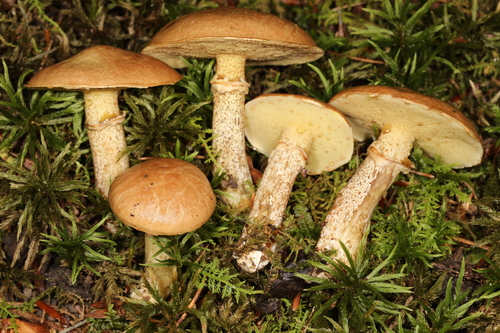
Suillus variegatus
(Fr.) O. Kuntze
The variegated bolete, Velvet bolete

iNaturalist · cc-by-nc
(c) Federico Calledda, some rights reserved (CC BY-NC), uploaded by Federico Calledda
(c) Federico Calledda, some rights reserved (CC BY-NC), uploaded by Federico Calledda
iNaturalist · cc-by-nc
(c) Tobias Polzer, some rights reserved (CC BY-NC)
(c) Tobias Polzer, some rights reserved (CC BY-NC)

iNaturalist · cc-by-nc
(c) vocifer, some rights reserved (CC BY-NC)
(c) vocifer, some rights reserved (CC BY-NC)
What to Eat
Edible parts: Mushroom, Fungus
The mushroom fruiting body is edible.
Known Hazards
Where to Find It
It is a temperate plant.
Balkans, Bulgaria, Czech Republic, Denmark, Europe, Finland, Norway, Poland, Russia, Scandinavia, Spain, Sweden,
Countries: Andorra, Albania, Austria, Bosnia & Herzegovina, Belgium, Bulgaria, Belarus, Switzerland, Cyprus, Czechia, Germany, Denmark, Estonia, Spain, Finland, France, United Kingdom, Greece, Croatia, Hungary, Ireland, Iceland, Italy, Liechtenstein, Lithuania, Luxembourg, Latvia, Monaco, Moldova, Montenegro, North Macedonia, Malta, Netherlands, Norway, Poland, Portugal, Romania, Serbia, Russia, Sweden, Slovenia, Slovakia, San Marino, Ukraine
How to Identify
A temperate-zone mushroom in the family Suillaceae.
Wikipedia
Source ↗Suillus variegatus, commonly called the velvet bolete or variegated bolete, is a species of edible mushroom in the genus Suillus. Like all bolete-like species it has tubes, and pores, instead of gills under its cap. The mushroom forms a mycorrhizal relationship with pine and occurs in North America and Eurasia.
Notes
Also put in the family Boletaceae.
Names & Synonyms
Kangstatti, Sandsopp, Sandsvamp
Boletus variegatus Fr.Ixocomus variegatus Swartz.:Fr.Boletus bovinus
References (9)
- Boa, E. R., 2004, Wild edible fungi and their importance to people. FAO Non Wood Forest Products Booklet 17
- Denchev, C. M., et al, The wild edible mushrooms in Bulgaria. Bulgarian Academy of Science.
- Jordan, P., 2000, The Mushroom Guide and Identifier, Hermes House, p 92
- Kalac, P. and Svoboda, L., 1999, A review of trace element concentrations in edible mushrooms. Food Chemistry 69: 273-281
- Kasper-Pakosz, R., et al, 2016, Wild and native plants and mushrooms sold in the open-air markets of south- eastern Poland. Journal of Ethnobiology and Ethnomedicine 12:45
- Kaufmann, B. et al, 1999, The Great Encyclopedia of Mushrooms. Konemann. p 18
- Pace, G., 1998, Mushrooms of the world. Firefly books. p 194 (As Boletus variegatus)
- Pelkonen, R., et al, 2008, Element Concentrations in Wild Edible Mushrooms in Finland. The Finnish Environment 25
- Svanberg, I., & Lindh, H., 2019, Mushroom hunting and consumption in twenty-first century post-industrial Sweden. Journal of Ethnobiology and Ethnomedicine (2019) 15:42