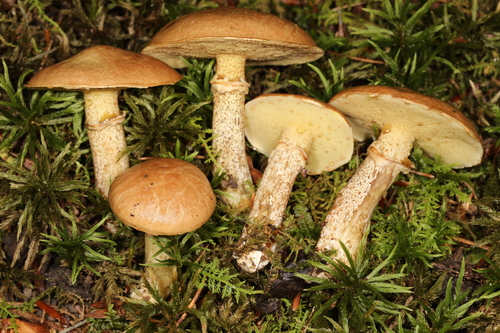
Suillus americanus
(Peck) Snell
White pine bolete

(c) Dave Lewis, some rights reserved (CC BY-NC-SA)

(c) Kathie Hodge, some rights reserved (CC BY-NC-SA)

(c) Kathie Hodge, some rights reserved (CC BY-NC-SA)
What to Eat
Edible parts: Mushroom, Fungus
The mushroom must be cooked before eating.
Known Hazards
Documented Toxic Effects
Source: Encyclopedia of Life TraitBank. Toxicity often varies by plant part — consult the hazards section above for preparation-specific details.
Where to Find It
It is a temperate plant. It grows in association with white pine.
Asia, China, Hong Kong, Mexico, North America, Russia, USA,
How to Identify
A temperate mushroom that grows in association with white pine trees.
Wikipedia
Source ↗Suillus americanus is a species of mushroom-forming fungus in the family Suillaceae. Commonly known as the chicken fat mushroom and the American suillus, it produces bright yellow, often slimy caps marked with red to reddish-brown scales, a pore surface of large yellow angular pores that can stain brownish when bruised, and a slender yellow stipe dotted with darker glandular spots. The species was first described in the late 19th century by the American mycologist Charles Horton Peck and later transferred to Suillus. It closely resembles S. sibiricus, and DNA-based studies have led some authors to treat the two names as referring to a single, wide-ranging species complex, with several regional variants recognized at infraspecific rank. Suillus americanus is an ectomycorrhizal fungus that forms symbiotic associations with pines, best known in North America from eastern white pine (Pinus strobus). Fruiting bodies appear on the ground, singly or in clusters, most often from late summer into autumn, and records based on collections and DNA sequencing indicate a broader Northern Hemisphere distribution than was once assumed, including parts of East Asia and the Balkan Peninsula. Greenhouse experiments suggest strong host filtering during spore germination, and competition studies indicate it can colonize pine seedlings readily and dominate some other pine-associated Suillus species. The mushroom is edible but often considered mediocre because of its slimy texture, and some people develop contact dermatitis after handling it; laboratory work has also identified a beta glucan with anti-inflammatory activity. Although assessed as Least Concern globally, it has been treated as threatened or legally protected in parts of southeastern Europe where it occurs with scattered high-elevation five-needle pine forests.
Notes
Also put in the family Boletaceae.
Names & Synonyms
References (4)
- Boa, E. R., 2004, Wild edible fungi and their importance to people. FAO Non Wood Forest Products Booklet 17
- Li, H., et al, 2020, Reviewing the world’s edible mushroom species: A new evidence-based classification system. Compr Rev Food Sci Food Saf. 2021;20:1982–2014.
- Ostry, M. E., et al, 2010, Field Guide to Common Macrofungi in Eastern Forests and Their Ecosystem Functions. USDA Forest Service General Technical Report NRS-79 p 46
- Wikipedia