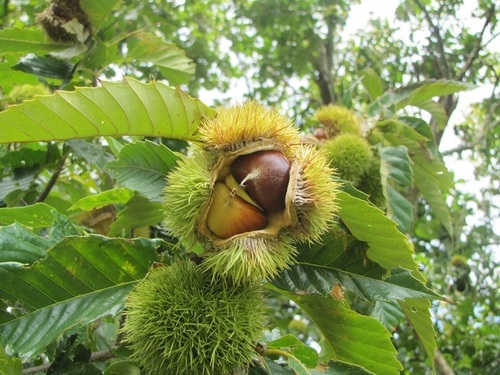
Lithocarpus pattaniensis
Barnett
Ko faai, Lan oak

President and Fellows of Harvard College

President and Fellows of Harvard College

President and Fellows of Harvard College
What to Eat
Edible parts: Seeds, Nuts
The seed is eaten.
Where to Find It
A tropical plant.
Asia, Indochina, Laos, SE Asia, Thailand,
How to Identify
A tree. It grows up to 25 m tall. The leaves are oval and narrow at the tip. They are rough. The midrib and veins are prominent. They are shiny brown on the upper surface and hairy brown underneath. The leaves are 14-16 cm long by 6-8 cm wide. The leaf stalk is 1-2 cm long. The flower branch has male and female flowers separately. They are along a 10-15 cm long stalk. The male flowers are in threes while the female flowers are single. The flowers are densely yellowish-brown and hairy. The cup surrounding the fruit is oval and thin. It encloses the fruit almost completely. The fruit is about 2 cm long and 2.5 cm wide. The fruit is round. It has a scar. The fruit is woody and 1-1.5 cm high by 2-2.5 cm wide. The fruit contains an edible seed.
Notes
There are about 300 Lithocarpus species.
References (1)
- Jacquat, C., 1990, Plants from the Markets of Thailand. D.K. Book House p 64
More from Fagaceae