Geonoma interrupta
(Ruiz. et Pav.) Mart.
Chontilla

(c) Eric Knight, some rights reserved (CC BY)
(c) amalib, some rights reserved (CC BY-NC)

(c) Diego Villar, some rights reserved (CC BY-NC)
What to Eat
Edible parts: Young flowers, Palm hearts, Cabbage, Seed, Fruit
The young tender flowers are cooked and eaten. The palm heart, though somewhat bitter, is also eaten. The fruit, seeds, and cabbage are edible portions.
Where to Find It
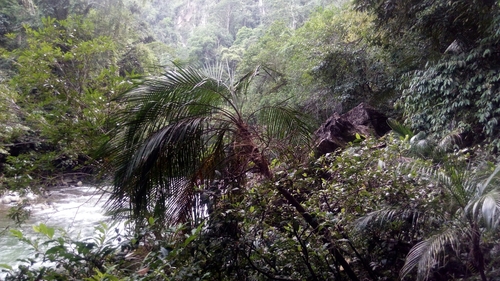
A tropical plant. It is an understorey plant in lower mountain rainforest. It need well drained soil. It grows up to about 1000 m altitude.
Amazon, Belize, Bolivia, Brazil, Central America, Colombia, Costa Rica, Dominica, Ecuador, Guianas, Guyana, Haiti, Honduras, Lesser Antilles, Martinique, Mexico, North America, Peru, SE Asia, Singapore, South America, Suriname, Trinidad, Venezuela, West Indies,
How to Identify
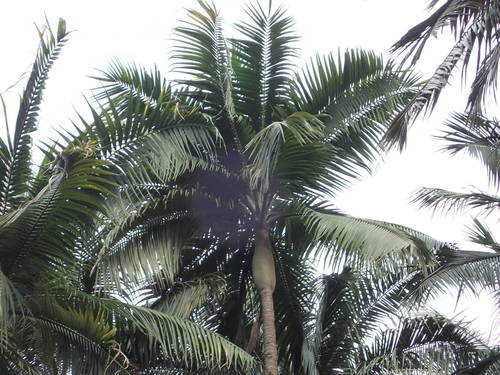
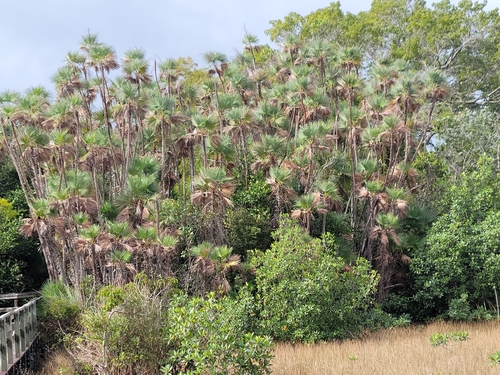
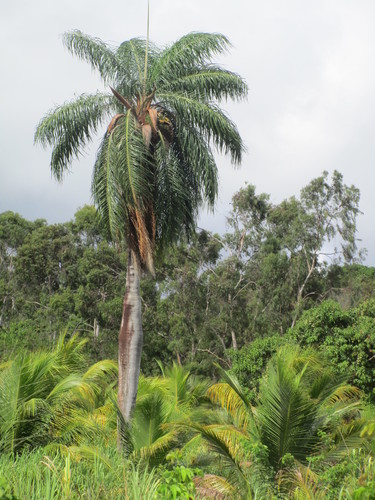
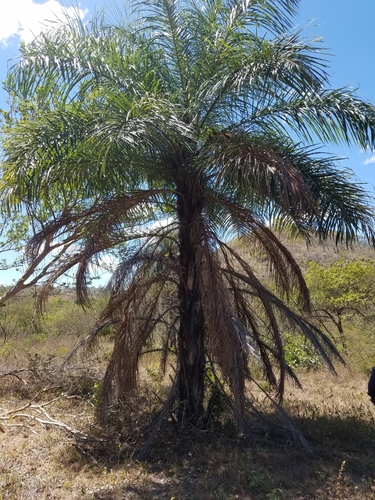
A palm. It can have a single stem or up to 10 stems. They can be 0.1-7 m tall and 2-12 cm wide. They are light brown. There are 6-23 leaves and the blades are 2 m long. The leaflets may be regular or irregular. There are 3-41 curved leaflets on each side. There are usually narrow leaflets among broad leaflets. The flowering stalk is among the leaves. The flowering stalk has 1-3 orders or branching. There are 8-32 flowering branches. The lower ones are branched again and 9-25 cm long and 1-3 mm thick. The fruit are round and 3-6 mm long.
How to Grow
A plant of the lowland tropics. Needs a moist semi shaded or shaded position.
Other Uses
Large leaves are used for thatching. The stems are used to make tool handles.
Notes
There are about 51 Geonoma species.
Names & Synonyms
Cana brava, Chillibo, Chocho blanco, Coco macaque, Cortadera, Ewenpaden, Juo, San Pablo, Sisawa, Surtuba, Pacuca, Palmiche, Turuji, Uksha, Urpi chunta, Yanga
References (19)
- Altschul, S.V.R., 1973, Drugs and Foods from Little-known Plants. Notes in Harvard University Herbaria. Harvard Univ. Press. Massachusetts. no. 84 (As Geonoma binervis)
- Balick, M.J. and Beck, H.T., (Ed.), 1990, Useful palms of the World. A Synoptic Bibliography. Colombia p 437 (As Geonoma edulis), 659 (As Geonoma edulis),
- Castaneda, H., & Stepp, J. R., 2007, Ecosystems as Sources of Useful Plants for the Guaymi People of Costa Rica. Ethnobotany Journal. 5(:249-257.
- D'Ambrosio, U., & Puri, R. K., 2016, Foodways in transition: food plants, diet and local perceptions of change in a Costa Rican Ngäbe community. Journal of Ethnobiology and Ethnomedicine (2016) 12:3 p 22
- Facciola, S., 1998, Cornucopia 2: a Source Book of Edible Plants. Kampong Publications, p 28 (As Geonoma binervia)
- Grandtner, M. M., 2008, World Dictionary of Trees. Wood and Forest Science Department. Laval University, Quebec, Qc Canada. (Internet database http://www.wdt.qc.ca)
- Grandtner, M. M. & Chevrette, J., 2013, Dictionary of Trees, Volume 2: South America: Nomenclature, Taxonomy and Ecology. Academic Press p 264
- Grayum, M. H., 2000, MBG: Research: Manual de Plantas de Costa Rica: Draft Treatments p 9
- Haynes, J., & McLaughlin, J., 2000, Edible palms and Their Uses. University of Florida Fact sheet MCDE-00-50-1 p 6
- James, A., 2009, Notes on the Uses of Dominica's Native Palms. Palms, Vol. 53(2): p 64
- Jones, D.L., 2000, Palms of Australia 3rd edition. Reed/New Holland. p 159 (As Geonoma binervis)
- Kermath, B. M., et al, 2014, Food Plants in the Americas: A survey of the domesticated, cultivated and wild plants used for Human food in North, Central and South America and the Caribbean. On line draft. p 388
- Langlois, H. C., 2004, Ethnobotanical analysis of different successional stages as sources of wild edible plants for the Guaymi people in Costa Rica. M. Sc. thesis University of Florida.
- Marcia, M. J., et al, 2011, Palm Uses in Northwestern South America: A Quantitative Review. Bot. Rev. (2011) 77:462-570
- Penafield Anchundia, D. D., 2017, Traditional food consumption and its nutritional contribution in Guasaganda, Central Ecuador. PhD Ghent University p 71
- Roa, J. A. G. & Boada, D. S. G., 2018, Fundación para el Fortalecimiento de la Fruticultura y Plantas Alimenticias no Convencionales en Colombia.
- Torre, de la L., et al, 2008, Enciclopedia de las Plantas Útiles del Ecuador. Herbario QCA. Pontificia Universidad Católica del Ecuador. p 201
- van Roosmalen, M.G.M., 1985, Fruits of the Guianan Flora. Utrecht Univ. & Wageningen Univ. p 349
- World Checklist of Useful Plant Species 2020. Royal Botanic Gardens, Kew