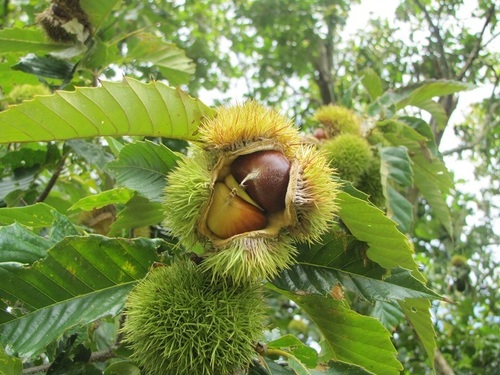
Castanopsis lamontii
Hance
Stone conical chestnut tree

(c) yko, some rights reserved (CC BY-NC)

(c) yko, some rights reserved (CC BY-NC)

(c) yko, some rights reserved (CC BY-NC)
What to Eat
Edible parts: Nuts
The nuts are eaten.
Where to Find It
A tropical plant. They grow in mountain and broad-leaved evergreen forest between 500-2500 m altitude in China.
Asia, China, Indochina, SE Asia, Vietnam,
How to Identify
A tree. It grows 8-15 m high. It can be 25 m tall. The leaf stalk is 1.5-3 cm long. The leaf blade is oval and 12-30 cm long by 4-10 cm wide. They are thickly papery or leathery. There are 10-15 veins on each side of the midrib. The female flowering stalk is in the axils of leaves. It is borne above the male flowering stalk. The fruiting stalk is 10-20 cm long. The cup is round and 2.5-6 cm across. There are 2-3 nuts per cup. They are cone shaped. They are 2-2.8 cm long by 3 cm wide. They are densely hairy.
Notes
There are about 120 Castanopsis species. Many have edible nuts.
Names & Synonyms
Lu jiao zhui
References (3)
- Altschul, S.V.R., 1973, Drugs and Foods from Little-known Plants. Notes in Harvard University Herbaria. Harvard Univ. Press. Massachusetts. no. 642
- Huang Chengjiu, Zhang Yongtian, Bartholomew, B., Fagaceae, Flora of China.
- Hu, Shiu-ying, 2005, Food Plants of China. The Chinese University Press. p 345
More from Fagaceae