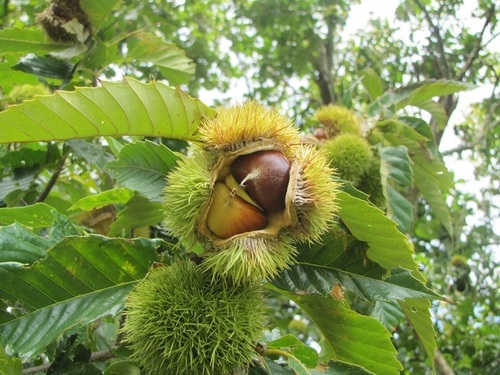
Lithocarpus thomsonii
(Miqu.) Rehder
Lu xi ke

Royal Botanic Gardens, Kew

Royal Botanic Gardens, Kew

GBIF
What to Eat
Edible parts: Seeds, Nuts
The seeds and nuts are edible.
Where to Find It
A tropical plant. It grows in broadleaved evergreen forest between 800-3000 m altitude in southern China.
Asia, China, India, Indochina, Laos, Myanmar, SE Asia, Thailand, Vietnam,
How to Identify
A tree. It grows to 8-10 m high. Many plant parts are covered with very small, grey hairs. The leaf stalk is less than 1 cm long. The leaf blade is oval or oblong and 9-20 cm long by 4-6.5 cm wide. The male flower stalks occur singly in the axils of leaves. They are 5-10 cm long. The female flowering stalks are 5-10 cm long. The cups occur in clusters of 3. They are 1.5-1.8 cm across. The outside in densely covered with grey hairs. The nut is 1.3-1.4 cm long by 1.4-1.6 cm wide.
Notes
There are about 300 Lithocarpus species.
Names & Synonyms
Thit-e
References (4)
- Altschul, S.V.R., 1973, Drugs and Foods from Little-known Plants. Notes in Harvard University Herbaria. Harvard Univ. Press. Massachusetts. no. 651
- Ambasta, S.P. (Ed.), 2000, The Useful Plants of India. CSIR India. p 333
- Huang Chengjiu, Zhang Yongtian, Bartholomew, B., Fagaceae, Flora of China.
- J. Arnold Arbor. 1:132. 1919
More from Fagaceae