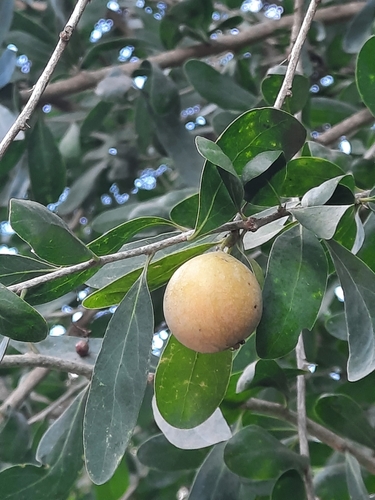
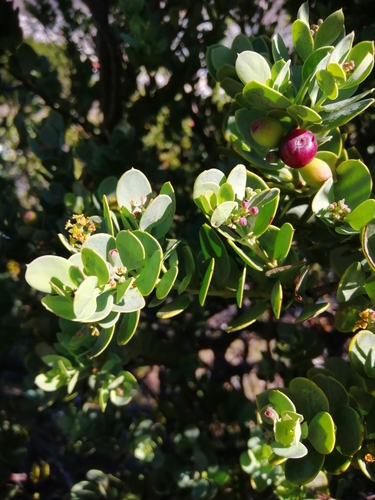
Phoradendron quadrangulare
(Kunth) Griseb.

no rights reserved
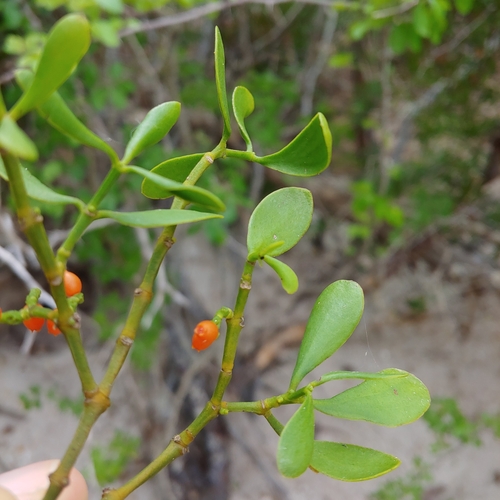
(c) Kurt Miller, some rights reserved (CC BY-NC)
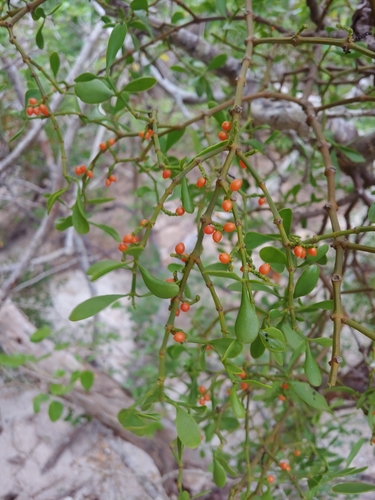
(c) Kurt Miller, some rights reserved (CC BY-NC)
What to Eat
Edible parts: Fruit
The fruit are eaten, particularly by children.
Where to Find It
A tropical plant. In Argentina it grows from sea level to 1,500 m above sea level.
Argentina, Brazil, Central America, Dominican Republic, Haiti, Paraguay, South America*, West Indies,
How to Identify
A shrub. It grows attached to other plants. It keeps growing from year to year.
Medicinal Uses
In Mexico, Phoradendron quadrangulare has been used as an antiviral treatment against Herpes zoster. Ground leaves are applied to the affected area, and above that a whole leaf is held in place by a bandage. Also it's used as an analgesic for muscular pain. In Argentina, Phoradendron quadrangulare has been regarded as a treatment for cancer. Chemical analysis finds that compounds in the plant show antioxidant activity which can be explained by the presence of flavonoids and other active molecules. Among the Mayan people of Mexico's Yucatan Peninsula, Phoradendron quadrangulare leaves have been documented used in combination with leaves of Talinum paniculatum and Phyllanthus amarus to treat a severe toothache. Below, it's shown how leaves from the three sources were mashed into a paste using a mortar and pestle, homemade with a whittled stick and the cut-off bottom of a 1-liter Coca-Cola bottle:
Other Information
The fruit are especially eaten by children.
Notes
Also put in the family Viscaceae.
References (1)
- Altschul, S.V.R., 1973, Drugs and Foods from Little-known Plants. Notes in Harvard University Herbaria. Harvard Univ. Press. Massachusetts. no. 780 (As Phoradendron randiae)