Dendrotrophe platyphylla
(Spreng.) N. H. Xia & M. G. Gilbert
SantalaceaeLeaves

gbif · cc0
Royal Botanic Garden Edinburgh
Royal Botanic Garden Edinburgh

gbif · cc0
Conveyor Belt
Conveyor Belt

gbif · cc0
Royal Botanic Garden Edinburgh
Royal Botanic Garden Edinburgh
What to Eat
Edible parts: Leaves
The leaves are used to make tea.
Where to Find It
A tropical plant. It grows in broad-leaved forests between 2,000-3,700 m in southern China. In Yunnan.
Asia, Bhutan, China, Himalayas, Indochina, Malaysia, Myanmar, Nepal, Northeastern India, SE Asia, Sikkim,
Countries: United Arab Emirates, Afghanistan, Armenia, Azerbaijan, Bangladesh, Bahrain, Brunei, Bhutan, China, Georgia, Indonesia, Israel, India, Iraq, Iran, Jordan, Japan, Kyrgyzstan, Cambodia, North Korea, South Korea, Kuwait, Kazakhstan, Laos, Lebanon, Sri Lanka, Myanmar, Mongolia, Maldives, Malaysia, Nepal, Oman, Philippines, Pakistan, Qatar, Saudi Arabia, Singapore, Syria, Thailand, Tajikistan, Timor-Leste, Turkmenistan, Turkey, Taiwan, Uzbekistan, Vietnam, Yemen
How to Identify
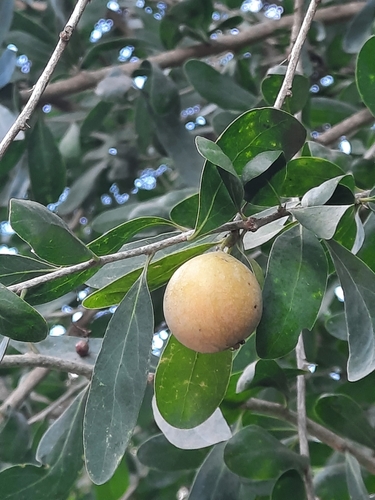
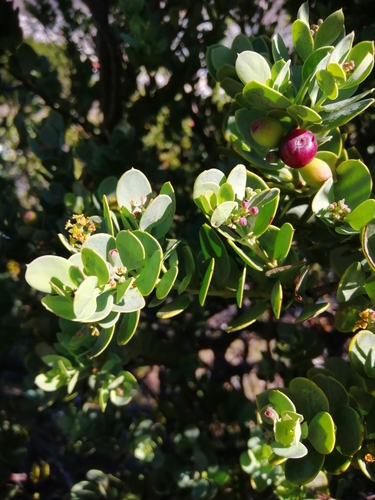
A woody vine. It grows 2 m tall. The stems can be erect or twining. It grows partly attached to oak trees. The leaf stalk is flat with narrow wings. The leaves vary in shape. They are often narrowly oval and 2-3 cm long by 1.5 cm wide. They are lumpy on both surfaces. The male flowers are in groups of 5 or 6 and the female flowers occur singly.
Names & Synonyms
Aeinjeru, Archola
Dufrenoya platyphylla (Spreng.) Staufferand others
References (3)
- Altschul, S.V.R., 1973, Drugs and Foods from Little-known Plants. Notes in Harvard University Herbaria. Harvard Univ. Press. Massachusetts. no. 788 (As Dufrenoya platyphylla)
- Mukhia, P.K., et al, 2013, Wild plants as Non Wood Forest Products used by the rural community of Dagana, a southern foothill district of Bhutan, SAARC Journal, 27 pages (As Dufrenoya platyphylla)
- Flora of China @ efloras.org Volume 5