Hirtella triandra
Swartz
Camaroncillo

(c) Armando Feliciano, some rights reserved (CC BY-NC), uploaded by Armando Feliciano
(c) Eduardo Chacón Madrigal, some rights reserved (CC BY), uploaded by Eduardo Chacón Madrigal

(c) Omar Monzon Carmona, some rights reserved (CC BY-NC), uploaded by Omar Monzon Carmona
What to Eat
Edible parts: Fruit, Seeds
The fleshy fruit is eaten raw, with the seed typically discarded, though the seeds are especially eaten by small children.
Where to Find It
A tropical plant. It grows in shady wet forests including lower mountain regions. In Puerto Rico it grows between 100-650 m above sea level.
Belize, Bolivia, Central America, Colombia, Costa Rica, Cuba, Dominica, Dominican Republic, Ecuador, El Salvador, Guatemala, Guiana, Guianas, Guyana, Haiti, Hispaniola, Honduras, Martinique, Mexico, Nicaragua, North America, Panama, Peru, Puerto Rico, South America, Suriname, Trinidad & Tobago, Venezuela, West Indies,
How to Identify
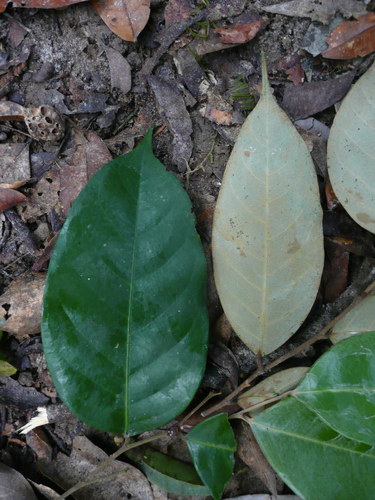
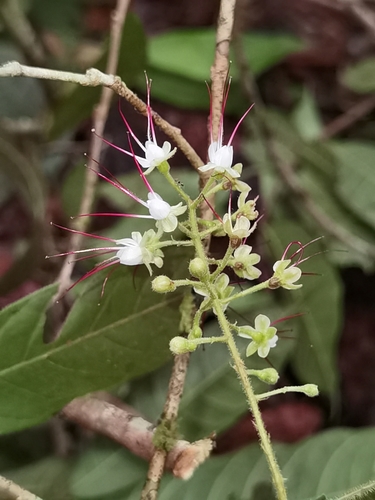
A medium sized tree. It grows up to 5-12 m tall. The leaves are simple and alternate. They are small and short. The leaves are shiny green above. The new leaves have round black spots. They have stipules in pairs at the base. The flowers are white with long pink stamens. They are in clusters. The fruit is fleshy and has one pointed seed. This has fine grooves.
Production
It flowers and fruits throughout the year.
Other Information
The seeds are especially eaten by small children.
Names & Synonyms
Amongabekamo, Amongagibe, Apacharama, Ashicobiti, Ashaninca, Ayaminiwe, Ayamonemo, Bazaron, Bokotokon, Boyegomonkawe, Caimito cimmarron, Caimito de perro, Camaron, Caramate negro, Carita de negro, Chicarron, Chuchuasa macha, Cocuyo, Conejo, Escobillo prieto, Garrapato, Icaquillo, Marisi balli, Merecurillo, Pasito, Quinulla, Siguapa, Sudor de buey, Teta de burra
References (11)
- Condit, R., et al, 2011, Trees of Panama and Costa Rica. Princeton Field Guides. p 124
- Grandtner, M. M., 2008, World Dictionary of Trees. Wood and Forest Science Department. Laval University, Quebec, Qc Canada. (Internet database http://www.wdt.qc.ca)
- Grandtner, M. M. & Chevrette, J., 2013, Dictionary of Trees, Volume 2: South America: Nomenclature, Taxonomy and Ecology. Academic Press p 307
- Hellmuth, N. M., 2011, Maya Ethnobotany. Complete Inventory of plants. Associacion FLAAR Mesoamerica. Tenth edition.
- Little, E. L., et al, 1974, Trees of Puerto Rico and the Virgin Islands. USDA Handbook 449. Forestry Service. p 234
- Lopez-Diago, D. & Garcia, N., 2021, Wild edible fruits of Colombia. Biota ColomBiana 22 (2) p 35
- Martin, F. W., et al, 1987, Perennial Edible Fruits of the Tropics. USDA Handbook 642 p 92
- Reis, S. V. and Lipp, F. L., 1982, New Plant Sources for Drugs and Foods from the New York Botanical Garden herbarium. Harvard. p 108
- Roa, J. A. G. & Boada, D. S. G., 2018, Fundación para el Fortalecimiento de la Fruticultura y Plantas Alimenticias no Convencionales en Colombia.
- Segura, S., et al, 2018, The edible fruit species in Mexico. Genet Resour Crop Evol (2018) 65:1767–1793
- Torre, de la, L., et al, 2008, Enciclopedia de las Plantas Útiles del Ecuador. Herbario QCA. Pontificia Universidad Católica del Ecuador. p 281