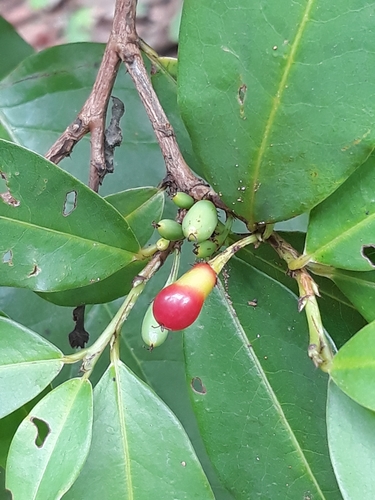
Erythroxylum gracilipes
Peyr.
ErythroxylaceaeFruit

iNaturalist · cc-by-nc
(c) Dawson White, some rights reserved (CC BY-NC), uploaded by Dawson White
(c) Dawson White, some rights reserved (CC BY-NC), uploaded by Dawson White

iNaturalist · cc-by-nc
(c) Dawson White, some rights reserved (CC BY-NC), uploaded by Dawson White
(c) Dawson White, some rights reserved (CC BY-NC), uploaded by Dawson White

iNaturalist · cc-by-nc
(c) Dawson White, some rights reserved (CC BY-NC), uploaded by Dawson White
(c) Dawson White, some rights reserved (CC BY-NC), uploaded by Dawson White
What to Eat
Edible parts: Fruit
The fruit is eaten.
Where to Find It
A tropical plant.
Amazon, Bolivia, Brazil, Colombia, Guiana, Guianas, Guyana, South America, Suriname, Venezuela,
How to Identify
A shrub or tree. It grows 3-10 m tall. The leaves are narrowly oblong. They are 12-19 cm long and 4-7 cm wide. There are 12-16 flowers in the axils of leaves. They are white to yellow.
Wikipedia
Source ↗Erythroxylum gracilipes is a species of flowering plant in the family Erythroxylaceae. It is native to Central and South Tropical America.
Notes
The Erythroxylaceae occur mostly in the tropics. There are about 250 Erythroxylum species.
Names & Synonyms
Sacha mangua
Erythroxylum cuatrecasasii W. A. Gentnerand others
References (2)
- Altschul, S.V.R., 1973, Drugs and Foods from Little-known Plants. Notes in Harvard University Herbaria. Harvard Univ. Press. Massachusetts. no. 1865
- Macbride. J. F., 1949, Flora of Peru. Geraniaceae. Field Museum Natural History. Chicago. p 641