Erythroxylum coca
Lam.
Coca, Cocaine

(c) douneika, some rights reserved (CC BY-NC-SA)
(c) James Bailey, some rights reserved (CC BY-NC), uploaded by James Bailey
(c) Mafe2004, some rights reserved (CC BY-NC), uploaded by Mafe2004
What to Eat
Edible parts: Leaves - tea
The dried leaves yield cocaine, a stimulant substance. Leaves are used to make coca 'wine' and are also chewed as a masticatory. Extract from the nut is used to flavour drinks, confectionery, candy, and alcoholic drinks. The leaves can also be prepared as a tea.
Known Hazards
Where to Find It
A tropical plant. It suits hardiness zones 10-12.
Africa, Andes, Argentina, Australia, Bolivia, Brazil, Cameroon, Central Africa, Central America, Colombia, Côte d'Ivoire, Ecuador, Ghana, Grenada, India, Indonesia, Ivory Coast, Nicaragua, Northeastern India, Peru, Sao Tome and Principe, SE Asia, Sierra Leone, South America, Sri Lanka, Taiwan, Tanzania, West Africa,
How to Identify
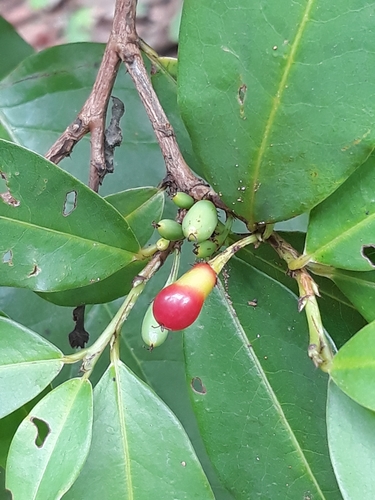
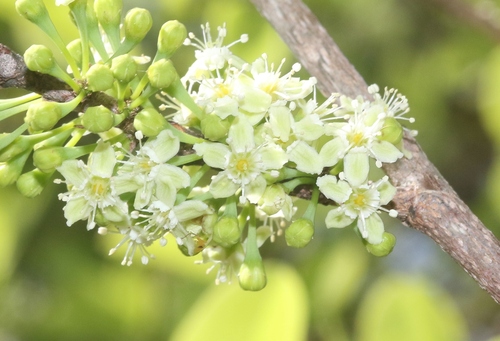
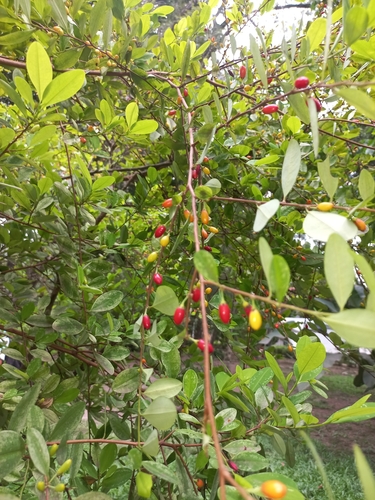
An erect evergreen shrub. It grows 3.5 m tall. It spreads about 1.5 m wide. The trunk is slender and branching. The leaves are oval but taper to a short tip. They are bright green and 6 cm long. The flowers have five petals and are yellowish-white. They are 6 mm across and are carried in the axils of the leaves. The fruit is soft and fleshy and 8 mm long. They are red berries.
How to Grow
A plant of moderate to higher elevations in the tropics. It grows best in areas where annual daytime temperatures are within the range 17 - 23°c, but can tolerate 14 - 27°c. Mature plants can be killed by temperatures of -5°c or lower, but young growth will be severely damaged at -1°c. It prefers a mean annual rainfall in the range 1,000 - 2,100mm, but tolerates 700 - 4,000mm. Widely cultivated in the Andean region of the tropics, where it locally also occurs wild, the plant is not easy to cultivate elsewhere, and it is little known in other parts of the world. In South-East Asia, it is only grown in botanical gardens, not as a crop. The form Erythroxylum coca ipadu is only found as a cultivated plant in Amazonian lowland rain forest areas. Grows best in a sunny position. Succeeds in most fertile, well-drained soils. Prefers a pH in the range 5.5 - 6.5, tolerating 4.3 - 8. Plants take 1 - 3 years from seed to the first harvest, and then have an economical life of around 20 years. Annual yields are up to 2 tonnes/ha of dried leaves. Flowering Time: Late Winter/Early Spring Mid Spring Late Spring/Early Summer Mid Summer. Bloom Color: White/Near White.
Propagation: Plants are grown from cuttings or seed.
Medicinal Uses
The leaves contain cocaine and other alkaloids and are narcotic, cerebral-stimulant, and locally anaesthetic. The alkaloids are extracted for use in various pharmaceutical drugs, including local anaesthetics. When chewed with lime or plant ashes, the leaves produce a feeling of ease and increased energy, and are used by indigenous peoples as a stimulant to help endure hunger, thirst, and physical exertion. An infusion of the leaves is also used as a remedy for altitude sickness, known as 'soroche'.
Other Uses
None known
Wikipedia
Source ↗Erythroxylum coca is a species of flowering plant in the family Erythroxylaceae. It is one of the two species of cultivated coca.
Other Information
It is cultivated.
Notes
There are about 250 Erythroxylum species. It contains tropane alkaloids.
Names & Synonyms
Bolivian coca
References (24)
- Ambasta, S.P. (Ed.), 2000, The Useful Plants of India. CSIR India. p 205
- Bodkin, F., 1991, Encyclopedia Botanica. Cornstalk publishing, p 404
- Bremness, L., 1994, Herbs. Collins Eyewitness Handbooks. Harper Collins. p 53
- Brouk, B., 1975, Plants Consumed by Man. Academic Press, London. p
- Burkill, H. M., 1985, The useful plants of west tropical Africa, Vol. 2. Kew.
- Cobley, L.S. (rev. Steele, W.M.) 2nd Ed., 1976, An Introduction to the Botany of Tropical Crops. Longmans. p 226
- Encycl. 2:393. 1786
- Etherington, K., & Imwold, D., (Eds), 2001, Botanica's Trees & Shrubs. The illustrated A-Z of over 8500 trees and shrubs. Random House, Australia. p 292
- Facciola, S., 1998, Cornucopia 2: a Source Book of Edible Plants. Kampong Publications, p 100
- Hedrick, U.P., 1919, (Ed.), Sturtevant's edible plants of the world. p 294
- Heywood, V.H., Brummitt, R.K., Culham, A., and Seberg, O. 2007, Flowering Plant Families of the World. Royal Botanical Gardens, Kew. p 143
- Kermath, B. M., et al, 2014, Food Plants in the Americas: A survey of the domesticated, cultivated and wild plants used for Human food in North, Central and South America and the Caribbean. On line draft. p 346
- Kew Plants of the World On line
- Kiple, K.F. & Ornelas, K.C., (eds), 2000, The Cambridge World History of Food. CUP p 1759
- Krishen P., 2006, Trees of Delhi, A Field Guide. DK Books. p 147
- Lazarides, M. & Hince, B., 1993, Handbook of Economic Plants of Australia, CSIRO. p 96
- Martin, F.W. & Ruberte, R.M., 1979, Edible Leaves of the Tropics. Antillian College Press, Mayaguez, Puerto Rico. p 106
- Purseglove, J.W., 1968, Tropical Crops Dicotyledons, Longmans. p 632
- Smith, P.M., 1979, Coca, in Simmonds, N.W., (ed), Crop Plant Evolution. Longmans. London. p 307
- Smith, N., Mori, S.A., et al, 2004, Flowering Plants of the Neotropics. Princeton. p 144 and Plate 18 (Photo)
- Torre, de la, L., et al, 2008, Enciclopedia de las Plantas Útiles del Ecuador. Herbario QCA. Pontificia Universidad Católica del Ecuador. p 316
- Wiersema, J. H. & Leon, B., 2013, World Economic Plants. A Standard Reference CRC Press. 2nd Ed. p 283
- Williams, C.N., Chew, W.Y., and Rajartnam, J.A., 1989, Tree and Field Crops of the Wetter Regions of the Tropics. Longman, p 79
- World Checklist of Useful Plant Species 2020. Royal Botanic Gardens, Kew