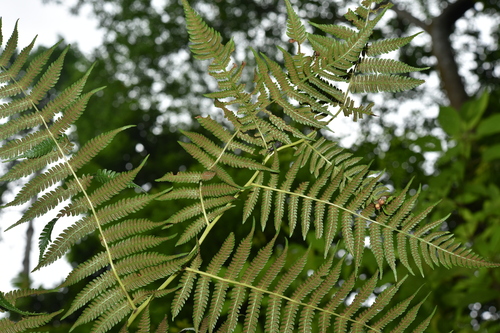
Athyrium yokoscense
(Franch. & Sav.) Christ.
fern

(c) Kim, Hyun-tae, some rights reserved (CC BY), uploaded by Kim, Hyun-tae

(c) Morgan Heinz, some rights reserved (CC BY-NC), uploaded by Morgan Heinz

(c) Alexey P. Seregin, some rights reserved (CC BY-NC), uploaded by Alexey P. Seregin
What to Eat
Edible parts: Leaves, Fronds
Edible Parts: Leaves Edible Uses: Very young fronds (croziers) - boiled. Some caution is advised. See the notes above on toxicity.
Where to Find It
It is a temperate plant. It grows in rock crevices in forests in north China between 100-2,400 m above sea level.
Asia, China, Japan, Korea, Russia,
How to Identify
A small fern growing to 30cm tall, hardy to UK zone 7. Adapts to light sandy, medium loamy, and heavy clay soils with preference for well-drained soil; tolerates heavy clay and very acidic conditions. Grows in full shade (deep woodland) or semi-shade (light woodland). Prefers moist or wet soil and suits mildly acidic, neutral, and basic pH ranges.
How to Grow
Propagation: Spores - surface sow in a pot of sterile compost in a shady part of the greenhouse and keep moist, this is most easily done by putting the pot in a plastic bag. Pot up small clumps of the plants when they are large enough to handle and keep them moist until they are established. Plant out in late spring of the following year. Division in spring as plants come into growth. Larger divisions can be planted straight into their permanent positions whilst smaller clumps are best potted up and kept in a cold frame until they are growing away well.
Medicinal Uses
None known
Other Uses
None known Special Uses
Wikipedia
Source ↗Athyrium yokoscense, commonly known as Asian common ladyfern in English and as Hebino-negoza in Japanese, is a species of fern in the family Athyriaceae. These tough plants live primarily in and around mine sites and thrive in soils contaminated with high concentrations of heavy metals, such as zinc, cadmium, lead, and copper. A. yokoscense is indigenous to Japan, Korea, eastern Siberia and northeastern China and has been known for centuries to tolerate phytotoxic mining sites. The predominance and concentration of this fern species at a particular region was used to identify potential mining sites. The primary potential of A. yokoscense is in its phytoremediative ability to accumulate toxic metals from soils contaminated with heavy metals, so it may have some long-term commercial importance. No medicinal or culinary values of this fern species have been studied or confirmed.
Notes
There are about 180 Athyrium species. They are also put in the family Woodsiaceae.
Names & Synonyms
References (4)
- Bull. Herb. Boissier 4:668. 1896
- Hwang, HS, et al, 2014, Distribution characteristics of plant in the Ungseokbong Mountain, Gyeongsangnam-do, Korea. Journal of Asia-Pacific Biodiversity. 7(2014) e164-e178
- Liu, Y., et al, 2012, Food uses of ferns in China: a review. Acta Societatis Botanicorum Poloniae 84(4): 263-270
- Plants for a Future database, The Field, Penpol, Lostwithiel, Cornwall, PL22 0NG, UK. http://www.scs.leeds.ac.uk/pfaf/