Attalea cohune
Mart.
Cohune Nut

(c) Tony Rodd, some rights reserved (CC BY-NC-SA)

(c) Tony Rodd, some rights reserved (CC BY-NC-SA)
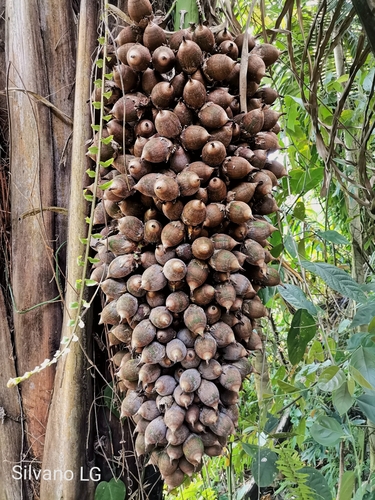
(c) Silvano LG, some rights reserved (CC BY-NC), uploaded by Silvano LG
What to Eat
Edible parts: Cabbage, Kernel, Oil, Fruit, Palm heart, Nuts, Vegetable
The young leaf buds are cooked and eaten as a vegetable (palm heart). The nuts contain kernels that can be eaten, and the oil extracted from kernels can be used as a coconut oil substitute in margarine, baking, and biscuits. The oil also serves as an industrial lubricant.
Where to Find It
A tropical plant. It does best in the hot humid lowland tropics. It grows at low elevations in Central America. It suits hardiness zones 9-12. It needs regular moisture and humidity. It needs fertile, well drained soil. It needs full sun. In Cairns Botanical Gardens. In Townsville palmetum.
Asia, Australia, Belize, Central America*, Colombia, Costa Rica, El Salvador, Guatemala, Honduras, Indonesia, Malaysia, Mexico, Nicaragua, North America, SE Asia, Singapore, South America, Trinidad-Tobago, USA,
How to Identify
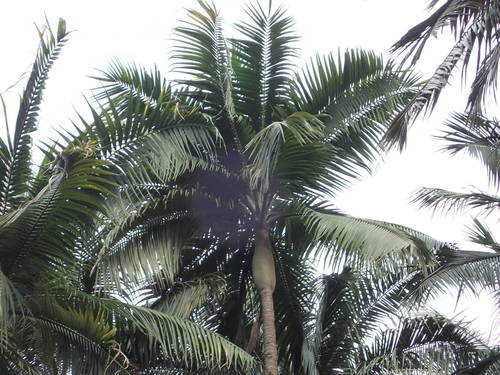
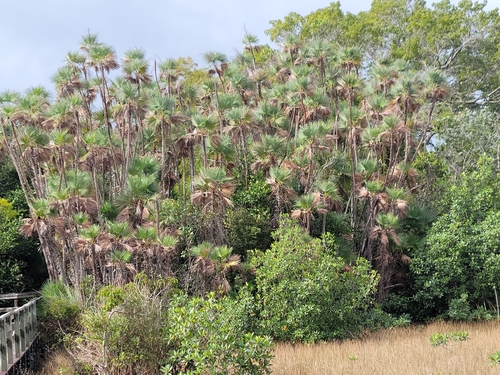
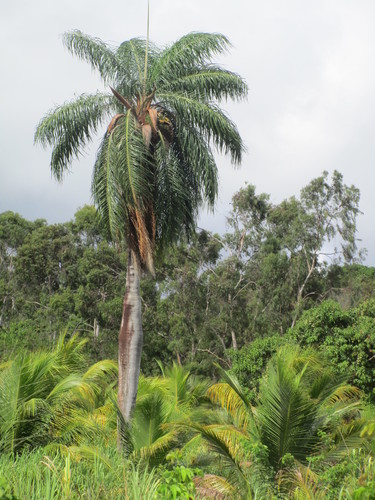
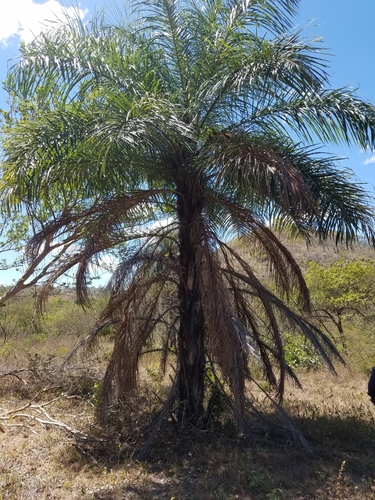
A tall solitary palm. It can grow up to 15-30 m tall. The trunk is grey and scarred. It is 30-40 cm across. Often the leaf bases remain attached to younger plants. The crown is very large. The fronds are held stiffly erect. The leaves are 10 m long and 2 m across. The leaf stalks have very broad bases. The leaves are dark green and have leaflets along the stalk. The leaflets are broad and long. They are crowded along the midrib. They are carried in various planes. The flowering stalk is carried among the leaf bases. It is 1-1.5 cm long. There are many flowers. It bears large clusters of fruit that look like small coconuts. They are egg shaped. They are 6 cm long.
Nutrition Score: 2/100
| Part | Moisture | kJ | kcal | Protein | Vit A | Vit C | Iron | Zinc |
|---|---|---|---|---|---|---|---|---|
| Palm heart | — | — | — | — | — | — | — | — |
| Nuts | — | — | — | — | — | — | — | — |
| Nut | — | — | 6.8 | — | — | — | — | — |
How to Grow
Plants are grown from seed. Seed germinate readily. They take 2 months to germinate. Young plants can withstand direct sun.
Other Uses
The leaves are used for thatching. The plant is commonly used to make huts and temporary shelters.The stout midribs of the leaves are used to form the framework, whilst the leaves, placed crosswise so that their segments form a dense thatch, are used to make the roofs. Such buildings are substantial and durable. Segments of the large leaves are used by the Indians of Alta Verapaz for making the suyacales - large mats that protect their clothing and loads from the rains. During the rainy season an Indian with a rolled-up suyacal (if it is not raining) is almost as characteristic of Alta Verapaz as the Britisher with his rolled umbrella is of England. Young leaves are used to make hats. The dried inflorescence is used as broom. A valuable non-drying oil obtained from the seed is used as an illuminant and in making soap. The nuts are very hard and difficult to crush, which makes extracting the oil more difficult. Special machinery has been developed to do this. The large, oval-shaped fruit is harvested commercially to produce cohune oil, a lubricant. The endocarp of the fruit is exploited as fuel. The wood is used in construction. The hard seed shells have been used in the preparation of charcoal for gas masks.
Wikipedia
Source ↗Attalea cohune, commonly known as the cohune palm (also rain tree, American oil palm, corozo palm or manaca palm), is a species of palm tree native to Mexico and parts of Central America. The cohune palm is used in the production of cohune oil and its nut can be used as a variety of vegetable ivory.
Production
Nuts are often collected after they fall. The nut has a hard shell. There is a machine capable of breaking 100 tons of fruit per day. The palm heart is usually taken from a 7-10 year old palm. One palm can yield 250 kg of nuts per year.
Notes
There are between (22) 30-71 Attalea species. Some authorities divide them among Attalea, Orbignya, Scheela and Maximiliana. Cohune oil is used as a lubricant.
Names & Synonyms
Biscoyol, Cayaco, Coquito, Coquito de aceite, Corozo, Coyol, Guacoyol, Manaca, Palem kohune
References (33)
- Altschul, S.V.R., 1973, Drugs and Foods from Little-known Plants. Notes in Harvard University Herbaria. Harvard Univ. Press. Massachusetts. no. 92
- Balick, M.J. and Beck, H.T., (Ed.), 1990, Useful palms of the World. A Synoptic Bibliography. Colombia p 59 (As Orbignya cohune), 122, 310, 470 (As Orbignya guacuyule), 604,
- Bircher, A. G. & Bircher, W. H., 2000, Encyclopedia of Fruit Trees and Edible Flowering Plants in Egypt and the Subtropics. AUC Press. p 48
- Blomberry, A. & Rodd, T., 1982, Palms. An informative practical guide. Angus & Robertson. p 135 (As Orbignya cohune)
- Bost, J. B., 2009, Edible plants of the Chinantla, Oazaca, Mexico. Master's thesis University of Florida. p 39
- Burkill, I.H., 1966, A Dictionary of the Economic Products of the Malay Peninsula. Ministry of Agriculture and Cooperatives, Kuala Lumpur, Malaysia. Vol 1 (A-H) p 268
- Chizmar Fernandez, C., et al, 2009, Plantas comestibles de Centroamerica. Instituto de Biodiversidad, Costa Rica. p 73
- A. D. d'Orbigny, Voy. Amerique mer. 7(3). Palmiers 121. 1844
- Facciola, S., 1998, Cornucopia 2: a Source Book of Edible Plants. Kampong Publications, p 30 (As Orbignya cohune)
- Glassman, S.F., 1977, Preliminary Taxonomic Studies in the palm genus Orbignya. Phytologia 36(2):89-115
- Grandtner, M. M., 2008, World Dictionary of Trees. Wood and Forest Science Department. Laval University, Quebec, Qc Canada. (Internet database http://www.WDT.QC.ca)
- Grandtner, M. M. & Chevrette, J., 2013, Dictionary of Trees, Volume 2: South America: Nomenclature, Taxonomy and Ecology. Academic Press p 52
- Haynes, J., & McLaughlin, J., 2000, Edible palms and Their Uses. University of Florida Fact sheet MCDE-00-50-1 p 3
- Hedrick, U.P., 1919, (Ed.), Sturtevant's edible plants of the world. p 85
- Henderson, A., Galeano, G and Bernal, R., 1995, Field Guide to the Palms of the Americas. Princeton. p 159
- Janick, J. & Paul, R. E. (Eds.), 2008, The Encyclopedia of Fruit & Nuts. CABI p 90
- Jones, D.L., 1994, Palms throughout the World. Smithtonian Institution, Washington. p, 56 282 (As Orbignya cohune)
- Jones, D.L., 2000, Palms of Australia 3rd edition. Reed/New Holland. p 190 (As Orbignya cohune)
- Kew Plants of the World Online
- Kiple, K.F. & Ornelas, K.C., (eds), 2000, The Cambridge World History of Food. CUP p 1761
- Lentz, D. L., 1993, Medicinal and Other Economic Plants of the Paya of Honduras. Economic Botany, Vol. 47, No. 4, pp. 358-370
- Llamas, K.A., 2003, Tropical Flowering Plants. Timber Press. p 93
- Martin, F. W., et al, 1987, Perennial Edible Fruits of the Tropics. USDA Handbook 642 p 46
- Menninger, E.A., 1977, Edible Nuts of the World. Horticultural Books. Florida p 127
- Mutchnick, P. A. and McCarthy, B. C., 1997, An Ethnobotanical Analysis of the Tree Species Common to the Subtropical Moist Forests of the Peten, Guatemala. Economic Botany, Vol. 51, No. 2, pp. 158-183 (As Orbignya cohune)
- Purseglove, J.W., 1972, Tropical Crops. Monocotyledons. Longmans p 429
- Riffle, R.L. & Craft, P., 2003, An Encyclopedia of Cultivated Palms. Timber Press. p 42, 265
- Roa, J. A. G. & Boada, D. S. G., 2018, Fundación para el Fortalecimiento de la Fruticultura y Plantas Alimenticias no Convencionales en Colombia.
- Segura, S. et al, 2018, The edible fruit species in Mexico. Genet Resour Crop Evol (2018) 65:1767–1793
- Sukarya, D. G., (Ed.) 2013, 3,500 Plant Species of the Botanic Gardens of Indonesia. LIPI p 799 (As Orbigyna cohune)
- Wickens, G.E., 1995, Edible Nuts. FAO Non-wood forest products. FAO, Rome. p168
- Wiersema, J. H. & Leon, B., 2013, World Economic Plants. A Standard Reference CRC Press. 2nd Ed. p 85
- World Checklist of Useful Plant Species 2020. Royal Botanic Gardens, Kew