Attalea funifera
Mart. ex Spreng.
Conquilla Nut, Bahia Piassava Palm, Piassaba palm

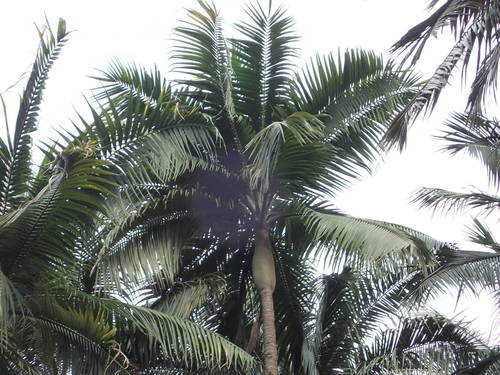
(c) Alex Popovkin, some rights reserved (CC BY)

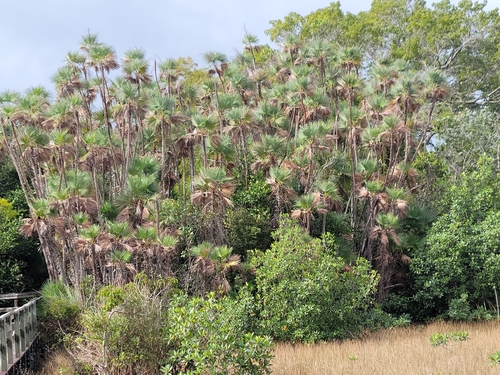
(c) Geovane Siqueira, some rights reserved (CC BY-NC), uploaded by Geovane Siqueira

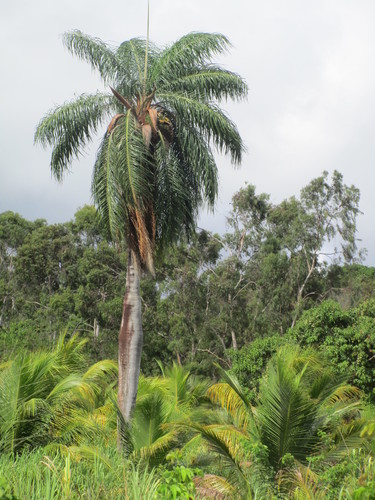
(c) Geovane Siqueira, some rights reserved (CC BY-NC), uploaded by Geovane Siqueira
What to Eat
Edible parts: Nuts - oil, Fruit
Edible Parts: Oil Seed Edible Uses: Oil Edible portion: Nut. The oil or fat from the nut is used in margarine.
Where to Find It
A tropical plant. It grows in rainforest at low altitudes in the tropics in Brazil. They are often on sand dunes near the sea.
Brazil, French Guiana, South America,
How to Identify
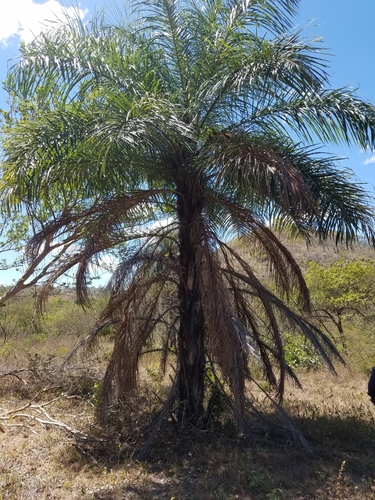
A large, upright, solitary palm. The trunk is clean and 15 m tall and 30 cm across. In some locations the trunk can be small and underground. There are 5-15 leaves and the leaf stalk is long. The leaves are long and divided into leaflets along the stalk. The leaves are carried erect. The leaflets are arranged irregularly. The fruit are very large. They contain 1-3 seeds. They are 10-15 cm long and 3-9 cm across. They are borne in huge bunches. These hang down among the leaves.
How to Grow
It grows best in areas where annual daytime temperatures are within the range 22° - 25°c, but can tolerate 18° - 30°c. It can be killed by temperatures of 5°c or lower. It prefers a mean annual rainfall in the range 1,800 - 2,000mm, but tolerates 1,500 - 2,400mm. Prefers a moist soil and a warm, sunny position. Prefers a pH in the range 5 - 5.5, tolerating 4.5 - 6.5. The seedlings grow down into the soil for 3 - 4 years, producing a stem below ground to a depth of 100 - 150cm. After a few more years a trunk may begin to form at ground level. Young plants generally produce inflorescences with male flowers, whilst older, taller plants are more likely to produce female inflorescences. Production: The melting point of oil is 25-26C. A kernel weighs 3g. They contain about 67% oil. About 7.5 kg of seeds can be harvested by hand in one day.
Propagation: Seed - The large seeds are slow and erratic to germinate.
Medicinal Uses
None known
Other Uses
Beads Brush Buttons Charcoal Fibre Oil String Thatching Other uses rating: High (4/5). Other Uses: A good oil is produced from the seed. It can be used for oiling watches and other fine instruments. An oil is obtained from the fruit. A long fibre obtained from the leaves is used for various purposes. This palm is widely used locally for its high quality, stiff fibres which are used in making ropes, mats, and brushes. The fibre is strong, and hard and it does not absorb moisture easily. A fibre obtained from the dilated base of the leaf stalks, which separates into a long, coarse fringe, is collected by cutting with a small axe. The fibre is stiff, wiry, and a bright chocolate in colour. It is employed in the manufacture of brushes, these are largely used on street-sweeping machines, particularly in London. The fibres can be twisted into coarse cables, which are light, durable and float on the water. Fibre from young, undeveloped plants, known as 'bananeiras' is bright coloured and more flexible. Fibre from fully matured plants is separated into three qualities:- (1) Ordinary fibre, which is found wound up among the broken leaves and the upper part of the trunk. (2) Balloon, formed by the older fibre which has fallen to the ground around the base of the trunk. (3) Piassava d'olho, or 'eye piassava', which is the latest growth, and is in all respects similar to that yielded by the 'bananeiras'. The latter, on account of its flexibility and colour, is chiefly used in tying the bales. Its yield is small. The leaves are used for thatching. The seeds can be used to carve buttons and beads for rosaries etc. The fruits have been used to make a good quality charcoal. Special Uses Carbon Farming
Wikipedia
Source ↗Attalea funifera, the Bahia piassava, is a species of palm (family Arecaceae), native to eastern Brazil. It is a major source of piassava fiber, used in brooms and brushes.
Production
The melting point of the oil is 25-26°C. A kernel weighs 3 g. They contain about 67% oil. About 7.5 kg of seeds can be harvested by hand in one day.
Notes
There are between (22) 30-71 Attalea species. Some authorities divide them among Attalea, Orbignya, Scheela and Maximiliana.
Names & Synonyms
Bahia Piassava, Conquilla Nut, Piassaba Palm, Attalea funifera or Bahia Piassava Palm
References (13)
- Balick, M.J. and Beck, H.T., (Ed.), 1990, Useful palms of the World. A Synoptic Bibliography. Colombia p 122, 572, 646,
- Bircher, A. G. & Bircher, W. H., 2000, Encyclopedia of Fruit Trees and Edible Flowering Plants in Egypt and the Subtropics. AUC Press. p 48
- Burkill, I.H., 1966, A Dictionary of the Economic Products of the Malay Peninsula. Ministry of Agriculture and Cooperatives, Kuala Lumpur, Malaysia. Vol 1 (A-H) p 268
- Gibbons, M., 2003, A pocket guide to Palms. Chartwell Books. p 44
- Grandtner, M. M. & Chevrette, J., Dictionary of Trees, Volume 2: South America: Nomenclature, Taxonomy and Ecology p 52
- Henderson, A., Galeano, G and Bernal, R., 1995, Field Guide to the Palms of the Americas. Princeton. p 161
- Kermath, B. M., et al, 2014, Food Plants in the Americas: A survey of the domesticated, cultivated and wild plants used for Human food in North, Central and South America and the Caribbean. On line draft. p 107
- Menninger, E.A., 1977, Edible Nuts of the World. Horticultural Books. Florida p 127
- NYBG herbarium "edible"
- Purseglove, J.W., 1972, Tropical Crops. Monocotyledons. Longmans p 420
- Syst. veg. 2:624. 1825 (C. Martius, Hist. nat. palm. 2:136, t. 95, 96, fig. 4. 1826)
- Wiersema, J. H. & Leon, B., 2013, World Economic Plants. A Standard Reference CRC Press. 2nd Ed. p 85
- World Checklist of Useful Plant Species 2020. Royal Botanic Gardens, Kew