Attalea maripa
(Aubl.) Mart.
Maripa palm
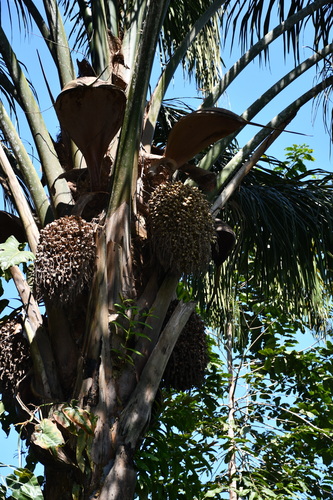
(c) Vincent A. Vos, some rights reserved (CC BY), uploaded by Vincent A. Vos
What to Eat
Edible parts: Fruit, Kernel, Drink, Palm heart, Cabbage, Oil, Nuts
Edible Parts: Fruit Oil Seed Edible Uses: Condiment Drink Milk Oil Edible portion: Fruit, Kernel, Drink, Palm heart, Cabbage, Oil, Nut. Fruit - raw. A succulent, aromatic, almost fibreless pulp with a sweet, pleasant flavour. It is used to make a drink. The fruit is up to 5cm long. The mesocarp provides a 'milk' for drinking. Seed - the endosperm is toasted. An oil extracted from the seed is used for cooking. The outer husk of the fruit makes a kind of salty flour used to flavour food. The apical bud is eaten as a vegetable. Eating this bud will effectively kill the tree since it is unable to produce side shoots.
Where to Find It
A tropical plant. It grows in lowland and secondary forest. It grows on non flooded soils. It grows at low elevations.
Amazon, Andes, Bolivia, Brazil, Central America, Colombia, Ecuador, French Guiana, Guianas, Guyana, Peru, South America, Suriname, Trinidad and Tobago, Trinidad, Venezuela,
How to Identify
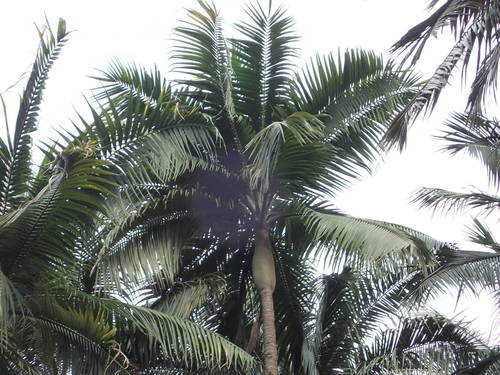
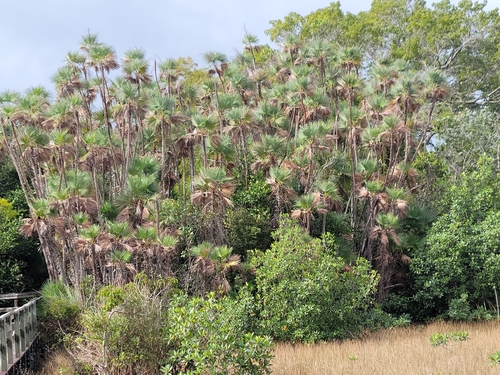
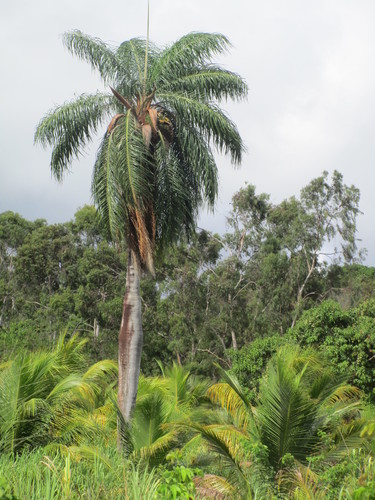
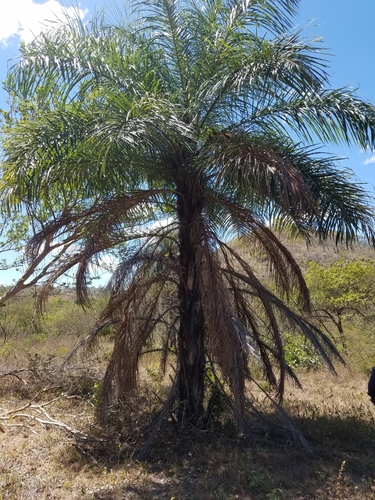
A solitary palm. The stems are tall. They are 3.5-20 m tall. The trunks are 20-33 cm across. They can be 100 cm across. The fronds are 10 m long. There are 10-22 leaves. They are borne in 5 distinct vertical rows. They are on long leaf stalks. The leaflets are irregularly placed in tight clusters. They spread in different planes. The flowers are on long stalks borne among the leaves. The fruit have 2-3 seeds. They are oblong and 4-6 cm long by 2.5-3 cm wide. They are brownish-yellow. The pulp is sweet and juicy.
How to Grow
Plants are grown from seed.
Propagation: Seed - best sown as soon as it is ripe in a nursery bed or individual containers.
Medicinal Uses
Antirheumatic An oil obtained from the seeds is rubbed onto rheumatic areas of the body in order to bring relief.
Other Uses
Beads Containers Oil Pioneer Thatching Wood Other uses rating: Very High (5/5). Agroforestry Uses: The plant shows pioneer characteristics. It regenerates vigorously after being cut down and the dormant seeds germinate after forest fires or the clearing of forested areas. These traits make it an excellent choice as a pioneer species for restoring native woodland and especially, when taking into account all the plant's uses, for establishing a woodland garden. Other Uses The fruit is a rich source of oil. It is currently being investigated for its suitability for biodiesel production. The leaves are used for thatching. The young leaves are made into mats and pack baskets. They are used as a heavy-duty weaving material. The woody bract is used as a container. The seeds are used to make jewellery. The wood is moderately heavy, hard, resistant, of low durability. The whole trunks are used locally for rustic constructions such as stays, rafters and laths. Special Uses Carbon Farming Food Forest
Wikipedia
Source ↗Attalea maripa, commonly called maripa palm is a palm native to tropical South America and Trinidad and Tobago. It grows up 35 m (115 ft) tall and can have leaves or fronds 10–12 m (33–39 ft) long, bearing up to 636 leaflets. This plant has a yellow edible fruit which is oblong ovoid and cream. An edible oil can be extracted from the pulp of the fruit and from the kernel of the seed.
Other Information
The fruit are enjoyed throughout the Amazon. They are sold in local and national markets.
Notes
There are between (22) 30-71 Attalea species. Some authorities divide them among Attalea, Orbignya, Scheela and Maximiliana.
Names & Synonyms
Abak, Anaja, Bojo, Cucurite Palm, Cucurito, Curete, Cusi, Doi arau, Edi ni, Guichire, Huacava, Inaja, Inayuga, Incham, Koheri Palm, Kokerite, Kokoriti, Kukarit, Maripa, Maripya, Motacusillo, Shapaja, Shapajilla, Taparo, Xebi choqui
References (35)
- Balick, M.J. and Beck, H.T., (Ed.), 1990, Useful palms of the World. A Synoptic Bibliography. Colombia p 49 (As Attalea regia), 121 (As Maximiliana regia), 309 (As Maximiliana regia), 535,
- Balick, M.J. and Beck, H.T., (Ed.), 1990, Useful palms of the World. A Synoptic Bibliography. Colombia p 68 (As Maximiliana maripa),
- A. D. d'Orbigny, Voy. Amerique mer. 7(3). Palmiers 123. 1844
- Etkin, N.L. (Ed.), 1994, Eating on the Wild Side, Univ. of Arizona. p 121, 139 (As Maximiliana maripa)
- Gilmore, M. P., et al, 2013, The socio-cultural importance of Mauritia flexuosa palm swamps (aguajales) and implications for multi-use management in two Maijuna communities of the Peruvian Amazon. Journal of Ethnobiology and Ethnomedicine 2013, 9:29
- Grandtner, M. M. & Chevrette, J., 2013, Dictionary of Trees, Volume 2: South America: Nomenclature, Taxonomy and Ecology. Academic Press p 52
- Haynes, J., & McLaughlin, J., 2000, Edible palms and Their Uses. University of Florida Fact sheet MCDE-00-50-1 p 3
- Hedrick, U.P., 1919, (Ed.), Sturtevant's edible plants of the world. p 406 (As Maximiliana regia),
- Henderson, A., Galeano, G and Bernal, R., 1995, Field Guide to the Palms of the Americas. Princeton. p 162
- Janick, J. & Paul, R. E. (Eds.), 2008, The Encyclopedia of Fruit & Nuts. CABI p 91
- Johnson, D.V., 1998, Tropical palms. Non-wood Forest products 10. FAO Rome. p 91
- Johnson, M. and Colquhoun, A., 1996, Preliminary Ethnobotanical Survey of Kurupukari: An Amerindian Settlement of Central Guyana. Economic Botany, Vol. 50, No. 2, pp. 182-194 (As Maximiliana maripa)
- Jones, D.L., 1994, Palms throughout the World. Smithtonian Institution, Washington. p 55, 57 (As Maximiliana maripa)
- Jones, D.L., 2000, Palms of Australia 3rd edition. Reed/New Holland. p 183 (As Maximiliana regia),
- Kermath, B. M., et al, 2014, Food Plants in the Americas: A survey of the domesticated, cultivated and wild plants used for Human food in North, Central and South America and the Caribbean. On line draft. p 108
- Lopez-Diago, D. & Garcia, N., 2021, Wild edible fruits of Colombia. Biota ColomBiana 22 (2) p 30
- Lorenzi, H., 2002, Brazilian Trees. A Guide to the Identification and Cultivation of Brazilian Native Trees. Vol. 01 Nova Odessa, SP, Instituto Plantarum p 298 (As Maximiliana maripa)
- Lorenzi, H., Bacher, L., Lacerda, M. & Sartori, S., 2006, Brazilian Fruits & Cultivated Exotics. Sao Paulo, Instituto Plantarum de Estuados da Flora Ltda. p 83 (As Maximiliana maripa)
- Maas, P.J. M., Useful plants of Guyana. Non-Timber Forest Products of the North-West District of Guyana Part 1. p 103
- Maas, P.J. M., Non-Timber Forest Products of the North-West District of Guyana Part 2. The 85 most important NTFP species. p 160
- Marcia, M. J., et al, 2011, Palm Uses in Northwestern South America: A Quantitative Review. Bot. Rev. (2011) 77:462-570 (As Maximiliana maripa)
- Martin, F.W. & Ruberte, R.M., 1979, Edible Leaves of the Tropics. Antillian College Press, Mayaguez, Puerto Rico. p 210 (As Maximiliana martiana)
- Menninger, E.A., 1977, Edible Nuts of the World. Horticultural Books. Florida p 138 (As Maximiliana regia),
- NYBG herbarium "edible"
- Omawale, 1973, Guyana's edible plants. Guyana University, Georgetown p 26 (As Maximiliana regia),
- Paz, F. S., et al, 2021, Edible Fruit Plant Species in the Amazon Forest Rely Mostly on Bees and Beetles as Pollinators. Journal of Economic Entomology, XX(XX), 2021, 1–13 (As Maximiliana maripa)
- Philips, O., 1992, The potential for harvesting fruits in tropical rainforests: new data from Amazonian Peru. Biodiversity and Conservation 2, 18-38 (As Maximiliana maripa)
- Roa, J. A. G. & Boada, D. S. G., 2018, Fundación para el Fortalecimiento de la Fruticultura y Plantas Alimenticias no Convencionales en Colombia.
- Torre, de la L., et al, 2008, Enciclopedia de las Plantas Útiles del Ecuador. Herbario QCA. Pontificia Universidad Católica del Ecuador. p 196
- Vasquez, R. and Gentry, A. H., 1989, Use and Misuse of Forest-harvested Fruits in the Iquitos Area. Conservation Biology 3(4): 350f (As Maximiliana maripa)
- Villachica, H., (Ed.), 1996, Frutales Y hortalizas promisorios de la Amazonia. FAO, Lima. p 159 (As Maximiliana maripa)
- Wickens, G.E., 1995, Edible Nuts. FAO Non-wood forest products. FAO, Rome. p168
- Wiersema, J. H. & Leon, B., 2013, World Economic Plants. A Standard Reference CRC Press. 2nd Ed. p 85
- World Checklist of Useful Plant Species 2020. Royal Botanic Gardens, Kew
- Zambrana, P, et al, 2017, Traditional knowledge hiding in plain sight – twenty-first century ethnobotany of the Chácobo in Beni, Bolivia. Journal of Ethnobiology and Ethnomedicine (2017) 13:57