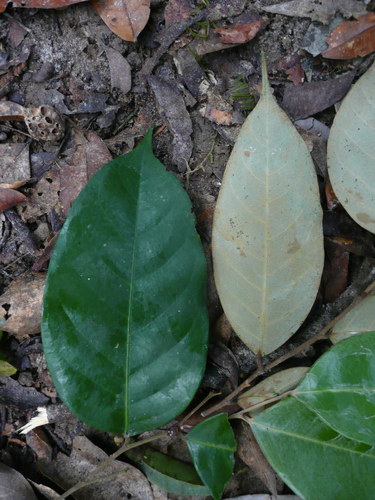
Couepia ulei
Pilg.
Parinari
ChrysobalanaceaeFruit

gbif · cc-by-nc
Field Museum of Natural History - Botany Department
Field Museum of Natural History - Botany Department

gbif · cc-by-nc
Field Museum of Natural History - Botany Department
Field Museum of Natural History - Botany Department
What to Eat
Edible parts: Fruit
The fruit are eaten.
Where to Find It
A tropical plant. It grows on sunny riverbanks. They grow near black water rivers.
Amazon, Brazil*, Colombia, Ecuador, Peru*, South America, Venezuela,
How to Identify
A tree. The flowers are white and have a scent. The fruit are green. They have raised grey spots.
Other Uses
The heartwood is dark reddish brown; the sapwood purplish or pale brown with a greyish cast. The wood is moderately heavy to heavy, dense, hard, and appears to be durable. Resilient and easy to work, it takes a smooth finish with a moderate lustre. The wood is esteemed locally for carpentry. The wood makes a good fuel.
Notes
There are 71 Couepia species. They are all in tropical America.
Names & Synonyms
Supay huayo
References (6)
- Grandtner, M. M. & Chevrette, J., 2013, Dictionary of Trees, Volume 2: South America: Nomenclature, Taxonomy and Ecology. Academic Press p 167
- Kew Plants of the World onLine
- Lamont, S.R., et al, 1999, Species composition, and use of Homegardens among three Amazonian Villages. Economic Botany 53(3) pp 312-326
- Lopez-Diago, D. & Garcia, N., 2021, Wild edible fruits of Colombia. Biota ColomBiana 22 (2) p 35
- Roa, J. A. G. & Boada, D. S. G., 2018, Fundación para el Fortalecimiento de la Fruticultura y Plantas Alimenticias no Convencionales en Colombia.
- Smith, N., et al, 2007, Amazon River Fruits. Flavors for Conservation. Missouri Botanical Gardens Press. p 95