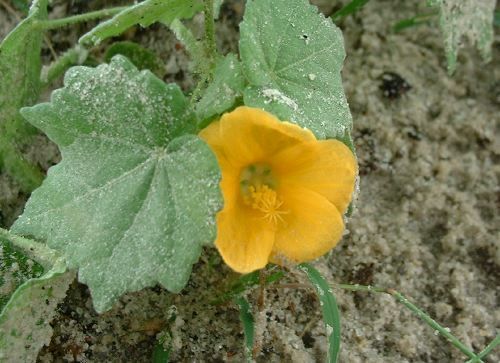
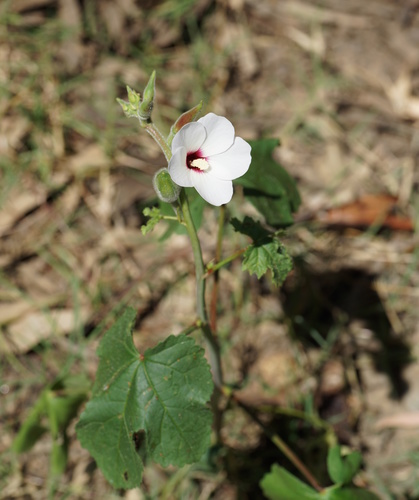
Pentapetes phoenicea
Linn.
Midday flower
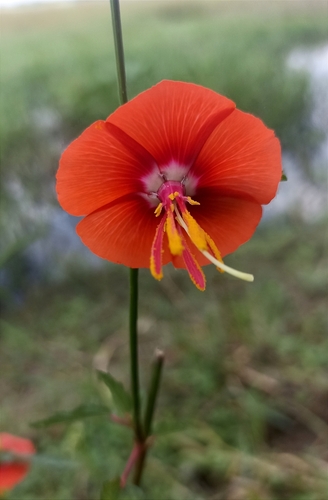
(c) Prosenjit Dawn, some rights reserved (CC BY-NC), uploaded by Prosenjit Dawn

(c) Nadiatalent, some rights reserved (CC BY-SA)

(c) Rushafi, some rights reserved (CC BY-SA)
What to Eat
Edible parts: Leaves - tea
The leaves are used to make herbal tea.
Where to Find It
A tropical plant. It grows in wet places.
Asia, Australia, Cambodia, China, Cuba, Dominican Republic, Fiji, Haiti, India*, Indochina, Indonesia, Laos, Malaysia, Pacific, Philippines, Puerto Rico, SE Asia, Sri Lanka, Thailand, Vietnam, West Indies,
How to Identify
A herb or small shrub. It grows 0.3-1.2 m high. The flowers are 3-4 cm wide. The flower petals are red. The fruit is a 5-valved hairy capsule. The seeds are black with white processes.
Notes
Some authorities put it in the Sterculiaceae and Pentapetaceae. There is only one Pentapetes.
Names & Synonyms
Arkavallabha, Ban-duja, Bandhuli, Bare baha, Bo hoang, Bunga tengah hari, Chettu, Copper cups, Dopahariya, Duporio, Dupahariya, Kat-lata, Kro chieb, Makina, Nguphuong, Paw seng, Scarlet mallow, Scarlet phoenician, Sowbhagya-sundari, Tambdi-dupari, Tambridupari, Tingo
References (8)
- Ambasta, S.P. (Ed.), 2000, The Useful Plants of India. CSIR India. p 439
- Burkill, I.H., 1966, A Dictionary of the Economic Products of the Malay Peninsula. Ministry of Agriculture and Cooperatives, Kuala Lumpur, Malaysia. Vol 2 (I-Z) p 1720
- Crevost & Petelot, 1928, Bull. Econ. Indochine p 161
- Heyne, K., 1927, p 1059
- Plants of Haiti Smithsonian Institute http://botany.si.edu/antilles/West Indies
- Smith, A.C., 1981, Flora Vitiensis Nova, Lawaii, Kuai, Hawaii, Volume 2 p 385
- Sp. pl. 2:698. 1753
- World Checklist of Useful Plant Species 2020. Royal Botanic Gardens, Kew